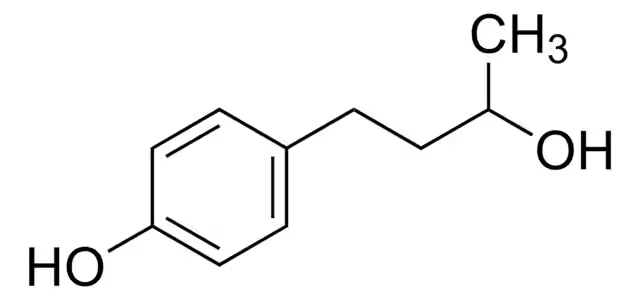
CAS Number501-96-2
Synonyms4-[(3R)-3-Hydroxybutyl]phenol; 4-(3-Hydroxybutyl)phenol; 4-(p-Hydroxyphenyl)-2-butanol; UNII:12QWN45UL0; Rhododendrol; (-)-Rhododendrol
Molecular FormulaC10H14O2
Molecular Weight166.22
Purity≥95 (LC/MS-ELSD)%
Density1.1±0.1 g/cm3
Boiling Point315.4±17.0 °C at 760 mmHg
Appearancesolid
Symbol
Signal WordWarning


Please Login or Create an Account to: See VlP prices and availability
US Stock: ship in 0-1 business day
Global Stock: ship in 5-7 days
| Chemical & Physical Properties | |
|---|---|
| CAS Number | 501-96-2 |
| Catalog No. | 2A-9068848 |
| Chinese Name | 杜鹃醇 |
| Synonyms | 4-[(3R)-3-Hydroxybutyl]phenol; 4-(3-Hydroxybutyl)phenol; 4-(p-Hydroxyphenyl)-2-butanol; UNII:12QWN45UL0; Rhododendrol; (-)-Rhododendrol |
| Molecular Formula | C10H14O2 |
| Molecular Weight | 166.22 |
| Purity | ≥95 (LC/MS-ELSD) |
| Density | 1.1±0.1 g/cm3 |
| Boiling Point | 315.4±17.0 °C at 760 mmHg |
| Appearance | solid |
| Storage Condition | ?20°C |
| Application | Rhododendron can induce leukoderma. Rhododendron induces hydroxyl radical production and melanocyte cytotoxicity by increasing glutathione levels. Rhododendron is a phenolic compound that can be isola |
| PubChem ID | 329824844 |
| MDL Number | MFCD01117650 |
| SMILES | CC(O)CCc1ccc(O)cc1 |
| InChI | 1S/C10H14O2/c1-8(11)2-3-9-4-6-10(12)7-5-9/h4-8,11-12H,2-3H2,1H3 |
| InChI Key | SFUCGABQOMYVJW-UHFFFAOYSA-N |
| NACRES Code | NA.25 |
| UNSPSC | 12352205 |
| Hazard Symbols | transportation |
| MSDS | msds/68848_2_501_96_2.pdf |
| Bioactivity | Rhododendrol can induce leukoderma. Rhododendrol induces generation of hydroxyl radicals and melanocyte cytotoxicity by increasing glutathione levels. Rhododendrol is a phenolic compound that can be isolated from plants such as Acer nikoense and Betula platyphylla[1]. Related Catalog Signaling Pathways >> Others >> Others Research Areas >> Inflammation/Immunology References [1]. Gabe Y, et al. Substantial evidence for the rhododendrol-induced generation of hydroxyl radicals that causes melanocyte cytotoxicity and induces chemical leukoderma. J Dermatol Sci. 2018 Sep;91(3):311-316. Chemical & Physical Properties Density 1.1±0.1 g/cm3 Boiling Point 315.4±17.0 °C at 760 mmHg Molecular Formula C10H14O2 Molecular Weight 166.22 Flash Point 153.4±15.5 °C Exact Mass 166.099380 PSA 40.46000 LogP 1.49 Vapour Pressure 0.0±0.7 mmHg at 25°C Index of Refraction 1.552 InChIKey SFUCGABQOMYVJW-MRVPVSSYSA-N SMILES CC(O)CCc1ccc(O)cc1 Storage condition ?20°C |
| Use of | Rhododendrol can induce leukoderma. Rhododendrol induces generation of hydroxyl radicals and melanocyte cytotoxicity by increasing glutathione levels. Rhododendrol is a phenolic compound that can be isolated from plants such as Acer nikoense and Betula platyphylla[1]. Properties Name 4-[(3R)-3-Hydroxybutyl]phenol Synonym More Synonyms Rhododendrol Biological Activity Description Rhododendrol can induce leukoderma. Rhododendrol induces generation of hydroxyl radicals and melanocyte cytotoxicity by increasing glutathione levels. Rhododendrol is a phenolic compound that can be isolated from plants such as Acer nikoense and Betula platyphylla[1]. Related Catalog Signaling Pathways >> Others >> Others Research Areas >> Inflammation/Immunology References [1]. Gabe Y, et al. Substantial evidence for the rhododendrol-induced generation of hydroxyl radicals that causes melanocyte cytotoxicity and induces chemical leukoderma. J Dermatol Sci. 2018 Sep;91(3):311-316. Chemical & Physical Properties Molecular Formula C10H14O2 Exact Mass 166.099380 PSA 40.46000 Index of Refraction 1.552 InChIKey SFUCGABQOMYVJW-MRVPVSSYSA-N |
| Transport Info | Shipping Name: UN |
| MSDS Transport Info | Module 14. Shipping information 14.1 UN dangerous goods number European Land Transport Dangerous Regulations: -International Maritime Dangerous Regulations: -International Air Transport Dangerous Regulations: - 14.2 United Nations shipping name European Land Transport Dangerous Regulations: Non-dangerous goods IMDG Code: Non-dangerous goods International air transport dangerous goods regulations: non-dangerous goods 14.3 Transport hazard categories European Land Transport Dangerous Regulations: -International Maritime Dangerous Regulations: -International Air Transport Dangerous Regulations: - 14.4 Package group European Land Transport Dangerous Regulations: -International Maritime Dangerous Regulations: -International Air Transport Dangerous Regulations: - 14.5 Environmental hazards European Land Transport Danger Regulations: No International Maritime Danger Regulations International Air Transport Danger Regulations: No Marine pollutants (yes/no): No 14.6 Special reminder to users No data available |
| Related Products in Specialty Chemicals | ||
|---|---|---|
| 2,2-m-pheylene-bis-benzoxazol | 59049-84-2 | 2A-9068827 |
| 3-Epicabraleahydroxylactone | 35833-72-8 | 2A-9068829 |
| 24,25-Dihydroxycycloartan-3-one | 155060-48-3 | 2A-9068832 |
| Tetrahydroamentoflavone | 48236-96-0 | 2A-9068841 |
| 1,4-di(1H-benzo[d]imidazol-2-yl)benzene | 1047-63-8 | 2A-9068844 |
| Canadine | 5096-57-1 | 2A-9068850 |
| Prenylpiperitol | 157659-20-6 | 2A-9068852 |
| Shanzhisidemethylester | 64421-28-9 | 2A-9068853 |
| IsotetrandrineN-2'-oxide | 70191-83-2 | 2A-9068854 |
| 2-nitro-4-bromo-5-fluorobenzoicacid | 1020717-99-0 | 2A-9068855 |
| Browse all Specialty Chemicals products » | ||
Phone:
630-322-8886
630-322-8887
Email:
Office Locations:
Chicago, IL, USA
San Francisco, CA, USA


 EN
EN

 SDS
SDS