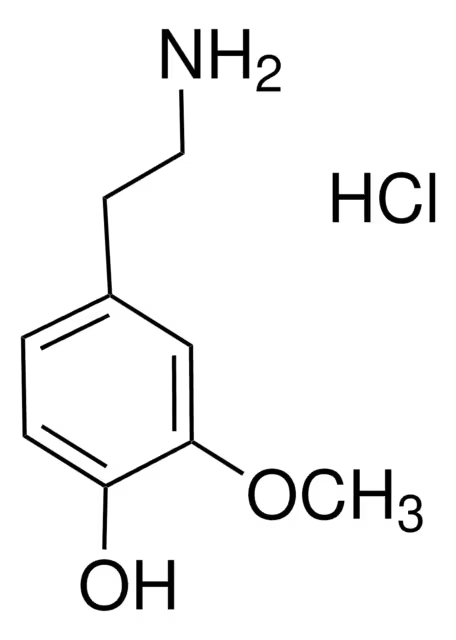
CAS Number1477-68-5
Synonyms3-O-Methyldopamine hydrochloride; Homovanillylamine hydrochloride; 4-(2-Aminoethyl)-2-methoxyphenol hydrochloride; Phenol, 4-(2-aminoethyl)-2-methoxy-, hydrochloride (1:1); 4-(2-aminoethyl)-2-methoxyphenol,hydrochloride; MFCD00012902; EINECS 216-035-1; 4-(2-Aminoethyl)-2-methoxyphenol hydrochloride (1:1); Methoxytyramine; 3-Methoxytyramine hydrochloride
Molecular FormulaCH3OC6H3-4-(OH)CH2CH2NH2·HCl
Molecular Weight203.67
Purity99 (AT)%
Boiling Point306.8ºC at 760 mmHg
Melting Point212-215 °C
Appearancesolid
EINECS216-035-1
Symbol
Signal WordWarning
| Chemical & Physical Properties | |
|---|---|
| CAS Number | 1477-68-5 |
| Catalog No. | 2A-9063291 |
| Chinese Name | 2-甲氧基-4-(2-氨基乙基)苯酚 |
| Synonyms | 3-O-Methyldopamine hydrochloride; Homovanillylamine hydrochloride; 4-(2-Aminoethyl)-2-methoxyphenol hydrochloride; Phenol, 4-(2-aminoethyl)-2-methoxy-, hydrochloride (1:1); 4-(2-aminoethyl)-2-methoxyphenol,hydrochloride; MFCD00012902; EINECS 216-035-1; 4-(2-Aminoethyl)-2-methoxyphenol hydrochloride (1:1); Methoxytyramine; 3-Methoxytyramine hydrochloride |
| Molecular Formula | CH3OC6H3-4-(OH)CH2CH2NH2·HCl |
| Molecular Weight | 203.67 |
| Purity | 99 (AT) |
| Boiling Point | 306.8ºC at 760 mmHg |
| Melting Point | 212-215 °C |
| Appearance | solid |
| Storage Condition | Sealed, store at -20 ºC |
| Application | 3-Methoxytyramine hydrochloride is an inactive metabolite of dopamine that activates trace amine-associated receptor 1 (TAAR1). |
| EINECS | 216-035-1 |
| HTC | 2922509090 |
| PubChem ID | 57652028 |
| MDL Number | MFCD00012902 |
| SMILES | Cl[H].COc1cc(CCN)ccc1O |
| InChI | 1S/C9H13NO2.ClH/c1-12-9-6-7(4-5-10)2-3-8(9)11;/h2-3,6,11H,4-5,10H2,1H3;1H |
| InChI Key | AWRIOTVUTPLWLF-UHFFFAOYSA-N |
| Beilstein/REAXYS | 3631283 |
| NACRES Code | NA.22 |
| UNSPSC | 12352100 |
| Hazard Symbols | transportation |
| MSDS | msds/63291_1_1477_68_5.pdf |
| Bioactivity | 3-Methoxytyramine hydrochloride is an inactive metabolite of dopamine which can activate trace amine associated receptor 1 (TAAR1). Related Catalog Signaling Pathways >> Others >> Others Research Areas >> Neurological Disease Target TAAR1[1] In Vitro The intensity of the fluorescence developed is in a linear relation to the amount of 3-Methoxytyramine hydrochloride presented in the sample up to at least 1 μg. When a high concentration of dopamine is present in the reaction mixture, there is some reduction in the fluorescence derived from 3-Methoxytyramine hydrochloride[1]. In Vivo The extracellular DA metabolite 3-Methoxytyramine hydrochloride (3-MT) induces significant behavioral activation in DDD mice. This activity however, is mostly presented as a set of disorganized abnormal movements that includes tremor, head bobbing, straub tail, grooming and abnormal orofacial movements rather than normal forward activity. No effect is observed when 3-Methoxytyramine hydrochloride is infused at doses below 9 µg, at 9 µg and higher doses 3-Methoxytyramine hydrochloride dose-dependently causes transient behavioral activation with a complex set of behaviors. In particular, transient hyperactivity and stereotypy, sniffing, grooming, rearing and mild abnormal involuntary movements (AIMs) at the level of limbs is observed after infusion of 9 µg of 3-Methoxytyramine hydrochloride. Similar behaviors are also observed after 18 µg of 3-Methoxytyramine hydrochloride with the additional appearance of tremor as well as oral and whole body AIMs[1]. Cell Assay The rats are killed by cervical dislocation and the brains are removed and placed on an ice-cooled glass plate. The corpora striata are dissected out and homogenized immediately or stored at -17°C until analyzed. For the estimation of 3-Methoxytyramine hydrochloride 1 mL of the neutralized perchloric acid solution is placed in a glass test tube. One millilitre of a solution of potassium ferricyanide (20 μg/mL) in concentrated ammonium hydroxide is added. After 2 min 0 to 1 mL of a solution of cysteine (1 mg/mL) is added and mixed. The fluorescence of the resulting solution is measured in a spectrophotofluorometer fitted with an interference filter in the fluorescence light path. A blank determination is made by reversing the order of the addition of the ferricyanide-ammonia solution and the solution of cysteine. Authentic 3-Methoxytyramine hydrochloride is also added to a portion of the neutralized eluate and the fluorescence developed to check for quenching[1]. Animal Admin To assess effects of 3-Methoxytyramine hydrochloride (3-MT) in normal and TAAR1-KO mice, the animals are placed in the locomotor activity chamber and 30 min later various doses of 3-Methoxytyramine hydrochloride are administered i.c.v.. To perform i.c.v. administration in this paradigm, habituated mice are removed from the experimental chamber, briefly restrained, i.c.v. injection cannula is placed into the previously implanted (one week before) guide cannula and infusion of 3-Methoxytyramine hydrochloride or vehicle is performed for 4 minutes when animal is freely moving in a home cage. After infusion, animals are put back into experimental chamber and behavior is monitored for 90 min after administration[1]. References [1]. Sotnikova TD, et al. The dopamine metabolite 3-methoxytyramine is a neuromodulator. PLoS One. 2010 Oct 18;5(10):e13452. [2]. Guldberg HC, et al. Some observations on the estimation of 3-methoxytyramine in brain tissue. Br J Pharmacol. 1971 Aug;42(4):505-11. Chemical & Physical Properties Boiling Point 306.8ºC at 760 mmHg Melting Point 213 - 215ºC Molecular Formula C9H14ClNO2 Molecular Weight 203.666 Flash Point 139.3ºC Exact Mass 203.071304 PSA 55.48000 LogP 2.40430 Vapour Pressure 0.000418mmHg at 25°C InChIKey AWRIOTVUTPLWLF-UHFFFAOYSA-N SMILES COc1cc(CCN)ccc1O.Cl Storage condition -20°C |
| Use of | 3-Methoxytyramine hydrochloride is an inactive metabolite of dopamine which can activate trace amine associated receptor 1 (TAAR1). Properties Articles32 Name 3-O-Methyldopamine hydrochloride Synonym More Synonyms 3-Methoxytyramine hydrochloride Biological Activity Description 3-Methoxytyramine hydrochloride is an inactive metabolite of dopamine which can activate trace amine associated receptor 1 (TAAR1). Related Catalog Signaling Pathways >> Others >> Others Research Areas >> Neurological Disease In Vitro The intensity of the fluorescence developed is in a linear relation to the amount of 3-Methoxytyramine hydrochloride presented in the sample up to at least 1 μg. When a high concentration of dopamine is present in the reaction mixture, there is some reduction in the fluorescence derived from 3-Methoxytyramine hydrochloride[1]. In Vivo The extracellular DA metabolite 3-Methoxytyramine hydrochloride (3-MT) induces significant behavioral activation in DDD mice. This activity however, is mostly presented as a set of disorganized abnormal movements that includes tremor, head bobbing, straub tail, grooming and abnormal orofacial movements rather than normal forward activity. No effect is observed when 3-Methoxytyramine hydrochloride is infused at doses below 9 µg, at 9 µg and higher doses 3-Methoxytyramine hydrochloride dose-dependently causes transient behavioral activation with a complex set of behaviors. In particular, transient hyperactivity and stereotypy, sniffing, grooming, rearing and mild abnormal involuntary movements (AIMs) at the level of limbs is observed after infusion of 9 µg of 3-Methoxytyramine hydrochloride. Similar behaviors are also observed after 18 µg of 3-Methoxytyramine hydrochloride with the additional appearance of tremor as well as oral and whole body AIMs[1]. References [1]. Sotnikova TD, et al. The dopamine metabolite 3-methoxytyramine is a neuromodulator. PLoS One. 2010 Oct 18;5(10):e13452. [2]. Guldberg HC, et al. Some observations on the estimation of 3-methoxytyramine in brain tissue. Br J Pharmacol. 1971 Aug;42(4):505-11. Chemical & Physical Properties Exact Mass 203.071304 PSA 55.48000 LogP 2.40430 InChIKey AWRIOTVUTPLWLF-UHFFFAOYSA-N |
| Tax Rebate | 13.0% |
| Supervision | A. Customs clearance form for inbound goods B. Customs clearance form for outbound goods |
| Inspection | R. Hygiene supervision and inspection of imported food S. Hygiene supervision and inspection of exported food |
| Transport Info | Product name: Purity: 98.0% |
| MSDS Transport Info | Module 14. Shipping information 14.1 UN number European Land Transport Dangerous Regulations: -International Maritime Dangerous Regulations: -International Air Transport Dangerous Regulations: - 14.2 Names specified by the United Nations (UN) European Land Transport Dangerous Regulations: No dangerous goods IMDG Code: No dangerous goods International Air Transport Dangerous Regulations: No dangerous goods 14.3 Transport hazard categories European Land Transport Dangerous Regulations: -International Maritime Dangerous Regulations: -International Air Transport Dangerous Regulations: - 14.4 Package group European Land Transport Dangerous Regulations: -International Maritime Dangerous Regulations: -International Air Transport Dangerous Regulations: - 14.5 Environmental hazards European Land Transport Dangerous Regulations: No International Maritime Transport Dangerous Regulations Maritime Pollutants: No International Air Transport Risk Regulations: No 14.6 Special precautions for users No data available |
| Related Products in Specialty Chemicals | ||
|---|---|---|
| 4-(2-N,N-Dimethylaminoethoxyl)-1-nitrobenzene | 51344-13-9 | 2A-9063286 |
| 4-[2-(Dimethylamino)ethoxy]aniline | 62345-76-0 | 2A-9063287 |
| Methyl 2-(4-methylpiperazin-1-yl)acetate | 5780-70-1 | 2A-9063288 |
| (4-Methyl-piperazin-1-yl)-acetic acid | 54699-92-2 | 2A-9063289 |
| N-Vinylphthalimide | 3485-84-5 | 2A-9063290 |
| 2,3-Dibromo-3-phenylpropanoic acid | 6286-30-2 | 2A-9063292 |
| Butanoic acid, 2,2,3,3-tetramethyl- | 30407-41-1 | 2A-9063294 |
| Benzoic acid, 2-[(1E)-2-carboxyethenyl]- | 18454-53-0 | 2A-9063296 |
| Benzenepropanoic acid, 2-carboxy- | 776-79-4 | 2A-9063297 |
| 4H-1-Benzopyran-4-one, 2-ethyl- | 14736-30-2 | 2A-9063299 |
| Browse all Specialty Chemicals products » | ||
Phone:
630-322-8886
630-322-8887
Email:
Office Locations:
Chicago, IL, USA
San Francisco, CA, USA


 EN
EN


 SDS
SDS