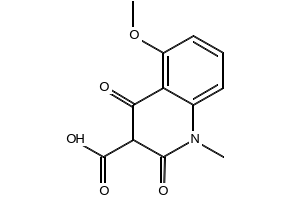
CAS Number1081-71-6
Synonymsvanilpyruvate; 3-Methoxy-4-hydroxyphenylbrenztraubensaeure; 4-Hydroxy-3-methoxyphenylpyruvic acid; 4-Oxy-3-methoxy-phenylbrenztraubensaeure; Hmppa cpd; 4-Hydroxy-3-methoxy-phenylbrenztraubensaeure; Vanilpyruvic acid
Molecular FormulaC10H10O5
Molecular Weight210.18300
Density1.374g/cm3
Boiling Point402ºC at 760mmHg
AppearanceLight yellow-yellow crystal-powder
| Chemical & Physical Properties | |
|---|---|
| CAS Number | 1081-71-6 |
| Catalog No. | 2A-9063236 |
| Chinese Name | 4-羟基-3-甲氧基苯基丙酮酸 |
| Synonyms | vanilpyruvate; 3-Methoxy-4-hydroxyphenylbrenztraubensaeure; 4-Hydroxy-3-methoxyphenylpyruvic acid; 4-Oxy-3-methoxy-phenylbrenztraubensaeure; Hmppa cpd; 4-Hydroxy-3-methoxy-phenylbrenztraubensaeure; Vanilpyruvic acid |
| Molecular Formula | C10H10O5 |
| Molecular Weight | 210.18300 |
| Density | 1.374g/cm3 |
| Boiling Point | 402ºC at 760mmHg |
| Appearance | Light yellow-yellow crystal-powder |
| Storage Condition | room temperature, dry |
| Application | Vanilpyruvic acid is a catecholamine metabolite and a precursor of vanillic acid. |
| HTC | 2918990090 |
| SMILES | COc1cc(CC(=O)C(=O)O)ccc1O |
| InChI | InChI=1S/C10H10O5/c1-15-9-5-6(2-3-7(9)11)4-8(12)10(13)14/h2-3,5,11H,4H2,1H3,(H,13,14) |
| InChI Key | YGQHQTMRZPHIBB-UHFFFAOYSA-N |
| MSDS | msds/63236_1_1081_71_6.pdf |
| Bioactivity | Vanilpyruvic acid is a catecholamine metabolite and precursor to vanillactic acid. Related Catalog Signaling Pathways >> GPCR/G Protein >> Adrenergic Receptor Signaling Pathways >> Membrane Transporter/Ion Channel >> Monoamine Transporter Signaling Pathways >> GPCR/G Protein >> Opioid Receptor Signaling Pathways >> Neuronal Signaling >> Opioid Receptor Research Areas >> Neurological Disease In Vitro The catecholamines, dopamine, norepinephrine, and epinephrine, constitute a class of chemical neurotransmitters and hormones that occupy key positions in the regulation of physiological processes and the development of neurological, psychiatric, endocrine, and cardiovascular diseases[1]. Catecholamines, namely dopamine (3,4-dihydrophenylethylamine), norepinephrine (noradrenaline) and epinephrine (adrenaline), act as neurotransmitters or hormones at central and peripheral levels. In addition to being the most abundant of the monoamine neurotransmitters, dopamine is also found in non-neuronal tissues such as the gastrointestinal tract and the kidney, where it participates in the regulation of sodium balance[2]. References [1]. Eisenhofer G, et al. Catecholamine metabolism: a contemporary view with implications for physiology and medicine. Pharmacol Rev. 2004 Sep;56(3):331-49. [2]. Bicker J, et al. Liquid chromatographic methods for the quantification of catecholamines and their metabolites in several biological samples--a review. Anal Chim Acta. 2013 Mar 20;768:12-34. Chemical & Physical Properties Density 1.374g/cm3 Boiling Point 402ºC at 760mmHg Molecular Formula C10H10O5 Molecular Weight 210.18300 Flash Point 162.1ºC Exact Mass 210.05300 PSA 83.83000 LogP 0.59700 Vapour Pressure 3.49E-07mmHg at 25°C Index of Refraction 1.575 InChIKey YGQHQTMRZPHIBB-UHFFFAOYSA-N SMILES COc1cc(CC(=O)C(=O)O)ccc1O |
| Use of | Vanilpyruvic acid is a catecholamine metabolite and precursor to vanillactic acid. Properties Name 3-(4-hydroxy-3-methoxyphenyl)-2-oxopropanoic acid Synonym More Synonyms Vanilpyruvic acid Biological Activity Description Vanilpyruvic acid is a catecholamine metabolite and precursor to vanillactic acid. Related Catalog Signaling Pathways >> GPCR/G Protein >> Adrenergic Receptor Signaling Pathways >> Membrane Transporter/Ion Channel >> Monoamine Transporter Signaling Pathways >> GPCR/G Protein >> Opioid Receptor Signaling Pathways >> Neuronal Signaling >> Opioid Receptor Research Areas >> Neurological Disease In Vitro The catecholamines, dopamine, norepinephrine, and epinephrine, constitute a class of chemical neurotransmitters and hormones that occupy key positions in the regulation of physiological processes and the development of neurological, psychiatric, endocrine, and cardiovascular diseases[1]. Catecholamines, namely dopamine (3,4-dihydrophenylethylamine), norepinephrine (noradrenaline) and epinephrine (adrenaline), act as neurotransmitters or hormones at central and peripheral levels. In addition to being the most abundant of the monoamine neurotransmitters, dopamine is also found in non-neuronal tissues such as the gastrointestinal tract and the kidney, where it participates in the regulation of sodium balance[2]. References [1]. Eisenhofer G, et al. Catecholamine metabolism: a contemporary view with implications for physiology and medicine. Pharmacol Rev. 2004 Sep;56(3):331-49. [2]. Bicker J, et al. Liquid chromatographic methods for the quantification of catecholamines and their metabolites in several biological samples--a review. Anal Chim Acta. 2013 Mar 20;768:12-34. Chemical & Physical Properties Molecular Formula C10H10O5 Exact Mass 210.05300 PSA 83.83000 LogP 0.59700 Index of Refraction 1.575 InChIKey YGQHQTMRZPHIBB-UHFFFAOYSA-N |
| Tax Rebate | 13.0% |
| Supervision | None. MFN tariff: 6.5%. Ordinary tariff: 30.0% |
| Transport Info | Product name: Purity: 95.0% |
| MSDS Transport Info | Module 14. Shipping information United Nations classification: inconsistent with United Nations classification standards UN number: not specified 4-Hydroxy-3-methoxyphenylpyruvic acid Modification number: 5 |
| Related Products in Specialty Chemicals | ||
|---|---|---|
| Benzenepropanoic acid, 2-methyl-.alpha.-oxo- | 61676-24-2 | 2A-9063228 |
| Benzenepropanoic acid, 4-(dimethylamino)-.alpha.-oxo- | 99855-77-3 | 2A-9063230 |
| Benzenepropanoic acid, 4-bromo-2-fluoro-.alpha.-oxo- | 1153354-80-3 | 2A-9063231 |
| Benzenepropanoic acid, 3,4-dichloro-.alpha.-oxo- | 128437-98-9 | 2A-9063234 |
| Benzenepropanoic acid, 3,4-dihydroxy-.alpha.-oxo- | 4228-66-4 | 2A-9063235 |
| Benzenepropanoic acid, 3-hydroxy-4-methoxy-.alpha.-oxo- | 70028-57-8 | 2A-9063237 |
| Benzenepropanoic acid, 3,4-dimethoxy-.alpha.-oxo- | 2460-33-5 | 2A-9063238 |
| Benzenepropanoic acid, 3,4,5-trimethoxy-.alpha.-oxo- | 61404-52-2 | 2A-9063239 |
| Benzenepropanoic acid, 3,5-dimethoxy-.alpha.-oxo- | 103987-53-7 | 2A-9063240 |
| Benzenepropanoic acid, 2,3,4-trimethoxy-.alpha.-oxo- | 68913-83-7 | 2A-9063241 |
| Browse all Specialty Chemicals products » | ||
Phone:
630-322-8886
630-322-8887
Email:
Office Locations:
Chicago, IL, USA
San Francisco, CA, USA


 EN
EN


 SDS
SDS