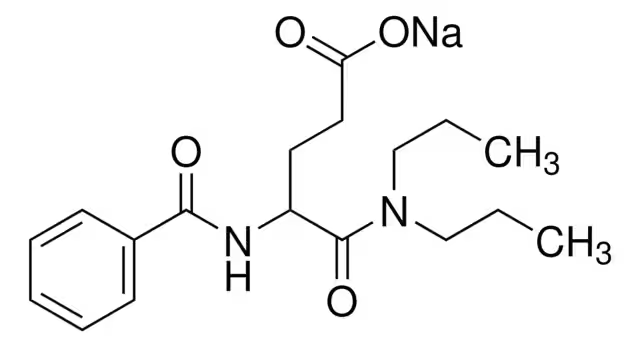
CAS Number99247-33-3
SynonymsN-Benzoyl-N',N'-dipropyl-DL-isoglutamine Sodium-Potassium salt; Glutaramic acid,4-benzamido-N,N-dipropyl-,sodium salt,dl; dl-4-Benzamido-N,N-dipropylglutaramic acid sodium salt; Proglumide sodium salt; Pentanoic acid,4-(Benzoylamino)-5-(dipropylamino)-5-oxo-,monosodium salt,(+-); 4-Benzoylamino-5-dipropylamino-5-oxopentanoic acid Sodium-Potassium salt; Proglumide sodium
Molecular FormulaC18H25N2NaO4
Molecular Weight356.39
Purity98%
Appearancesolid
Symbol
Signal WordWarning
| Chemical & Physical Properties | |
|---|---|
| CAS Number | 99247-33-3 |
| Catalog No. | 2A-9060828 |
| Chinese Name | 丙谷胺 钠盐 |
| Synonyms | N-Benzoyl-N',N'-dipropyl-DL-isoglutamine Sodium-Potassium salt; Glutaramic acid,4-benzamido-N,N-dipropyl-,sodium salt,dl; dl-4-Benzamido-N,N-dipropylglutaramic acid sodium salt; Proglumide sodium salt; Pentanoic acid,4-(Benzoylamino)-5-(dipropylamino)-5-oxo-,monosodium salt,(+-); 4-Benzoylamino-5-dipropylamino-5-oxopentanoic acid Sodium-Potassium salt; Proglumide sodium |
| Molecular Formula | C18H25N2NaO4 |
| Molecular Weight | 356.39 |
| Purity | 98 |
| Appearance | solid |
| Storage Condition | 2-8°C, dry, filled with argon |
| Application | Proglumide sodium is a nonpeptide and orally active cholecystokinin (CCK)-A/B receptor antagonist. Proglumide sodium selectively blocks the effects of CCK in the central nervous system. Proglumide sod |
| HTC | 2924299090 |
| PubChem ID | 24896533 |
| MDL Number | MFCD00069301 |
| SMILES | [Na+].CCCN(CCC)C(=O)C(CCC([O-])=O)NC(=O)c1ccccc1 |
| InChI | 1S/C18H26N2O4.Na/c1-3-12-20(13-4-2)18(24)15(10-11-16(21)22)19-17(23)14-8-6-5-7-9-14;/h5-9,15H,3-4,10-13H2,1-2H3,(H,19,23)(H,21,22);/q;+1/p-1 |
| InChI Key | UFMWGCINVOIJSO-UHFFFAOYSA-M |
| NACRES Code | NA.77 |
| UNSPSC | 12352200 |
| Hazard Symbols | transportation |
| MSDS | msds/60828_1_99247_33_3.pdf |
| Bioactivity | Proglumide sodium is a nonpeptide and orally active cholecystokinin (CCK)-A/B receptors antagonist. Proglumide sodium selective blocks CCK's effects in the central nervous system (CNS). Proglumide sodium has ability to inhibit gastric secretion and to protect the gastroduodenal mucosa. Proglumide sodium also has antiepileptic and antioxidant activities[1][2][3][4][5]. Related Catalog Research Areas >> Cancer Research Areas >> Endocrinology Signaling Pathways >> GPCR/G Protein >> Cholecystokinin Receptor Research Areas >> Neurological Disease Target Cholecystokinin (CCK)-A/B receptors[1][2] In Vitro In an in vitro study, Proglumide at concentrations between 0.3-10 mM inhibits CCK-stimulated amylase release dose-dependently, while Proglumide does not influence the basal amylase release at concentrations between 0-3 mM. Dose-response curves to CCK for amylase release shifted to the right with increase in Proglumide concentration. This inhibition by Proglumide is reversible. In addition, the effect of Proglumide is selective for CCK and its related peptide[2]. The incubation of HT29 cells with Proglumide significantly reduces the [3H]-thymidine incorporation to HT29 cells in a dose-dependent manner, with an IC50 of 6.5 mM. Proglumide reduces in a dose-dependent manner the percentage of necrosis with a parallel increase of apoptosis up to 70%[3]. In Vivo Proglumide (250-750 mg/kg; intraperitoneal injection; adult male Sprague Dawley rats) treatment is significantly effective in ameliorating the seizure activities, cognitive dysfunctions, and cerebral oxidative stress[1]. Animal Model: Adult male Sprague Dawley rats (200-250 g; 2 months old) are induced status epilepticus (SE)[1] Dosage: 250 mg/kg, 500 mg/kg, and 750 mg/kg Administration: Intraperitoneal injection Result: Dose-dependently and significantly increased the latencies to seizure and SE. Significantly and dose-dependently attenuated Li-PC (SE) induced increase in thiobarbituric acid (TBARS) and catalase (CAT), attenuated Li-Pc induced decrease in SOD, and attenuated depletion of GSH and glutathione-S transferase (GST) in the hippocampus and striatum. References [1]. Ahmad M, et al. The effects of quinacrine, proglumide, and pentoxifylline on seizure activity, cognitive deficit, and oxidative stress in rat lithium-pilocarpine model of status epilepticus. Oxid Med Cell Longev. 2014;2014:630509. [2]. Iwamoto Y, et al. In vitro and in vivo effect of proglumide on cholecystokinin-stimulated amylase release in mouse pancreatic acini. Gastroenterol Jpn. 1984 Feb;19(1):53-8. [3]. González-Puga C, et al. Selective CCK-A but not CCK-B receptor antagonists inhibit HT-29 cell proliferation: synergism with pharmacological levels of melatonin. J Pineal Res. 2005 Oct;39(3):243-50. [4]. Bunney BS, et al. Further studies on the specificity of proglumide as a selective cholecystokinin antagonist in the central nervous system. Ann N Y Acad Sci. 1985;448:345-51. [5]. Tariq M, et al. Gastric and duodenal antiulcer and cytoprotective effects of proglumide in rats. J Pharmacol Exp Ther. 1987 May;241(2):602-7. Chemical & Physical Properties Molecular Formula C18H25N2NaO4 Molecular Weight 356.39200 Exact Mass 356.17100 PSA 93.03000 LogP 1.53850 InChIKey UFMWGCINVOIJSO-UHFFFAOYSA-M SMILES CCCN(CCC)C(=O)C(CCC(=O)[O-])NC(=O)c1ccccc1.[Na+] |
| Use of | Proglumide sodium is a nonpeptide and orally active cholecystokinin (CCK)-A/B receptors antagonist. Proglumide sodium selective blocks CCK's effects in the central nervous system (CNS). Proglumide sodium has ability to inhibit gastric secretion and to protect the gastroduodenal mucosa. Proglumide sodium also has antiepileptic and antioxidant activities[1][2][3][4][5]. Properties Name sodium,4-benzamido-5-(dipropylamino)-5-oxopentanoate Synonym More Synonyms Proglumide sodium salt Biological Activity Description Proglumide sodium is a nonpeptide and orally active cholecystokinin (CCK)-A/B receptors antagonist. Proglumide sodium selective blocks CCK's effects in the central nervous system (CNS). Proglumide sodium has ability to inhibit gastric secretion and to protect the gastroduodenal mucosa. Proglumide sodium also has antiepileptic and antioxidant activities[1][2][3][4][5]. Related Catalog Research Areas >> Cancer Research Areas >> Endocrinology Signaling Pathways >> GPCR/G Protein >> Cholecystokinin Receptor Research Areas >> Neurological Disease Cholecystokinin (CCK)-A/B receptors[1][2] References [1]. Ahmad M, et al. The effects of quinacrine, proglumide, and pentoxifylline on seizure activity, cognitive deficit, and oxidative stress in rat lithium-pilocarpine model of status epilepticus. Oxid Med Cell Longev. 2014;2014:630509. [2]. Iwamoto Y, et al. In vitro and in vivo effect of proglumide on cholecystokinin-stimulated amylase release in mouse pancreatic acini. Gastroenterol Jpn. 1984 Feb;19(1):53-8. [4]. Bunney BS, et al. Further studies on the specificity of proglumide as a selective cholecystokinin antagonist in the central nervous system. Ann N Y Acad Sci. 1985;448:345-51. [5]. Tariq M, et al. Gastric and duodenal antiulcer and cytoprotective effects of proglumide in rats. J Pharmacol Exp Ther. 1987 May;241(2):602-7. Chemical & Physical Properties Molecular Formula C18H25N2NaO4 Exact Mass 356.17100 PSA 93.03000 LogP 1.53850 InChIKey UFMWGCINVOIJSO-UHFFFAOYSA-M |
| Tax Rebate | 13.0% |
| Supervision | None. MFN tariff: 6.5%. Ordinary tariff: 30.0% |
| Transport Info | Product name: Purity: 98.0% |
| MSDS Transport Info | Module 14. Shipping information 14.1 UN dangerous goods number European Land Transport Dangerous Regulations: -International Maritime Dangerous Regulations: -International Air Transport Dangerous Regulations: - 14.2 Names specified by the United Nations (UN) European Land Transport Dangerous Regulations: Non-dangerous goods IMDG Code: Non-dangerous goods International air transport dangerous goods regulations: non-dangerous goods 14.3 Transport hazard categories European Land Transport Dangerous Regulations: -International Maritime Dangerous Regulations: -International Air Transport Dangerous Regulations: - 14.4 Package group European Land Transport Dangerous Regulations: -International Maritime Dangerous Regulations: -International Air Transport Dangerous Regulations: - 14.5 Environmental hazards European Land Transport Dangerous Regulations: No International Maritime Transport Dangerous Regulations Maritime Pollutants: No International Air Transport Risk Regulations: No 14.6 Special reminder to users No data available |
| Related Products in Specialty Chemicals | ||
|---|---|---|
| IPCONAZOLE | 125225-28-7 | 2A-9060817 |
| (E)-METOMINOSTROBIN | 133408-50-1 | 2A-9060818 |
| OXAZICLOMEFONE | 153197-14-9 | 2A-9060819 |
| CLOMEPROP | 84496-56-0 | 2A-9060820 |
| METERGOLINE | 17692-51-2 | 2A-9060823 |
| ZIRCONIUM PHOSPHATE | 28132-50-5 | 2A-9060830 |
| Artichoke extract | 2A-152356 | 2A-9060831 |
| B-carotene | 2A-152357 | 2A-9060832 |
| CarbaModithioic acid | 594-07-0 | 2A-9060833 |
| Chromate(3-), bis[4-[4,5-dihydro-4-[(2-hydroxy-5-nitrophenyl)azo]-3-methyl-5-oxo-1H-pyrazol-1-yl]benzenesulfonato(3-)]-, trihydrogen, compds. with N,N'-bis(Ph and tolyl and xylyl)guanidine | 9817-15-8 | 2A-9060834 |
| Browse all Specialty Chemicals products » | ||
Phone:
630-322-8886
630-322-8887
Email:
Office Locations:
Chicago, IL, USA
San Francisco, CA, USA


 EN
EN


 SDS
SDS