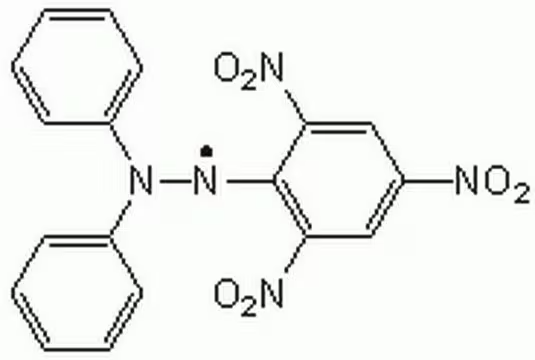
CAS Number1898-66-4
SynonymsDPPH radical; diphenylpicrylhydrazylfreeradical; 2,2-Diphenyl-1-(2,4,6-trinitrophenyl)hydrazyl; DPPH; di(phenyl)-(2,4,6-trinitrophenyl)iminoazanium; 1,1-Diphenyl-2-picrylhydrazyl Free Radical; 2,2-Diphenyl-1-(2,4,6-trinitrophenyl)hydrazino; Diphenylpicrylhydrazyl.; 1,1-Diphenyl-2-picrylhydrazyl radical; 2,2-Diphenylpicrylhydrazyl; 2,2-diphenyl-1-picrylhydrazyl; 1-diphenyl-2-picrylhydrazyl; EINECS 217-591-8; Diphenypicrylhydrazyl; MFCD00007231
Molecular FormulaC18H12N5O6
Molecular Weight394.32
Purity≥90 (elemental analysis)%
Melting Point136-138ºC
Appearancesolid
Symbol
Signal WordWarning


Please Login or Create an Account to: See VlP prices and availability
US Stock: ship in 0-1 business day
Global Stock: ship in 5-7 days
| Chemical & Physical Properties | |
|---|---|
| CAS Number | 1898-66-4 |
| Catalog No. | 2A-9060388 |
| Chinese Name | 2,2-联苯基-1-苦基肼基 |
| Synonyms | DPPH radical; diphenylpicrylhydrazylfreeradical; 2,2-Diphenyl-1-(2,4,6-trinitrophenyl)hydrazyl; DPPH; di(phenyl)-(2,4,6-trinitrophenyl)iminoazanium; 1,1-Diphenyl-2-picrylhydrazyl Free Radical; 2,2-Diphenyl-1-(2,4,6-trinitrophenyl)hydrazino; Diphenylpicrylhydrazyl.; 1,1-Diphenyl-2-picrylhydrazyl radical; 2,2-Diphenylpicrylhydrazyl; 2,2-diphenyl-1-picrylhydrazyl; 1-diphenyl-2-picrylhydrazyl; EINECS 217-591-8; Diphenypicrylhydrazyl; MFCD00007231 |
| Molecular Formula | C18H12N5O6 |
| Molecular Weight | 394.32 |
| Purity | ≥90 (elemental analysis) |
| Melting Point | 136-138ºC |
| Appearance | solid |
| Water Solubility | Soluble in dimethyl formamide, ethanol, chloroform |
| Storage Condition | Sealed, store at 2 ºC -8 ºC |
| Packaging | II |
| Application | DPPH (2,2-Diphenyl-1-picrylhydrazyl) is a stable free radical that can be used to measure the free radical scavenging activity of antioxidants. The odd electrons of the nitrogen atoms in DPPH are redu |
| MDL Number | MFCD00007231 |
| SMILES | [N+](=O)([O-])c1c(c(cc(c1)[N+](=O)[O-])[N+](=O)[O-])NN(c3ccccc3)c2ccccc2 |
| InChI | 1S/C18H13N5O6/c24-21(25)15-11-16(22(26)27)18(17(12-15)23(28)29)19-20(13-7-3-1-4-8-13)14-9-5-2-6-10-14/h1-12,19H |
| InChI Key | WCBPJVKVIMMEQC-UHFFFAOYSA-N |
| NACRES Code | NA.51 |
| UNSPSC | 12352200 |
| Hazard Symbols | 6.1 |
| MSDS | msds/60388_1_1898_66_4.pdf |
| Bioactivity | DPPH (2,2-Diphenyl-1-picrylhydrazyl) is a stable free radical that can be used to measure the radical scavenging activity of antioxidants. The odd electron of nitrogen atom in DPPH is reduced by receiving a hydrogen atom from antioxidants to the corresponding hydrazine. DPPH method may be utilized in aqueous and nonpolar organic solvents and can be used to examine both hydrophilic and lipophilic antioxidants[1]. Related Catalog Research Areas >> Others Signaling Pathways >> Others >> Others In Vitro DPPH shows a strong absorption band at 517 nm due to its odd electron and solution appears a deep violet colour, the absorption vanishes as the electron pairs off. The resulting decolorization is stoichiometric with respect to the number of electrons taken up. The alcoholic solutions of 0.5 mM are densely colored and at this concentration, the Lambert-Beer law is obeyed over the useful range of absorption[1]. DPPH assay is a rapid, simple, inexpensive and widely used method to measure the ability of compounds to act as free radical scavengers or hydrogen donors, and to evaluate antioxidant activity of foods. It can also be used to quantify antioxidants in complex biological systems, for solid or liquid samples. This method is easy and applies to measure the overall antioxidant capacity and the free radical scavenging activity of fruit and vegetable juice. This assay has been successfully utilized for investigating antioxidant properties of wheat grain and bran, vegetables, conjugated linoleic acids, herbs, edible seed oils, and flours in several different solvent systems including ethanol, aqueous acetone, methanol, aqueous alcohol and benzene. It is a convenient method for the antioxidant assay of cysteine, glutathione, ascorbic acid, tocopherol and polyhydroxy aromatic compounds, for olive oil, fruits, juices and wines[1]. References [1]. Kedare SB, et al. Genesis and development of DPPH method of antioxidant assay. J Food Sci Technol. 2011 Aug;48(4):412-22. Chemical & Physical Properties Melting Point 136-138ºC Molecular Formula C18H12N5O6 Molecular Weight 394.318 Exact Mass 394.078766 PSA 140.70000 LogP 5.97000 Appearance of Characters green Storage condition 2-8°C Water Solubility Soluble in dimethyl formamide, ethanol, chloroform, ether, carbon disulfinde, acetone, oils, carbon tetrachloride, glacial acetic acid and toluene. Insoluble in water. |
| Use of | DPPH (2,2-Diphenyl-1-picrylhydrazyl) is a stable free radical that can be used to measure the radical scavenging activity of antioxidants. The odd electron of nitrogen atom in DPPH is reduced by receiving a hydrogen atom from antioxidants to the corresponding hydrazine. DPPH method may be utilized in aqueous and nonpolar organic solvents and can be used to examine both hydrophilic and lipophilic antioxidants[1]. Properties Articles439 Name 1,1-diphenyl-2-picrylhydrazyl Synonym More Synonyms DPPH Biological Activity Description DPPH (2,2-Diphenyl-1-picrylhydrazyl) is a stable free radical that can be used to measure the radical scavenging activity of antioxidants. The odd electron of nitrogen atom in DPPH is reduced by receiving a hydrogen atom from antioxidants to the corresponding hydrazine. DPPH method may be utilized in aqueous and nonpolar organic solvents and can be used to examine both hydrophilic and lipophilic antioxidants[1]. Related Catalog Research Areas >> Others Signaling Pathways >> Others >> Others References [1]. Kedare SB, et al. Genesis and development of DPPH method of antioxidant assay. J Food Sci Technol. 2011 Aug;48(4):412-22. Chemical & Physical Properties Molecular Formula C18H12N5O6 Exact Mass 394.078766 PSA 140.70000 LogP 5.97000 Appearance of Characters green Water Solubility Soluble in dimethyl formamide, ethanol, chloroform, ether, carbon disulfinde, acetone, oils, carbon tetrachloride, glacial acetic acid and toluene. Insoluble in water. |
| Transport Info | Product name: 2,2-biphenyl-1-picrylhydrazyl (containing 10-20% benzene) |
| Related Products in Specialty Chemicals | ||
|---|---|---|
| SPARSOMYCIN | 1404-64-4 | 2A-9060377 |
| D-Aspartic Acid Calcium Chelate | 2A-351913 | 2A-9060379 |
| N-2+ Media Supplement (100X) | SB-CC-0002 | 2A-9060383 |
| B-27+ Media Supplement (50X) | SB-CC-0003 | 2A-9060384 |
| N-1+ Media Supplement (100X) | SB-CC-0004 | 2A-9060385 |
| Dehydroabietic acid | 1740-19-8 | 2A-0201397 |
| FENUGREEK | 84625-40-1 | 2A-9060398 |
| 6-benzylsulfanyl-9-propyl-purin-2-amine | 92-55-6 | 2A-9060399 |
| Methyl2-Amino-4-Iodobenzoate | 144550-76-5 | 2A-9060400 |
| 5-Phenyl-2-morpholinone | 134872-85-8 | 2A-9060401 |
| Browse all Specialty Chemicals products » | ||
Phone:
630-322-8886
630-322-8887
Email:
Office Locations:
Chicago, IL, USA
San Francisco, CA, USA


 EN
EN

 SDS
SDS