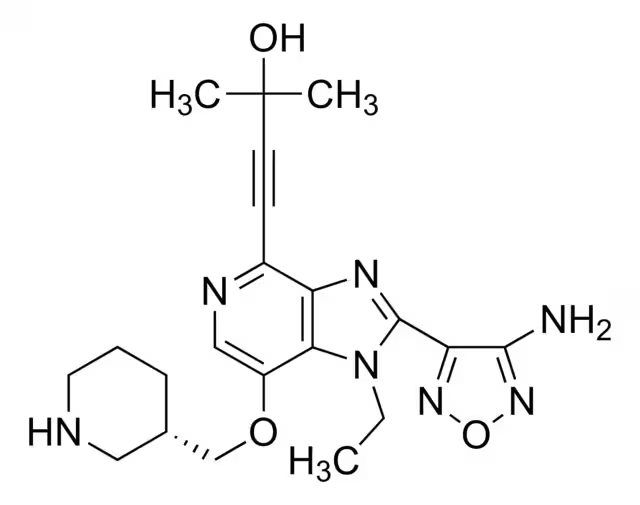
| Chemical & Physical Properties | |
|---|---|
| CAS Number | 937174-76-0 |
| Catalog No. | 2A-9059258 |
| Chinese Name | 土大黄甙 |
| Synonyms | GSK690693; cc-44; GSK-690693 |
| Molecular Formula | C21H27N7O3 |
| Molecular Weight | 425.48 |
| Purity | ≥98 (HPLC) |
| Density | 1.4±0.1 g/cm3 |
| Boiling Point | 683.8±65.0 °C at 760 mmHg |
| Appearance | powder |
| Water Solubility | DMSO: soluble5mg/mL (clear solution) |
| Storage Condition | 2-8°C |
| Application | GSK-690693 is a broad-spectrum Akt inhibitor that acts on Akt1/2/3 with IC50 values of 2/13/9 nM respectively; PKA, PrkX and PKC are also sensitive to it. |
| HTC | 2934999090 |
| PubChem ID | 329825423 |
| MDL Number | MFCD14105605 |
| SMILES | CCn1c(nc2c(ncc(OC[C@H]3CCCNC3)c12)C#CC(C)(C)O)-c4nonc4N |
| InChI | 1S/C21H27N7O3/c1-4-28-18-15(30-12-13-6-5-9-23-10-13)11-24-14(7-8-21(2,3)29)16(18)25-20(28)17-19(22)27-31-26-17/h11,13,23,29H,4-6,9-10,12H2,1-3H3,(H2,22,27)/t13-/m0/s1 |
| InChI Key | KGPGFQWBCSZGEL-ZDUSSCGKSA-N |
| NACRES Code | NA.77 |
| UNSPSC | 12352200 |
| Hazard Symbols | transportation |
| MSDS | msds/59258_1_937174_76_0.pdf |
| Bioactivity | GSK-690693 is a pan-Akt inhibitor targeting Akt1/2/3 with IC50 of 2/13/9 nM in cell-free assays, also sensitive to the AGC kinase family: PKA, PrkX and PKC isozymes. Related Catalog Signaling Pathways >> PI3K/Akt/mTOR >> Akt Signaling Pathways >> Autophagy >> Autophagy Research Areas >> Cancer Target Akt1:2 nM (IC50) Akt3:9 nM (IC50) Akt2:13 nM (IC50) PKCη:2 nM (IC50) PKCθ:2 nM (IC50) PrkX:5 nM (IC50) PAK6:6 nM (IC50) PAK4:10 nM (IC50) PKCδ:14 nM (IC50) PKCβ1:19 nM (IC50) PKCε:21 nM (IC50) PKA:24 nM (IC50) PKG1β:33 nM (IC50) AMPK:50 nM (IC50) PAK5:52 nM (IC50) DAPK3:81 nM (IC50) Autophagy In Vitro GSK690693 is very selective for the Akt isoforms versus the majority of kinases in other families. However, GSK690693 is less selective for members of the AGC kinase family including PKA, PrkX, and PKC isozymes with IC50 of 24 nM, 5 nM, and 2-21 nM, respectively. GSK690693 also potently inhibits AMPK and DAPK3 from the CAMK family with IC50 of 50 nM and 81 nM, respectively, and PAK4, 5, and 6 from the STE family with IC50 of 10 nM, 52 nM, and 6 nM, respectively. GSK690693 inhibits the phosphorylation of GSK3β in tumor cells with IC50 ranging from 43 nM to 150 nM. GSK690693 treatment leads to a dose-dependent increase in the nuclear accumulation of the transcription factor FOXO3A. GSK690693 potently inhibits the proliferation of T47D, ZR-75-1, BT474, HCC1954, MDA-MB-453, and LNCaP cells with IC50 of 72 nM, 79 nM, 86 nM, 119 nM, 975 nM, and 147 nM, respectively. GSK690693 treatment induces apoptosis at concentrations > 100 nM in both LNCaP and BT474 cells[1]. Consistent with the role of AKT in cell survival, GSK690693 induces apoptosis in sensitive ALL cell lines[2]. In Vivo A single administration of GSK690693 inhibits GSK3β phosphorylation in human breast carcinoma (BT474) xenografts in a dose- and time-dependent manner. Similarly, GSK690693 induces a reduction in phosphorylation of the Akt substrates, PRAS40, and FKHR/FKHRL1. GSK690693 also results in an acute increase in blood glucose, returning to baseline 8 to 10 hours after drug administration. Administration of GSK690693 induces reductions in phosphorylated Akt substrates in vivo, and potently inhibits the growth of human SKOV-3 ovarian, LNCaP prostate, and BT474 and HCC-1954 breast carcinoma xenografts, with maximal inhibition of 58% to 75% at the dose of 30 mg/kg/day[1]. GSK690693 exhibits efficacy irrespective of the mechanism of Akt activation involved. GSK690693 is most effective in delaying tumor progression in Lck-MyrAkt2 mice expressing a membrane-bound, constitutively active form of Akt[3]. Kinase Assay His-tagged full-length Akt1, 2, or 3 are expressed and purified from baculovirus. Activation is carried out with purified PDK1 to phosphorylate Thr308 and purified MK2 to phosphorylate Ser473. To more accurately measure time-dependent inhibition of Akt, activated Akt enzymes are incubated with GSK690693 at various concentrations at room temperature for 30 minutes before the reaction is initiated with the addition of substrate. Final reaction contains 5 nM to 15 nM Akt1, 2, and 3 enzymes; 2 μM ATP; 0.15 μCi/μL[γ-33P]ATP; 1 μM Peptide (Biotin-aminohexanoicacid-ARKR-ERAYSFGHHA-amide); 10 mM MgCl2; 25 mM MOPS (pH 7.5); 1 mM DTT; 1 mM CHAPS; and 50 mM KCl. The reactions are incubated at room temperature for 45 minutes, followed by termination with Leadseeker beads in PBS containing EDTA (final concentration, 2 mg/mL beads and 75 mM EDTA). The plates are then sealed, the beads are allowed to settle for at least 5 hours, and product formation is quantitated using a Viewlux Imager. Cell Assay Cells are plated at densities that allow untreated cells to grow logarithmically during the course of a 3-day assay. Briefly, cells are plated in 96- or 384-well plates and incubated overnight. Cells are then treated with GSK690693 (ranging from 30 μM-1.5 nM) and incubated for 72 hours. Cell proliferation is measured using the CellTiter Glo reagent. Data are analyzed using the XLFit curve-fitting tool for Microsoft Excel. IC50 values are obtained by fitting data to Eq, 2. Animal Admin Tumors are initiated by injection of tumor cell suspension (HCC1954, MDA-MB-453, and LNCaP) or tumor fragments (BT474, SKOV-3, and PANC1) s.c. in 8- to 12-wk-old CD1 Swiss Nude mice (LNCaP, SKOV-3, and PANC1) or SCID mice (HCC1954, MDA-MB-453, and BT474). When tumors reach a volume of 100 to 200 mm3, mice are randomized and divided into groups of 8 to 12 mice per group. GSK690693 is administered once daily at 10, 20, and 30 mg/kg by i.p. administration. Animals are euthanized by inhalation of CO2 at the completion of the study. Tumor volume is measured twice weekly by calipers, using the equation: tumor volume (mm3)=(length × width2)/2. Results are reported as % inhibition on day 21 of treatment=100× [1-(average growth of the drug-treated population/average growth of vehicle-treated control population)]. Statistical analysis is done using two-tailed t test. References [1]. Rhodes N, et al. Characterization of an Akt kinase inhibitor with potent pharmacodynamic and antitumor activity. Cancer Res, 2008, 68(7), 2366-2374. [2]. Levy DS, et al. AKT inhibitor, GSK690693, induces growth inhibition and apoptosis in acute lymphoblastic leukemia cell lines. Blood, 2009, 113(8), 1723-1729. [3]. Altomare DA, et al. GSK690693 delays tumor onset and progression in genetically defined mouse models expressing activated Akt. Clin Cancer Res, 2010, 16(2), 486-496. Chemical & Physical Properties Density 1.4±0.1 g/cm3 Boiling Point 683.8±65.0 °C at 760 mmHg Molecular Formula C21H27N7O3 Molecular Weight 425.484 Flash Point 367.3±34.3 °C Exact Mass 425.217529 PSA 137.14000 LogP 4.34 Appearance of Characters white to beige Vapour Pressure 0.0±2.2 mmHg at 25°C Index of Refraction 1.683 InChIKey KGPGFQWBCSZGEL-ZDUSSCGKSA-N SMILES CCn1c(-c2nonc2N)nc2c(C#CC(C)(C)O)ncc(OCC3CCCNC3)c21 Storage condition 2-8°C Water Solubility DMSO: soluble5mg/mL (clear solution) |
| Use of | Properties Articles14 Name 4-[2-(4-amino-1,2,5-oxadiazol-3-yl)-1-ethyl-7-[[(3S)-piperidin-3-yl]methoxy]imidazo[4,5-c]pyridin-4-yl]-2-methylbut-3-yn-2-ol Synonym More Synonyms GSK690693 Biological Activity Related Catalog Signaling Pathways >> PI3K/Akt/mTOR >> Akt Signaling Pathways >> Autophagy >> Autophagy Research Areas >> Cancer Akt1:2 nM (IC50) Akt3:9 nM (IC50) Akt2:13 nM (IC50) PKCη:2 nM (IC50) PKCθ:2 nM (IC50) PrkX:5 nM (IC50) PAK6:6 nM (IC50) PAK4:10 nM (IC50) PKCδ:14 nM (IC50) PKCβ1:19 nM (IC50) PKCε:21 nM (IC50) PKA:24 nM (IC50) PKG1β:33 nM (IC50) AMPK:50 nM (IC50) PAK5:52 nM (IC50) DAPK3:81 nM (IC50) Cell Assay Cells are plated at densities that allow untreated cells to grow logarithmically during the course of a 3-day assay. Briefly, cells are plated in 96- or 384-well plates and incubated overnight. Cells are then treated with GSK690693 (ranging from 30 μM-1.5 nM) and incubated for 72 hours. Cell proliferation is measured using the CellTiter Glo reagent. Data are analyzed using the XLFit curve-fitting tool for Microsoft Excel. IC50 values are obtained by fitting data to Eq, 2. References [1]. Rhodes N, et al. Characterization of an Akt kinase inhibitor with potent pharmacodynamic and antitumor activity. Cancer Res, 2008, 68(7), 2366-2374. [2]. Levy DS, et al. AKT inhibitor, GSK690693, induces growth inhibition and apoptosis in acute lymphoblastic leukemia cell lines. Blood, 2009, 113(8), 1723-1729. [3]. Altomare DA, et al. GSK690693 delays tumor onset and progression in genetically defined mouse models expressing activated Akt. Clin Cancer Res, 2010, 16(2), 486-496. Chemical & Physical Properties Molecular Formula C21H27N7O3 Exact Mass 425.217529 PSA 137.14000 Appearance of Characters white to beige Index of Refraction 1.683 InChIKey KGPGFQWBCSZGEL-ZDUSSCGKSA-N |
| Tax Rebate | 13.0% |
| Supervision | None. MFN tariff: 6.5%. Ordinary tariff: 20.0% |
| Transport Info | Product name: Purity: 98.0% |
| MSDS Transport Info | Module 14. Shipping information 14.1 UN dangerous goods number European Dangerous Regulations for land transport: 2811 International Dangerous Regulations for sea transport: 2811 International Dangerous Regulations for air transport: 2811 14.2 Names specified by the United Nations (UN) European Land Transport Dangerous Regulations: TOXIC SOLID, ORGANIC, N.O.S. (4-(2-(4-Amino-1,2,5-oxadiazol-3-yl)-1-ethyl-7-{[(3S)-3- piperidinylmethyl]oxy}-1H-imidazo[4,5-c]pyridin-4-yl)-2-methyl-3-butyn-2-ol) IMDG: TOXIC SOLID, ORGANIC, N.O.S. (4-(2-(4-Amino-1,2,5-oxadiazol-3-yl)-1-ethyl-7-{[(3S)-3- piperidinylmethyl]oxy}-1H-imidazo[4,5-c]pyridin-4-yl)-2-methyl-3-butyn-2-ol) International air transport hazard regulations: Toxic solid, organic, n.o.s. (4-(2-(4-Amino-1,2,5-oxadiazol-3-yl)-1-ethyl-7-{[(3S)-3- piperidinylmethyl]oxy}-1H-imidazo[4,5-c]pyridin-4-yl)-2-methyl-3-butyn-2-ol) 14.3 Transport hazard categories European Land Transport Danger Regulations: 6.1 International Maritime Transport Danger Regulations: 6.1 International Air Transport Danger Regulations: 6.1 14.4 Package group European Land Transport Danger Regulations: III International Maritime Transport Danger Regulations: III International Air Transport Danger Regulations: III 14.5 Environmental hazards European Land Transport Dangerous Regulations: No International Maritime Transport Dangerous Regulations Maritime Pollutants: No International Air Transport Risk Regulations: No 14.6 Special reminder to users No data available |
| Related Products in Specialty Chemicals | ||
|---|---|---|
| 2,3-Dihydro-1-oxoasenapine | 934996-79-9 | 2A-9059228 |
| 5-(1H-Imidazol-1-yl)-2-pyridinamine | 935547-73-2 | 2A-9059230 |
| 3-[(2-Chloro-5-methyl-4-pyrimidinyl)amino]-N-(tert-butyl)benzenesulfonamide | 936092-53-4 | 2A-9059235 |
| Methyl 4-(4-piperidyl)benzoate hydrochloride | 936130-82-4 | 2A-9059236 |
| 1-Aminoindan sulfate | 936474-09-8 | 2A-9059244 |
| 3-Methylpicolinamide | 937648-82-3 | 2A-9059261 |
| N-Methyl-1-(1-morpholin-4-ylcyclohexyl)methanamine | 938458-83-4 | 2A-9059268 |
| Allyl 2-O-acetyl-3-O-benzyl-alpha-L-rhamnopyranoside | 940274-20-4 | 2A-9059275 |
| Allyl 2-O-benzoyl-3-O-benzyl-alpha-L-rhamnopyranoside | 940274-21-5 | 2A-9059276 |
| tert-Butyl 6-bromonicotinate | 941294-58-2 | 2A-9059283 |
| Browse all Specialty Chemicals products » | ||
Phone:
630-322-8886
630-322-8887
Email:
Office Locations:
Chicago, IL, USA
San Francisco, CA, USA


 EN
EN


 SDS
SDS