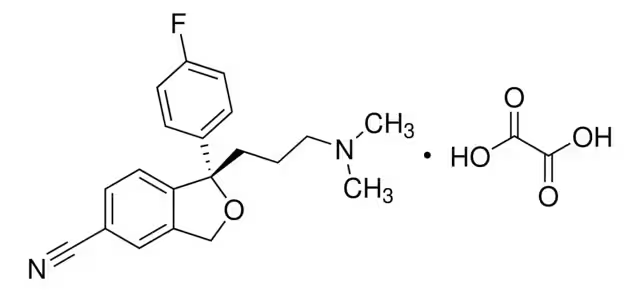
CAS Number219861-08-2
SynonymsLexapro (TN); MFCD06407826; Lu-26-054-0; (1S)-1-[3-(diméthylamino)propyl]-1-(4-fluorophényl)-1,3-dihydro-2-benzofurane-5-carbonitrile oxalate; ESCIFALOPRAMOXALATE; (S)-Citalopram Oxalate; Escitalopram oxalate (USAN); Lexapro; escitalopram oxalic acid; Escitalopram Oxalate; Cipralex; (1S)-1-[3-(Dimethylamino)propyl]-1-(4-fluorophenyl)-1,3-dihydro-2-benzofuran-5-carbonitrile oxalate; (S)-Escitalopram Oxalate; Escitalopram (oxalate)
Molecular FormulaC22H23FN2O5
Molecular Weight414.43
Purity98.00%
Boiling Point428.3ºC at 760 mmHg
Melting Point152-153ºC
Appearancewhite solid
| Chemical & Physical Properties | |
|---|---|
| CAS Number | 219861-08-2 |
| Catalog No. | 2A-9055705 |
| Chinese Name | 草酸右旋西酞普兰 |
| Synonyms | Lexapro (TN); MFCD06407826; Lu-26-054-0; (1S)-1-[3-(diméthylamino)propyl]-1-(4-fluorophényl)-1,3-dihydro-2-benzofurane-5-carbonitrile oxalate; ESCIFALOPRAMOXALATE; (S)-Citalopram Oxalate; Escitalopram oxalate (USAN); Lexapro; escitalopram oxalic acid; Escitalopram Oxalate; Cipralex; (1S)-1-[3-(Dimethylamino)propyl]-1-(4-fluorophenyl)-1,3-dihydro-2-benzofuran-5-carbonitrile oxalate; (S)-Escitalopram Oxalate; Escitalopram (oxalate) |
| Molecular Formula | C22H23FN2O5 |
| Molecular Weight | 414.43 |
| Purity | 98.00 |
| Boiling Point | 428.3ºC at 760 mmHg |
| Melting Point | 152-153ºC |
| Appearance | white solid |
| Storage Condition | -20°C Freezer, Under Inert Atmosphere |
| Application | Escitalopram is a selective serotonin reuptake inhibitor (SSRI) with a Ki of 0.89 nM. |
| MDL Number | MFCD06407826 |
| SMILES | Fc1ccc(cc1)[C@@]2(OCc3c2ccc(c3)C#N)CCCN(C)C.OC(=O)C(=O)O |
| InChI | 1S/C20H21FN2O.C2H2O4/c1-23(2)11-3-10-20(17-5-7-18(21)8-6-17)19-9-4-15(13-22)12-16(19)14-24-20;3-1(4)2(5)6/h4-9,12H,3,10-11,14H2,1-2H3;(H,3,4)(H,5,6)/t20-;/m0./s1 |
| InChI Key | KTGRHKOEFSJQNS-BDQAORGHSA-N |
| NACRES Code | NA.24 |
| UNSPSC | 41116107 |
| MSDS | msds/55705_1_219861_08_2.pdf |
| Bioactivity | Escitalopram is a selective serotonin reuptake inhibitor (SSRI) with Ki of 0.89 nM.Target: SSRIsEscitalopram, the S-enantiomer of citalopram, belongs to a class of antidepressant agents known as selective serotonin-reuptake inhibitors (SSRIs). Escitalopram may be used to treat major depressive disorder (MDD) and generalized anxiety disorder (GAD). Escitalopram has no significant affinity for adrenergic (alpha1, alpha2, beta), cholinergic, GABA, dopaminergic, histaminergic, serotonergic (5HT1A, 5HT1B, 5HT2), or benzodiazepine receptors; antagonism of such receptors has been hypothesized to be associated with various anticholinergic, sedative, and cardiovascular effects for other psychotropic drugs. The chronic administration of escitalopram is found to downregulate brain norepinephrine receptors, as has been observed with other drugs effective in the treatment of major depressive disorder. Escitalopram does not inhibit monoamine oxidase. Related Catalog Signaling Pathways >> Neuronal Signaling >> Serotonin Transporter Research Areas >> Neurological Disease References [1]. Zhang, P., et al., Structure-activity relationships for a novel series of citalopram (1-(3-(dimethylamino)propyl)-1-(4-fluorophenyl)-1,3-dihydroisobenzofuran-5-carbon itrile) analogues at monoamine transporters. J Med Chem, 2010. 53(16): p. 6112-21. [2]. Pastoor, D. and J. Gobburu, Clinical pharmacology review of escitalopram for the treatment of depression. Expert Opin Drug Metab Toxicol, 2014. 10(1): p. 121-8. Chemical & Physical Properties Boiling Point 428.3ºC at 760 mmHg Melting Point 152-153ºC Molecular Formula C22H23FN2O5 Molecular Weight 414.427 Flash Point 212.8ºC Exact Mass 414.159088 PSA 110.86000 LogP 2.96858 InChIKey KTGRHKOEFSJQNS-BDQAORGHSA-N SMILES CN(C)CCCC1(c2ccc(F)cc2)OCc2cc(C#N)ccc21.O=C(O)C(=O)O Storage condition -20°C Freezer, Under Inert Atmosphere |
| Use of | Escitalopram is a selective serotonin reuptake inhibitor (SSRI) with Ki of 0.89 nM.Target: SSRIsEscitalopram, the S-enantiomer of citalopram, belongs to a class of antidepressant agents known as selective serotonin-reuptake inhibitors (SSRIs). Escitalopram may be used to treat major depressive disorder (MDD) and generalized anxiety disorder (GAD). Escitalopram has no significant affinity for adrenergic (alpha1, alpha2, beta), cholinergic, GABA, dopaminergic, histaminergic, serotonergic (5HT1A, 5HT1B, 5HT2), or benzodiazepine receptors; antagonism of such receptors has been hypothesized to be associated with various anticholinergic, sedative, and cardiovascular effects for other psychotropic drugs. The chronic administration of escitalopram is found to downregulate brain norepinephrine receptors, as has been observed with other drugs effective in the treatment of major depressive disorder. Escitalopram does not inhibit monoamine oxidase. Properties Name Escitalopram oxalate Synonym More Synonyms Escitalopram oxalate Biological Activity Description Escitalopram is a selective serotonin reuptake inhibitor (SSRI) with Ki of 0.89 nM.Target: SSRIsEscitalopram, the S-enantiomer of citalopram, belongs to a class of antidepressant agents known as selective serotonin-reuptake inhibitors (SSRIs). Escitalopram may be used to treat major depressive disorder (MDD) and generalized anxiety disorder (GAD). Escitalopram has no significant affinity for adrenergic (alpha1, alpha2, beta), cholinergic, GABA, dopaminergic, histaminergic, serotonergic (5HT1A, 5HT1B, 5HT2), or benzodiazepine receptors; antagonism of such receptors has been hypothesized to be associated with various anticholinergic, sedative, and cardiovascular effects for other psychotropic drugs. The chronic administration of escitalopram is found to downregulate brain norepinephrine receptors, as has been observed with other drugs effective in the treatment of major depressive disorder. Escitalopram does not inhibit monoamine oxidase. Related Catalog Signaling Pathways >> Neuronal Signaling >> Serotonin Transporter Research Areas >> Neurological Disease References [1]. Zhang, P., et al., Structure-activity relationships for a novel series of citalopram (1-(3-(dimethylamino)propyl)-1-(4-fluorophenyl)-1,3-dihydroisobenzofuran-5-carbon itrile) analogues at monoamine transporters. J Med Chem, 2010. 53(16): p. 6112-21. [2]. Pastoor, D. and J. Gobburu, Clinical pharmacology review of escitalopram for the treatment of depression. Expert Opin Drug Metab Toxicol, 2014. 10(1): p. 121-8. Chemical & Physical Properties Molecular Formula C22H23FN2O5 Exact Mass 414.159088 PSA 110.86000 LogP 2.96858 InChIKey KTGRHKOEFSJQNS-BDQAORGHSA-N |
| Transport Info | Product name: Purity: 98.0% |
| MSDS Transport Info | Module 14. Shipping information United Nations classification: inconsistent with United Nations classification standards UN number: not specified |
| Related Products in API & Advanced Intermediates | ||
|---|---|---|
| 9,11b-Epoxidetriamcinolone | 215095-77-5 | 2A-9055603 |
| Benazepril hydrochloride | 215447-89-5 | 2A-9055610 |
| Benazepril hydrochloride | 215447-90-8 | 2A-9055611 |
| Peginterferon alfa-2b | 215647-85-1 | 2A-9055622 |
| Esomeprazole magnesium trihydrate | 217087-09-7 | 2A-9055655 |
| (R)-Citalopram oxalate | 219861-53-7 | 2A-9055706 |
| Tigecycline | 220620-09-7 | 2A-9055748 |
| 17beta-Estradiol-2,4,16,16,17-D5 | 221093-45-4 | 2A-9055760 |
| Vardenafil hydrochloride | 224785-91-5 | 2A-9055817 |
| Atazanavir sulfate | 229975-97-7 | 2A-9055855 |
| Browse all API & Advanced Intermediates products » | ||
Phone:
630-322-8886
630-322-8887
Email:
Office Locations:
Chicago, IL, USA
San Francisco, CA, USA


 EN
EN


 SDS
SDS