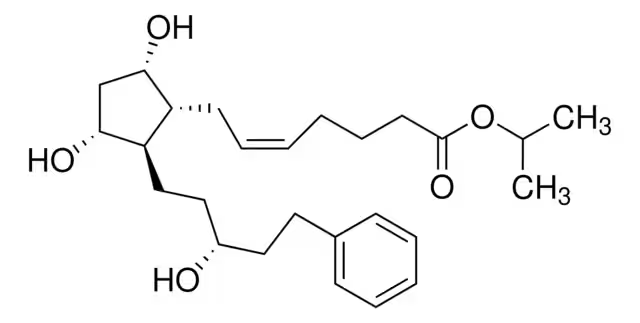
CAS Number130209-82-4
Synonyms13,14-Dihydro-17-phenyl-18,19,20-trinor-PGF2a-isopropyl Ester; Lata prostaglandin; Xalatan; phxa41; Latanoprost; MFCD00216074; xa41; LATANAPROST; Xalata
Molecular FormulaC26H40O5
Molecular Weight432.59
Purity99.00%
Density1.1±0.1 g/cm3
Boiling Point583.8±50.0 °C at 760 mmHg
Appearanceliquid
Symbol
Signal WordWarning
| Chemical & Physical Properties | |
|---|---|
| CAS Number | 130209-82-4 |
| Catalog No. | 2A-9052027 |
| Chinese Name | 拉坦前列素 |
| Synonyms | 13,14-Dihydro-17-phenyl-18,19,20-trinor-PGF2a-isopropyl Ester; Lata prostaglandin; Xalatan; phxa41; Latanoprost; MFCD00216074; xa41; LATANAPROST; Xalata |
| Molecular Formula | C26H40O5 |
| Molecular Weight | 432.59 |
| Purity | 99.00 |
| Density | 1.1±0.1 g/cm3 |
| Boiling Point | 583.8±50.0 °C at 760 mmHg |
| Appearance | liquid |
| Water Solubility | DMSO: freely soluble |
| Storage Condition | −20°C |
| Application | Latanoprost is a prostaglandin receptor (FP prostanoid receptor) agonist that can reduce intraocular pressure. |
| HTC | 2937500000 |
| MDL Number | MFCD00216074 |
| SMILES | CC(C)OC(=O)CCC\C=C/C[C@H]1[C@@H](O)C[C@@H](O)[C@@H]1CC[C@@H](O)CCc2ccccc2 |
| InChI | 1S/C26H40O5/c1-19(2)31-26(30)13-9-4-3-8-12-22-23(25(29)18-24(22)28)17-16-21(27)15-14-20-10-6-5-7-11-20/h3,5-8,10-11,19,21-25,27-29H,4,9,12-18H2,1-2H3/b8-3-/t21-,22+,23+,24-,25+/m0/s1 |
| InChI Key | GGXICVAJURFBLW-CEYXHVGTSA-N |
| NACRES Code | NA.24 |
| UNSPSC | 41116107 |
| Hazard Symbols | transportation |
| MSDS | msds/52027_1_130209_82_4.pdf |
| Bioactivity | Latanoprost is an agonist for the FP prostanoid receptor, and lowers intraocular-pressure (IOP). Related Catalog Signaling Pathways >> GPCR/G Protein >> Prostaglandin Receptor Research Areas >> Others Target FP Receptor In Vitro Benzalkonium chloride latanoprost (BAK-latanoprost) and 0.02% BAK induce significant apoptosis in the apical layers that correlated with the significant decrease of cell viability. Preservative-free latanoprost (PF-latanoprost) slightly decreases cell viability and few apoptotic cells are found in the superficial layers, without reaching statistical significance compared with PBS[1]. Latanoprost (0.1 μM) significantly increases cell viability as compared with control. Meanwhile, 0.1 μM latanoprost results in the obvious promotion of neurite outgrowth similar to ciliary neurotrophic factor (CNTF) and simultaneously increases the levels of p-Akt and p-mTOR expression. Latanoprost can promote neurite outgrowth through an FP receptor-mediated modulation of the PI3K-Akt-mTOR signaling pathway[3]. Latanoprost (0.03 or 0.3 μg/mL) and bimatoprost increase MMP-9 activity by 75% ± 27% and 75% ± 24%, respectively, in human CBSM cells[4]. In Vivo A single drop of latanoprost results in marked miosis, anterior bowing of the peripheral iris, narrowing of the iridocorneal angle, and shallowing of the anterior chamber of the beagle dog. Following latanoprost, the pupil diameter, ACA, and AOD (means) decreases 84%, 14%, and 16%, respectively[2]. Cell Assay Cellular viability is evaluated in duplicate at 24 hours with the MTT assay. The 3D-HCEs are transferred to 24-well plates containing 300 μL of MTT solution diluted at 0.5 mg/mL in the culture medium, and 300 μL of the same MTT solution is applied on the apical surface of the 3D-HCEs. Reconstituted tissues are incubated for 3 hours at 37°C. Then they are transferred to 24-well plates containing 750-μL isopropanol, and 750-μL isopropanol is added to the apical surface of the 3D-HCEs. The plates are agitated for 2 hours at room temperature before reading the optical density (OD) at 570 nm versus OD 690 nm. The results are expressed as percentages of cell viability (mean ± SD) compared with the negative control (PBS). References [1]. Pauly A, et al. In vitro and in vivo comparative toxicological study of a new preservative-free latanoprost formulation. Invest Ophthalmol Vis Sci. 2012 Dec 13;53(13):8172-80. [2]. Tsai S, et al. The effect of topical latanoprost on anterior segment anatomic relationships in normal dogs. Vet Ophthalmol. 2013 Sep;16(5):370-6. [3]. Zheng J, et al. Latanoprost promotes neurite outgrowth in differentiated RGC-5 cells via the PI3K-Akt-mTOR signaling pathway. Cell Mol Neurobiol. 2011 May;31(4):597-604. [4]. Ooi YH, et al. Effect of bimatoprost, latanoprost, and unoprostone on matrix metalloproteinases and their inhibitors in human ciliary body smooth muscle cells. Invest Ophthalmol Vis Sci. 2009 Nov;50(11):5259-65. [5]. B'Ann True Gabelt, et al. Prostaglandin Subtype-Selective and Non-Selective IOP-Lowering Comparison in Monkeys. Chemical & Physical Properties Density 1.1±0.1 g/cm3 Boiling Point 583.8±50.0 °C at 760 mmHg Molecular Formula C26H40O5 Molecular Weight 432.593 Flash Point 188.3±23.6 °C Exact Mass 432.287567 PSA 86.99000 LogP 3.65 Vapour Pressure 0.0±1.7 mmHg at 25°C Index of Refraction 1.538 InChIKey GGXICVAJURFBLW-CEYXHVGTSA-N SMILES CC(C)OC(=O)CCCC=CCC1C(O)CC(O)C1CCC(O)CCc1ccccc1 Storage condition −20°C Water Solubility DMSO: freely soluble |
| Use of | Latanoprost is an agonist for the FP prostanoid receptor, and lowers intraocular-pressure (IOP). Properties Articles79 Name latanoprost Synonym More Synonyms Latanoprost Biological Activity Description Latanoprost is an agonist for the FP prostanoid receptor, and lowers intraocular-pressure (IOP). Related Catalog Signaling Pathways >> GPCR/G Protein >> Prostaglandin Receptor Research Areas >> Others FP Receptor In Vitro Benzalkonium chloride latanoprost (BAK-latanoprost) and 0.02% BAK induce significant apoptosis in the apical layers that correlated with the significant decrease of cell viability. Preservative-free latanoprost (PF-latanoprost) slightly decreases cell viability and few apoptotic cells are found in the superficial layers, without reaching statistical significance compared with PBS[1]. Latanoprost (0.1 μM) significantly increases cell viability as compared with control. Meanwhile, 0.1 μM latanoprost results in the obvious promotion of neurite outgrowth similar to ciliary neurotrophic factor (CNTF) and simultaneously increases the levels of p-Akt and p-mTOR expression. Latanoprost can promote neurite outgrowth through an FP receptor-mediated modulation of the PI3K-Akt-mTOR signaling pathway[3]. Latanoprost (0.03 or 0.3 μg/mL) and bimatoprost increase MMP-9 activity by 75% ± 27% and 75% ± 24%, respectively, in human CBSM cells[4]. In Vivo A single drop of latanoprost results in marked miosis, anterior bowing of the peripheral iris, narrowing of the iridocorneal angle, and shallowing of the anterior chamber of the beagle dog. Following latanoprost, the pupil diameter, ACA, and AOD (means) decreases 84%, 14%, and 16%, respectively[2]. References [1]. Pauly A, et al. In vitro and in vivo comparative toxicological study of a new preservative-free latanoprost formulation. Invest Ophthalmol Vis Sci. 2012 Dec 13;53(13):8172-80. [2]. Tsai S, et al. The effect of topical latanoprost on anterior segment anatomic relationships in normal dogs. Vet Ophthalmol. 2013 Sep;16(5):370-6. [4]. Ooi YH, et al. Effect of bimatoprost, latanoprost, and unoprostone on matrix metalloproteinases and their inhibitors in human ciliary body smooth muscle cells. Invest Ophthalmol Vis Sci. 2009 Nov;50(11):5259-65. [5]. B'Ann True Gabelt, et al. Prostaglandin Subtype-Selective and Non-Selective IOP-Lowering Comparison in Monkeys. Chemical & Physical Properties Molecular Formula C26H40O5 Exact Mass 432.287567 PSA 86.99000 Index of Refraction 1.538 InChIKey GGXICVAJURFBLW-CEYXHVGTSA-N Water Solubility DMSO: freely soluble |
| Transport Info | Product name: Purity: 99.0% |
| MSDS Transport Info | Module 14. Shipping information 14.1 UN dangerous goods number European Land Transport Dangerous Regulations: -International Maritime Dangerous Regulations: -International Air Transport Dangerous Regulations: - 14.2 Names specified by the United Nations (UN) European Land Transport Dangerous Regulations: Non-dangerous goods IMDG Code: Non-dangerous goods International air transport dangerous goods regulations: non-dangerous goods 14.3 Transport hazard categories European Land Transport Dangerous Regulations: -International Maritime Dangerous Regulations: -International Air Transport Dangerous Regulations: - 14.4 Package group European Land Transport Dangerous Regulations: -International Maritime Dangerous Regulations: -International Air Transport Dangerous Regulations: - 14.5 Environmental hazards European Land Transport Dangerous Regulations: No International Maritime Transport Dangerous Regulations Maritime Pollutants: No International Air Transport Risk Regulations: No 14.6 Special reminder to users No data available |
| Related Products in Specialty Chemicals | ||
|---|---|---|
| 4,5-Difluoro-2-iodobenzoic acid | 130137-05-2 | 2A-9052019 |
| Cetrorelix acetate | 130143-01-0 | 2A-9052020 |
| 7-Ethyl-10-hydroxycamptothecin | 130144-34-2 | 2A-9052021 |
| 4-Bromo-3,5-difluorophenol | 130191-91-2 | 2A-9052024 |
| 1-[2-Amino-1-(4-methoxyphenyl)-ethyl]-cyclohexanol hydrochloride | 130198-05-9 | 2A-9052025 |
| 2-(Hydroxyimino)-3-oxo-olean-12-en-28-oic acid | 130216-67-0 | 2A-9052028 |
| Olean-12-eno[2,3-c][1,2,5]oxadiazol-28-oic acid | 130216-69-2 | 2A-9052029 |
| Cetrorelix trifluoroacetate | 130289-71-3 | 2A-9052034 |
| Batimastat | 130370-60-4 | 2A-9052042 |
| Bis(4,7-dimethylindenyl)zirconium dichloride | 130408-22-9 | 2A-9052045 |
| Browse all Specialty Chemicals products » | ||
Phone:
630-322-8886
630-322-8887
Email:
Office Locations:
Chicago, IL, USA
San Francisco, CA, USA


 EN
EN


 SDS
SDS