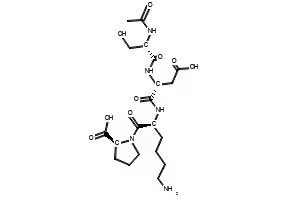
CAS Number127103-11-1
Synonymsgoralatide; Acetyl-Ser-Asp-Lys-Pro; NAcSerDAspLysPro; N-Acetyl-L-seryl-L-α-aspartyl-L-lysyl-L-proline; MFCD00133611; 1-(N2-(N-(N-Acetyl-L-seryl)-L-a-aspartyl)-L-lysyl)-L-proline; Ac-Ser-Asp-Lys-Pro-OH; Thymosin β4 (1-4); N-Acetyl-Ser-Asp-Lys-Pro
Molecular FormulaC20H33N5O9
Molecular Weight487.51
Purity98.00%
Density1.4±0.1 g/cm3
Boiling Point992.0±65.0 °C at 760 mmHg
AppearanceSolid | White to off-white
Symbol
Signal WordWarning
| Chemical & Physical Properties | |
|---|---|
| CAS Number | 127103-11-1 |
| Catalog No. | 2A-9051790 |
| Chinese Name | 戈雷拉肽 |
| Synonyms | goralatide; Acetyl-Ser-Asp-Lys-Pro; NAcSerDAspLysPro; N-Acetyl-L-seryl-L-α-aspartyl-L-lysyl-L-proline; MFCD00133611; 1-(N2-(N-(N-Acetyl-L-seryl)-L-a-aspartyl)-L-lysyl)-L-proline; Ac-Ser-Asp-Lys-Pro-OH; Thymosin β4 (1-4); N-Acetyl-Ser-Asp-Lys-Pro |
| Molecular Formula | C20H33N5O9 |
| Molecular Weight | 487.51 |
| Purity | 98.00 |
| Density | 1.4±0.1 g/cm3 |
| Boiling Point | 992.0±65.0 °C at 760 mmHg |
| Appearance | Solid | White to off-white |
| Water Solubility | Soluble in water at 2mg/ml |
| Storage Condition | Seal and store at -20ºC |
| Application | N-Acetyl-Ser-Asp-Lys-Pro is a natural and specific substrate of the N-terminal site of ACE. |
| MDL Number | C20H33N5O9 |
| SMILES | CC(=O)NC(CO)C(=O)NC(CC(=O)O)C(=O)NC(CCCCN)C(=O)N1CCCC1C(=O)O |
| InChI Key | HJDRXEQUFWLOGJ-UHFFFAOYSA-N |
| Hazard Symbols | transportation |
| MSDS | msds/51790_1_127103_11_1.pdf |
| Bioactivity | N-Acetyl-Ser-Asp-Lys-Pro is a natural and specific substrate for the N-terminal site of ACE. Related Catalog Signaling Pathways >> Metabolic Enzyme/Protease >> Angiotensin-converting Enzyme (ACE) Research Areas >> Cardiovascular Disease Research Areas >> Inflammation/Immunology Peptides In Vitro N-Acetyl-Ser-Asp-Lys-Pro is an endogenous tetrapeptide secreted by bone marrow and is ubiquitously found in plasma and various tissues. N-Acetyl-Ser-Asp-Lys-Pro is degraded specifically by ACE, and its plasma level rises substantially during ACE inhibitor therapy. N-Acetyl-Ser-Asp-Lys-Pro inhibits the proliferation of isolated cardiac fibroblasts but significantly stimulates the proliferation of vascular smooth muscle cells. Flow cytometry of rat cardiac fibroblasts treated with N-Acetyl-Ser-Asp-Lys-Pro shows significant inhibition of the progression of cells from G0/G1 phase to S phase of the cell cycle. In cardiac fibroblasts transfected with a Smad-sensitive luciferase reporter construct, N-Acetyl-Ser-Asp-Lys-Pro decreases luciferase activity by 55%. Moreover, phosphorylation and nuclear translocation of Smad2 is decreased in cardiac fibroblasts treated with N-Acetyl-Ser-Asp-Lys-Pro[1]. N-acetyl-seryl-aspartyl-lysyl-proline is a negative regulator of hematopoietic stem cell proliferation. N-acetyl-seryl-aspartyl-lysyl-proline is involved in the control of hematopoietic stem cell proliferation by preventing their recruitment into S-phase. N-acetyl-seryl-aspartyl-lysyl-proline appears to exert this function by blocking the action of a stem cell-specific proliferation stimulator and acts selectively on quiescent progenitors[2]. N-Acetyl-Ser-Asp-Lys-Pro inhibits collagenase expression and activation is associated with increased expression of TIMP-1 and TIMP-2. N-Acetyl-Ser-Asp-Lys-Pro does not alter collagenase or gelatinase activity in cardiac fibroblasts under basal conditions, but blunts the IL-1β-induced increase in total collagenase activity. Similarly, N-Acetyl-Ser-Asp-Lys-Pro normalizes the IL-1β-mediated increase in MMP-2 and MMP-9 activities and MMP-13 expression[3]. In Vivo N-Acetyl-Ser-Asp-Lys-Pro prevents hypertension-induced inflammatory cell infiltration, collagen deposition, nephrin downregulation and albuminuria, which could lead to renoprotection in hypertensive mice[4]. Kinase Assay The kinetics of N-Acetyl-Ser-Asp-Lys-Pro hydrolysis are determined by incubating enzymes (0.4 nM wild-type ACE, 0.3 nM ACE K959 963, and 9 nM ACE K361 365) with N-Acetyl-Ser-Asp-Lys-Pro over a concentration range of 0.35-40 μM, added to [3H]N-Acetyl-Ser-Asp-Lys-Pro (5 μCi). The reaction is stopped by freezing on dry ice, and samples are then analyzed[2]. Animal Admin Mice: 16-week-old C57BL/6J mice are treated with either placebo, DCOA (10 mg/10 g body weight subcutaneous) and 1% sodium chloride with 0.2% potassium chloride in drinking water (DOCA-salt) or DOCA-salt with Ac-SDKP (800 μg/kg per day) for 12 weeks. Bloof pressure, urine albumin, glomerular matrix, renal collagen content, monocyte/macrophage infiltration and glomerular nephrin expression are measured[4]. References [1]. Rousseau A, et al. The hemoregulatory peptide N-acetyl-Ser-Asp-Lys-Pro is a natural and specificsubstrate of the N-terminal active site of human angiotensin-converting enzyme. J Biol Chem. 1995 Feb 24;270(8):3656-61. [2]. Pokharel S, et al. N-acetyl-Ser-Asp-Lys-Pro inhibits phosphorylation of Smad2 in cardiac fibroblasts. Hypertension. 2002 Aug;40(2):155-61. [3]. Rhaleb NE, et al. N-acetyl-Ser-Asp-Lys-Pro inhibits interleukin-1β-mediated matrix metalloproteinase activation in cardiac fibroblasts. Pflugers Arch. 2013 Oct;465(10):1487-95. [4]. Rhaleb NE, et al. Renal protective effects of N-acetyl-Ser-Asp-Lys-Pro in deoxycorticosterone acetate-salt hypertensive mice. J Hypertens. 2011 Feb;29(2):330-8. Chemical & Physical Properties Density 1.4±0.1 g/cm3 Boiling Point 992.0±65.0 °C at 760 mmHg Molecular Formula C20H33N5O9 Molecular Weight 487.504 Flash Point 553.7±34.3 °C Exact Mass 487.227814 PSA 238.93000 LogP -1.91 Appearance of Characters Solid | White to off-white Vapour Pressure 0.0±0.6 mmHg at 25°C Index of Refraction 1.565 InChIKey HJDRXEQUFWLOGJ-UHFFFAOYSA-N SMILES CC(=O)NC(CO)C(=O)NC(CC(=O)O)C(=O)NC(CCCCN)C(=O)N1CCCC1C(=O)O Storage condition −20°C Water Solubility Soluble in water at 2mg/ml |
| Use of | N-Acetyl-Ser-Asp-Lys-Pro is a natural and specific substrate for the N-terminal site of ACE. Properties Name 1-[2-[[2-[(2-acetamido-3-hydroxypropanoyl)amino]-3-carboxypropanoyl]amino]-6-aminohexanoyl]pyrrolidine-2-carboxylic acid Synonym More Synonyms goralatide Biological Activity Description N-Acetyl-Ser-Asp-Lys-Pro is a natural and specific substrate for the N-terminal site of ACE. Related Catalog Signaling Pathways >> Metabolic Enzyme/Protease >> Angiotensin-converting Enzyme (ACE) Research Areas >> Cardiovascular Disease Research Areas >> Inflammation/Immunology In Vivo N-Acetyl-Ser-Asp-Lys-Pro prevents hypertension-induced inflammatory cell infiltration, collagen deposition, nephrin downregulation and albuminuria, which could lead to renoprotection in hypertensive mice[4]. Kinase Assay The kinetics of N-Acetyl-Ser-Asp-Lys-Pro hydrolysis are determined by incubating enzymes (0.4 nM wild-type ACE, 0.3 nM ACE K959 963, and 9 nM ACE K361 365) with N-Acetyl-Ser-Asp-Lys-Pro over a concentration range of 0.35-40 μM, added to [3H]N-Acetyl-Ser-Asp-Lys-Pro (5 μCi). The reaction is stopped by freezing on dry ice, and samples are then analyzed[2]. References [1]. Rousseau A, et al. The hemoregulatory peptide N-acetyl-Ser-Asp-Lys-Pro is a natural and specificsubstrate of the N-terminal active site of human angiotensin-converting enzyme. J Biol Chem. 1995 Feb 24;270(8):3656-61. [2]. Pokharel S, et al. N-acetyl-Ser-Asp-Lys-Pro inhibits phosphorylation of Smad2 in cardiac fibroblasts. Hypertension. 2002 Aug;40(2):155-61. [3]. Rhaleb NE, et al. N-acetyl-Ser-Asp-Lys-Pro inhibits interleukin-1β-mediated matrix metalloproteinase activation in cardiac fibroblasts. Pflugers Arch. 2013 Oct;465(10):1487-95. [4]. Rhaleb NE, et al. Renal protective effects of N-acetyl-Ser-Asp-Lys-Pro in deoxycorticosterone acetate-salt hypertensive mice. J Hypertens. 2011 Feb;29(2):330-8. Chemical & Physical Properties Molecular Formula C20H33N5O9 Exact Mass 487.227814 PSA 238.93000 LogP -1.91 Appearance of Characters Solid | White to off-white Index of Refraction 1.565 InChIKey HJDRXEQUFWLOGJ-UHFFFAOYSA-N |
| Transport Info | Product name: Purity: 98.0% |
| MSDS Transport Info | Module 14. Shipping information 14.1 UN number European Land Transport Dangerous Regulations: -International Maritime Dangerous Regulations: -International Air Transport Dangerous Regulations: - 14.2 Names specified by the United Nations (UN) European Land Transport Dangerous Regulations: No dangerous goods IMDG Code: No dangerous goods International Air Transport Dangerous Regulations: No dangerous goods 14.3 Transport hazard categories European Land Transport Dangerous Regulations: -International Maritime Dangerous Regulations: -International Air Transport Dangerous Regulations: - 14.4 Package group European Land Transport Dangerous Regulations: -International Maritime Dangerous Regulations: -International Air Transport Dangerous Regulations: - 14.5 Environmental hazards European Land Transport Dangerous Regulations: No International Maritime Transport Dangerous Regulations Maritime Pollutants: No International Air Transport Risk Regulations: No 14.6 Special precautions for users No data available |
| Related Products in Specialty Chemicals | ||
|---|---|---|
| Lutetium(III) trifluoromethanesulfonate | 126857-69-0 | 2A-9051780 |
| Diethylisopropylsilyl trifluoromethanesulfonate | 126889-55-2 | 2A-9051781 |
| 1-Bromo-4-dodecylbenzene | 126930-72-1 | 2A-9051782 |
| Dicyclopentyldimethoxysilane | 126990-35-0 | 2A-9051785 |
| Pazufloxacin hydrochloride | 127046-45-1 | 2A-9051787 |
| 1-Methyl-1H-pyrazol-4-ylamine | 127107-23-7 | 2A-9051792 |
| 2,6-Diamino-4-(4-nitrophenyl)-4H-thiopyran-3,5-dicarbonitrile | 127118-57-4 | 2A-9051793 |
| 4-Chlorobenzyl pinacolone | 127141-86-0 | 2A-9051794 |
| (2-Benzylisoindolin-4-yl)methanamine | 127169-00-0 | 2A-9051798 |
| 8-Fluoro-3,4-dihydro-2(1H)-naphthalenone | 127169-82-8 | 2A-9051800 |
| Browse all Specialty Chemicals products » | ||
Phone:
630-322-8886
630-322-8887
Email:
Office Locations:
Chicago, IL, USA
San Francisco, CA, USA


 EN
EN


 SDS
SDS