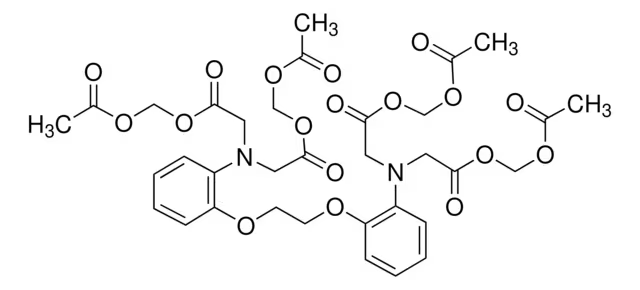
CAS Number126150-97-8
Synonymstetraacetoxymethyl ester; Tetrakis(acetoxymethyl) 1,2-Bis(2-aminophenoxy)ethane-N,N,N',N'-tetraacetate; 1,2-Bis(2-aminophenoxy)ethane-N,N,N',N'-tetraacetic Acid Tetrakis(acetoxymethyl) Ester; MFCD00036696; Tetrakis(acetoxymethyl) 2,2',2'',2'''-[1,2-ethanediylbis(oxy-2,1-phenylenenitrilo)]tetraacetate; Tetrakis(acetoxymethyl) 2,2',2'',2'''-[ethane-1,2-diylbis(oxy-2,1-phenylenenitrilo)]tetraacetate; BAPTA-acetoxymethylester; BAPTA-AM
Molecular FormulaC34H40N2O18
Molecular Weight764.68
Purity≥95 (HPLC)%
Density1.4±0.1 g/cm3
Boiling Point796.1±60.0 °C at 760 mmHg
Melting Point86-90°C
Appearancepowder
Symbol
Signal WordWarning
| Chemical & Physical Properties | |
|---|---|
| CAS Number | 126150-97-8 |
| Catalog No. | 2A-9051723 |
| Chinese Name | BAPTA-AM |
| Synonyms | tetraacetoxymethyl ester; Tetrakis(acetoxymethyl) 1,2-Bis(2-aminophenoxy)ethane-N,N,N',N'-tetraacetate; 1,2-Bis(2-aminophenoxy)ethane-N,N,N',N'-tetraacetic Acid Tetrakis(acetoxymethyl) Ester; MFCD00036696; Tetrakis(acetoxymethyl) 2,2',2'',2'''-[1,2-ethanediylbis(oxy-2,1-phenylenenitrilo)]tetraacetate; Tetrakis(acetoxymethyl) 2,2',2'',2'''-[ethane-1,2-diylbis(oxy-2,1-phenylenenitrilo)]tetraacetate; BAPTA-acetoxymethylester; BAPTA-AM |
| Molecular Formula | C34H40N2O18 |
| Molecular Weight | 764.68 |
| Purity | ≥95 (HPLC) |
| Density | 1.4±0.1 g/cm3 |
| Boiling Point | 796.1±60.0 °C at 760 mmHg |
| Melting Point | 86-90°C |
| Appearance | powder |
| Storage Condition | Seal and store at -20ºC |
| Application | BAPTA-AM is an intracellular calcium chelator. |
| PubChem ID | 24890502 |
| MDL Number | MFCD00036696 |
| SMILES | CC(=O)OCOC(=O)CN(CC(=O)OCOC(C)=O)c1ccccc1OCCOc2ccccc2N(CC(=O)OCOC(C)=O)CC(=O)OCOC(C)=O |
| InChI | 1S/C34H40N2O18/c1-23(37)47-19-51-31(41)15-35(16-32(42)52-20-48-24(2)38)27-9-5-7-11-29(27)45-13-14-46-30-12-8-6-10-28(30)36(17-33(43)53-21-49-25(3)39)18-34(44)54-22-50-26(4)40/h5-12H,13-22H2,1-4H3 |
| InChI Key | YJIYWYAMZFVECX-UHFFFAOYSA-N |
| Beilstein/REAXYS | 7458534 |
| NACRES Code | NA.77 |
| UNSPSC | 12352200 |
| Hazard Symbols | transportation |
| MSDS | msds/51723_1_126150_97_8.pdf |
| Bioactivity | BAPTA-AM is an intracellular calcium chelator. Related Catalog Signaling Pathways >> Others >> Others Research Areas >> Others Biochemical Assay Reagents Target calcium chelator[1] In Vitro The permeable calcium chelator BAPTA/AM is known to prevent free radical-mediated toxicity promote apoptosis in non-neuronal cells and produce a beneficial effect in neuronal cells by protecting neurons from ischemic damage. In addition, it has been suggested that BAPTA/AM induces a late, but not early, increase of intracellular calcium in I-IL-60 neoplastic cells. Mixed cortical cell cultures (DIV 13-16) exposed to 10μM BAPTA/AM for 24- or 48-hr show moderate (45-70%) neuronal injury as evaluated by increased LDH release into the bathing medium after 24-48-hr. Exposure of cortical cultures to 3-10 μM BAPTA/AM for 48-hr evoke dose-dependent neuronal damage[1]. Cell Assay Neuronal injury is quantitatively estimated by measuring lactate dehydrogenase (LDH) released from damaged cells into the bathing medium 24- or 48-hr after the 10 μM BAPTA/AM treatment. The morphological findings are confirmed by staining with neuron-specific enolase (NSE) antibody and tryphan blue[1]. References [1]. Wie MB, et al. BAPTA/AM, an intracellular calcium chelator, induces delayed necrosis by lipoxygenase-mediated free radicals in mouse cortical cultures. Prog Neuropsychopharmacol Biol Psychiatry. 2001 Nov;25(8):1641-59. Chemical & Physical Properties Density 1.4±0.1 g/cm3 Boiling Point 796.1±60.0 °C at 760 mmHg Melting Point 86-90°C Molecular Formula C34H40N2O18 Molecular Weight 764.684 Flash Point 435.3±32.9 °C Exact Mass 764.227600 PSA 235.34000 LogP 2.28 Vapour Pressure 0.0±2.8 mmHg at 25°C Index of Refraction 1.551 InChIKey YJIYWYAMZFVECX-UHFFFAOYSA-N SMILES CC(=O)OCOC(=O)CN(CC(=O)OCOC(C)=O)c1ccccc1OCCOc1ccccc1N(CC(=O)OCOC(C)=O)CC(=O)OCOC(C)=O Storage condition −20°C Stability Light Sensitive |
| Use of | BAPTA-AM is an intracellular calcium chelator. Properties Articles44 Name acetyloxymethyl 2-[N-[2-(acetyloxymethoxy)-2-oxoethyl]-2-[2-[2-[bis[2-(acetyloxymethoxy)-2-oxoethyl]amino]phenoxy]ethoxy]anilino]acetate Synonym More Synonyms BAPTA-AM Biological Activity Description BAPTA-AM is an intracellular calcium chelator. Related Catalog Signaling Pathways >> Others >> Others Research Areas >> Others Biochemical Assay Reagents calcium chelator[1] In Vitro The permeable calcium chelator BAPTA/AM is known to prevent free radical-mediated toxicity promote apoptosis in non-neuronal cells and produce a beneficial effect in neuronal cells by protecting neurons from ischemic damage. In addition, it has been suggested that BAPTA/AM induces a late, but not early, increase of intracellular calcium in I-IL-60 neoplastic cells. Mixed cortical cell cultures (DIV 13-16) exposed to 10μM BAPTA/AM for 24- or 48-hr show moderate (45-70%) neuronal injury as evaluated by increased LDH release into the bathing medium after 24-48-hr. Exposure of cortical cultures to 3-10 μM BAPTA/AM for 48-hr evoke dose-dependent neuronal damage[1]. Cell Assay Neuronal injury is quantitatively estimated by measuring lactate dehydrogenase (LDH) released from damaged cells into the bathing medium 24- or 48-hr after the 10 μM BAPTA/AM treatment. The morphological findings are confirmed by staining with neuron-specific enolase (NSE) antibody and tryphan blue[1]. References [1]. Wie MB, et al. BAPTA/AM, an intracellular calcium chelator, induces delayed necrosis by lipoxygenase-mediated free radicals in mouse cortical cultures. Prog Neuropsychopharmacol Biol Psychiatry. 2001 Nov;25(8):1641-59. Chemical & Physical Properties Molecular Formula C34H40N2O18 Exact Mass 764.227600 PSA 235.34000 Index of Refraction 1.551 InChIKey YJIYWYAMZFVECX-UHFFFAOYSA-N Stability Light Sensitive |
| Transport Info | Shipping Name: UN |
| MSDS Transport Info | Module 14. Shipping information 14.1 UN dangerous goods number European Land Transport Dangerous Regulations: -International Maritime Dangerous Regulations: -International Air Transport Dangerous Regulations: - 14.2 United Nations shipping name European Land Transport Dangerous Regulations: Non-dangerous goods IMDG Code: Non-dangerous goods International air transport dangerous goods regulations: non-dangerous goods 14.3 Transport hazard categories European Land Transport Dangerous Regulations: -International Maritime Dangerous Regulations: -International Air Transport Dangerous Regulations: - 14.4 Package group European Land Transport Dangerous Regulations: -International Maritime Dangerous Regulations: -International Air Transport Dangerous Regulations: - 14.5 Environmental hazards European Land Transport Danger Regulations: No International Maritime Danger Regulations International Air Transport Danger Regulations: No Marine pollutants (yes/no): No 14.6 Special reminder to users No data available |
| Related Products in Specialty Chemicals | ||
|---|---|---|
| tert-Butyl N-(methylsulfamoyl)carbamate | 125987-94-2 | 2A-9051712 |
| Colonel | 126040-58-2 | 2A-9051716 |
| Atractyloside A | 126054-77-1 | 2A-9051717 |
| 4-Amino-2,6-difluorophenol | 126058-97-7 | 2A-9051718 |
| 4-Acetyl-2,2-difluoro-1,3-benzodioxole | 126120-83-0 | 2A-9051720 |
| 2,3-Difluoro-4-hydroxybenzonitrile | 126162-38-7 | 2A-9051724 |
| 2,3-Difluoro-4'-propylbiphenyl | 126163-02-8 | 2A-9051725 |
| Combretastatin D2 | 126191-23-9 | 2A-9051726 |
| 3-tert-Butyl-1-phenyl-1H-pyrazol-5-amine | 126208-61-5 | 2A-9051728 |
| Benzoylmesaconine hydrochloride | 126266-38-4 | 2A-9051730 |
| Browse all Specialty Chemicals products » | ||
Phone:
630-322-8886
630-322-8887
Email:
Office Locations:
Chicago, IL, USA
San Francisco, CA, USA


 EN
EN


 SDS
SDS