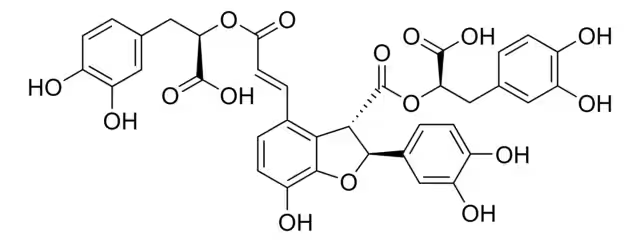
CAS Number121521-90-2
Synonymslithospermic acid B; SalvianolicacidB; salvianolic acid B; DanfensuanB
Molecular FormulaC36H30O16
Molecular Weight718.61
Purity≥94 (HPLC)%
Density1.6±0.1 g/cm3
Boiling Point1020.3±65.0 °C at 760 mmHg
Melting Point98-110ºC
Appearancepowder
Symbol
Signal WordWarning
| Chemical & Physical Properties | |
|---|---|
| CAS Number | 121521-90-2 |
| Catalog No. | 2A-9051427 |
| Chinese Name | 丹酚酸B |
| Synonyms | lithospermic acid B; SalvianolicacidB; salvianolic acid B; DanfensuanB |
| Molecular Formula | C36H30O16 |
| Molecular Weight | 718.61 |
| Purity | ≥94 (HPLC) |
| Density | 1.6±0.1 g/cm3 |
| Boiling Point | 1020.3±65.0 °C at 760 mmHg |
| Melting Point | 98-110ºC |
| Appearance | powder |
| Water Solubility | H2O: ≥5mg/mL |
| Storage Condition | -20°C Freezer |
| Application | Salvianolic acid B is an important component of Salvia miltiorrhiza, which is often used to treat microcirculatory diseases. |
| PubChem ID | 329825118 |
| MDL Number | MFCD23115783 |
| SMILES | OC(=O)[C@@H](Cc1ccc(O)c(O)c1)OC(=O)\C=C\c2ccc(O)c3O[C@@H]([C@@H](C(=O)O[C@H](Cc4ccc(O)c(O)c4)C(O)=O)c23)c5ccc(O)c(O)c5 |
| InChI | 1S/C36H30O16/c37-20-6-1-16(11-24(20)41)13-27(34(45)46)50-29(44)10-5-18-3-9-23(40)33-30(18)31(32(52-33)19-4-8-22(39)26(43)15-19)36(49)51-28(35(47)48)14-17-2-7-21(38)25(42)12-17/h1-12,15,27-28,31-32,37-43H,13-14H2,(H,45,46)(H,47,48)/b10-5+/t27-,28-,31+,32-/m1/s1 |
| InChI Key | SNKFFCBZYFGCQN-VWUOOIFGSA-N |
| NACRES Code | NA.77 |
| UNSPSC | 12352106 |
| Hazard Symbols | transportation |
| MSDS | msds/51427_1_121521_90_2.pdf |
| Bioactivity | Salvianolic acid B is an active ingredient of Salvia miltiorrhiza, which has been widely applied in China for the management of various microcirculation-related disorders, such as cardiovascular disease, cerebrovascular disease, and diabetic vascular complication.IC50 value:Target:In vitro: Salvianolic acid B (SA-B) 1 and 10 micromol/L decrease the cell active TGF-beta1 secretion by 63.3 % and 15.6 % of the control, down-regulat pro-collgen alpha1(I) mRNA expression to 77.0% and 51.8% respectively (P<0.05). SA-B 1 and 10 micromol/L also inhibit MAPK activity by 1 to 2 fold respectively [3].In vivo: Salvianolic acid B (SalB) (5 mg · kg-1 · h-1) significantly attenuates LPS-induced pulmonary microcirculatory disturbance, including the increase in leukocyte adhesion and albumin leakage. In addition, LPS increases pulmonary tissue wet-to-dry weight ratio and tumor necrosis factor [alpha] and interleukin 8 levels in plasma and bronchoalveolar lavage fluid enhances the expression of E-selectin, intercellular adhesion molecule 1, myeloperoxidase, MMP-2, and MMP-9, whereas it decreases the expression of AQP-1 and AQP-5 in pulmonary tissue, all of which are attenuated by SalB pretreatment[1]. SalB administration (10 mg/kg) significantly ameliorate the Aβ25-35 peptide-induced memory impairment in the passive avoidance task (P<0.05). SalB treatment also reduced the number of activated microglia and astrocytes that are observed during the inflammatory reaction after the administration of the Aβ25-35 peptide. Moreover, SalB markedly reduce inducible nitric oxide synthase and cyclooxygenase-2 expression levels and thiobarbituric acid reactive substances, which are increased by the administration of the Aβ25-35 peptide. Furthermore, SalB administration significantly rescue the Aβ25-35 peptide-induced decrease of choline acetyltransferase and brain-derived neurotrophic factor protein levels[2]. Related Catalog Signaling Pathways >> Autophagy >> Autophagy Research Areas >> Cardiovascular Disease Natural Products >> Phenols References [1]. Lee YW, et al.Neuroprotective effects of salvianolic acid B on an Aβ25-35 peptide-induced mouse model of Alzheimer's disease. Eur J Pharmacol. 2013 Mar 15;704(1-3):70-7. [2]. Liu P, et al. Effect of salvianolic acid B on collagen production and mitogen-activated protein kinase activity in rat hepatic stellate cells. Acta Pharmacol Sin. 2002 Aug;23(8):733-8. [3]. Lin, Fang, et al. Salvianolic acid B protects from pulmonary microcirculation disturbance induced by lipopolysaccharide in rat. Shock. 2013 Mar;39(3):317-25. Chemical & Physical Properties Density 1.6±0.1 g/cm3 Boiling Point 1020.3±65.0 °C at 760 mmHg Melting Point 98-110ºC Molecular Formula C36H30O16 Molecular Weight 718.614 Flash Point 322.1±27.8 °C Exact Mass 718.153381 PSA 278.04000 LogP 2.14 Vapour Pressure 0.0±0.3 mmHg at 25°C Index of Refraction 1.739 InChIKey SNKFFCBZYFGCQN-ARBMFGAVSA-N SMILES O=C(C=Cc1ccc(O)c2c1C(C(=O)OC(Cc1ccc(O)c(O)c1)C(=O)O)C(c1ccc(O)c(O)c1)O2)OC(Cc1ccc(O)c(O)c1)C(=O)O Storage condition -20°C Freezer Water Solubility H2O: ≥5mg/mL |
| Use of | Properties Articles33 Name Salvianolic acid B Synonym More Synonyms salvianolic acid B Biological Activity Related Catalog Signaling Pathways >> Autophagy >> Autophagy Research Areas >> Cardiovascular Disease Natural Products >> Phenols References [1]. Lee YW, et al.Neuroprotective effects of salvianolic acid B on an Aβ25-35 peptide-induced mouse model of Alzheimer's disease. Eur J Pharmacol. 2013 Mar 15;704(1-3):70-7. [2]. Liu P, et al. Effect of salvianolic acid B on collagen production and mitogen-activated protein kinase activity in rat hepatic stellate cells. Acta Pharmacol Sin. 2002 Aug;23(8):733-8. [3]. Lin, Fang, et al. Salvianolic acid B protects from pulmonary microcirculation disturbance induced by lipopolysaccharide in rat. Shock. 2013 Mar;39(3):317-25. Chemical & Physical Properties Molecular Formula C36H30O16 Exact Mass 718.153381 PSA 278.04000 Index of Refraction 1.739 InChIKey SNKFFCBZYFGCQN-ARBMFGAVSA-N |
| Transport Info | Shipping Name: UN |
| MSDS Transport Info | Module 14. Shipping information 14.1 UN dangerous goods number European Land Transport Dangerous Regulations: -International Maritime Dangerous Regulations: -International Air Transport Dangerous Regulations: - 14.2 United Nations shipping name European Land Transport Dangerous Regulations: Non-dangerous goods IMDG Code: Non-dangerous goods International air transport dangerous goods regulations: non-dangerous goods 14.3 Transport hazard categories European Land Transport Dangerous Regulations: -International Maritime Dangerous Regulations: -International Air Transport Dangerous Regulations: - 14.4 Package group European Land Transport Dangerous Regulations: -International Maritime Dangerous Regulations: -International Air Transport Dangerous Regulations: - 14.5 Environmental hazards European Land Transport Danger Regulations: No International Maritime Danger Regulations International Air Transport Danger Regulations: No Marine pollutants (yes/no): No 14.6 Special reminder to users No data available |
| Related Products in Botanical Reference Standards | ||
|---|---|---|
| Phenyl 2,3,4,6-tetra-O-acetyl-alpha-D-thiomannopyranoside | 108032-93-5 | 2A-9050374 |
| Heptyl 2-acetamido-3,4,6-tri-O-acetyl-2-deoxy-beta-D-glucopyranoside | 115431-24-8 | 2A-9050926 |
| Soyasaponin Aa | 117230-33-8 | 2A-9051089 |
| Anthocyanin | 528-53-0 | 2A-9051183 |
| 1-Naphthyl 2-acetamido-3,4,6-tri-O-acetyl-2-deoxy-beta-D-glucopyranoside | 121356-12-5 | 2A-9051420 |
| Escin IA | 123748-68-5 | 2A-9051587 |
| 4-Methylumbelliferyl 2-acetamido-3,4,6-tri-O-acetyl-2-deoxy-beta-D-glucopyranoside | 124167-45-9 | 2A-9051616 |
| Pent-4-enyl-D-glucopyranoside | 125631-33-6 | 2A-9051688 |
| Ethyl 2,3,4-tri-O-benzyl-beta-D-thioglucopyranoside | 126461-54-9 | 2A-9051742 |
| 3-Indoxyl-beta-D-galactopyranoside | 126787-65-3 | 2A-9051773 |
| Browse all Botanical Reference Standards products » | ||
Phone:
630-322-8886
630-322-8887
Email:
Office Locations:
Chicago, IL, USA
San Francisco, CA, USA


 EN
EN


 SDS
SDS