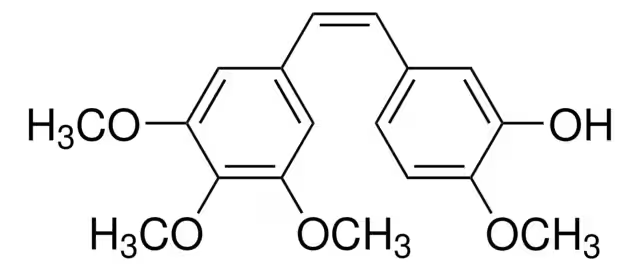
CAS Number117048-59-6
Synonyms(Z)-2-Methoxy-5-[2-(3,4,5,-trimethoxyphenyl)ethenyl]phenol; (Z)-CombretastatinA4; (Z)-2-Methoxy-5-(3,4,5-trimethoxystyryl)phenol; 3'-Hydroxy-3,4,4',5-tetramethoxy-cis-stilbene; CS A4; 2-Methoxy-5-[(Z)-2-(3,4,5-trimethoxyphenyl)ethenyl]benzolol; 2-methoxy-5-[(Z)-2-(3,4,5-trimethoxyphenyl)ethenyl]phenol; 2-Methoxy-5-[(Z)-2-(3,4,5-trimethoxyphenyl)vinyl]phenol; Combretastatin A-4; 3,4,5-Trimethoxy-3'-hydroxy-4'-methoxy-(Z)-stilbene
Molecular FormulaC18H20O5
Molecular Weight316.35
Purity≥98 (HPLC)%
Density1.2±0.1 g/cm3
Boiling Point490.3±45.0 °C at 760 mmHg
Melting Point84.5-85.5ºC
Appearancepowder
Symbol
Signal WordWarning
| Chemical & Physical Properties | |
|---|---|
| CAS Number | 117048-59-6 |
| Catalog No. | 2A-9051080 |
| Chinese Name | 康普瑞丁A4 |
| Synonyms | (Z)-2-Methoxy-5-[2-(3,4,5,-trimethoxyphenyl)ethenyl]phenol; (Z)-CombretastatinA4; (Z)-2-Methoxy-5-(3,4,5-trimethoxystyryl)phenol; 3'-Hydroxy-3,4,4',5-tetramethoxy-cis-stilbene; CS A4; 2-Methoxy-5-[(Z)-2-(3,4,5-trimethoxyphenyl)ethenyl]benzolol; 2-methoxy-5-[(Z)-2-(3,4,5-trimethoxyphenyl)ethenyl]phenol; 2-Methoxy-5-[(Z)-2-(3,4,5-trimethoxyphenyl)vinyl]phenol; Combretastatin A-4; 3,4,5-Trimethoxy-3'-hydroxy-4'-methoxy-(Z)-stilbene |
| Molecular Formula | C18H20O5 |
| Molecular Weight | 316.35 |
| Purity | ≥98 (HPLC) |
| Density | 1.2±0.1 g/cm3 |
| Boiling Point | 490.3±45.0 °C at 760 mmHg |
| Melting Point | 84.5-85.5ºC |
| Appearance | powder |
| Water Solubility | DMSO: >10mg/mL |
| Storage Condition | Desiccate at -20°C |
| Packaging | Ⅲ |
| Application | Combretastatin A4 is a microtubule inhibitor that binds to β-tubulin with a Kd of 0.4 μM. |
| PubChem ID | 329775149 |
| MDL Number | MFCD03453309 |
| SMILES | COc1ccc(\C=C/c2cc(OC)c(OC)c(OC)c2)cc1O |
| InChI | 1S/C18H20O5/c1-20-15-8-7-12(9-14(15)19)5-6-13-10-16(21-2)18(23-4)17(11-13)22-3/h5-11,19H,1-4H3/b6-5- |
| InChI Key | HVXBOLULGPECHP-WAYWQWQTSA-N |
| NACRES Code | NA.77 |
| UNSPSC | 12352200 |
| Hazard Symbols | 6.0 |
| MSDS | msds/51080_1_117048_59_6.pdf |
| Bioactivity | Combretastatin A4 is a microtubule-targeting agent that binds β-tubulin with Kd of 0.4 μM. Related Catalog Signaling Pathways >> Cell Cycle/DNA Damage >> Microtubule/Tubulin Signaling Pathways >> Cytoskeleton >> Microtubule/Tubulin Natural Products >> Others Research Areas >> Cancer Target Kd: 0.4 μM (β-tubulin) In Vitro Combretastatin A4 phosphate (≥ 50 µM) significantly increases the percentage of annexin-V-binding cells and significantly decreases forward scatter. Combretastatin A4 phosphate does not appreciably increase hemolysis. Hundred µM Combretastatin A4 phosphate significantly increases Fluo3-fluorescence. The effect of Combretastatin A4 phosphate (100 µM) on annexin-V-binding is significantly blunted, but not abolished, by removal of extracellular Ca2+. Combretastatin A4 phosphate (≥ 50 µM) significantly decreases GSH abundance and ATP levels but does not significantly increase ROS or ceramide[2]. Polymersomes co-encapsulating doxorubicin-combretastatin-A4 phosphate (1:10) shows strong synergistic cytotoxicity against human nasopharyngeal epidermal carcinoma (KB) cells[3]. Pretreatment with Combretastatin A4 phosphate does not influence the amount of VM in 3-D culture as well as the expression of these key molecules[4]. In Vivo DBP and MBP at 30 minutes after administration are higher in rats treated with Combretastatin A4 disodium phosphate 120 mg/10 mL/kg. The toxicokinetic parameters of Combretastatin A4 phosphate and Combretastatin A4 in rats treated with Combretastatin A4 disodium phosphate 120 mg/10 mL/kg are indicated, and the values of Cmax, T1/2, and AUC0-inf for Combretastatin A4 are 156±13 μM, 5.87±1.69 h, and 89.4±10.1 h·μM, respectively[1]. In vivo, W256 tumors show marked intratumoral hypoxia after Combretastatin A4 phosphate treatment, accompanied by increased VM formation. Combretastatin A4 phosphate exhibits only a delay in tumor growth within 2 days but rapid tumor regrowth afterward. VM density is positively related to tumor volume and tumor weight at day 8. Combretastatin A4 phosphate causes hypoxia which induces VM formation in W256 tumors through HIF-1α/EphA2/PI3K/matrix metalloproteinase (MMP) signaling pathway, resulting in the consequent regrowth of the damaged tumor[4]. Animal Admin Rats: Rats are administered a single intravenous dose of Combretastatin A4 disodium phosphate at 120 mg/10 mL/kg by bolus infusion (n=3). Blood is taken via the jugular vein and collected in heparin-coated tubes at 10 minutes and 1, 3, 6, and 24 hours after administration. Plasma is separated by centrifugation immediately after sampling. After centrifugation, an aliquot of plasma is mixed with the equivalent volume of 1% formic acid and stored at −20°C. The thawed plasma samples are purified by solid-phase extraction, and the plasma concentrations of combretastatin A4 phosphate (free base of Combretastatin A4 disodium phosphate; Combretastatin A4 phosphate) and combretastatin A4 (the metabolite of Combretastatin A4 disodium phosphate; Combretastatin A4 ) are determined by liquid chromatography-tandem mass spectrometry (LC-MS/MS). Toxicokinetic parameters [maximum concentration (Cmax), terminal half-life (T1/2), and area under the concentration-time curve from time zero to infinity (AUC0-inf)] are obtained by non-compartmental analysis using Phoenix WinNonlin 6.3. References [1]. Tochinai R, et al. Combretastatin A4 disodium phosphate-induced myocardial injury. J Toxicol Pathol. 2016 Jul;29(3):163-71. [2]. Signoretto E, et al. Stimulation of Eryptosis by Combretastatin A4 Phosphate Disodium (CA4P). Cell Physiol Biochem. 2016;38(3):969-81 [3]. Zhu J, et al. Co-Encapsulation of Combretastatin-A4 Phosphate and Doxorubicin in Polymersomes for Synergistic Therapy of Nasopharyngeal Epidermal Carcinoma. J Biomed Nanotechnol. 2015 Jun;11(6):997-1006. [4]. Yao N, et al. Combretastatin A4 phosphate treatment induces vasculogenic mimicry formation of W256 breast carcinoma tumor in vitro and in vivo. Tumour Biol. 2015 Nov;36(11):8499-510. Chemical & Physical Properties Density 1.2±0.1 g/cm3 Boiling Point 490.3±45.0 °C at 760 mmHg Melting Point 84.5-85.5ºC Molecular Formula C18H20O5 Molecular Weight 316.348 Flash Point 250.3±28.7 °C Exact Mass 316.131073 PSA 57.15000 LogP 3.57 Vapour Pressure 0.0±1.3 mmHg at 25°C Index of Refraction 1.607 Storage condition Desiccate at -20°C Water Solubility DMSO: >10mg/mL |
| Use of | Combretastatin A4 is a microtubule-targeting agent that binds β-tubulin with Kd of 0.4 μM. Properties Articles53 Name Combretastatin A4 Synonym More Synonyms Combretastatin A4 Biological Activity Description Combretastatin A4 is a microtubule-targeting agent that binds β-tubulin with Kd of 0.4 μM. Related Catalog Signaling Pathways >> Cell Cycle/DNA Damage >> Microtubule/Tubulin Signaling Pathways >> Cytoskeleton >> Microtubule/Tubulin Natural Products >> Others Research Areas >> Cancer Kd: 0.4 μM (β-tubulin) In Vitro Combretastatin A4 phosphate (≥ 50 µM) significantly increases the percentage of annexin-V-binding cells and significantly decreases forward scatter. Combretastatin A4 phosphate does not appreciably increase hemolysis. Hundred µM Combretastatin A4 phosphate significantly increases Fluo3-fluorescence. The effect of Combretastatin A4 phosphate (100 µM) on annexin-V-binding is significantly blunted, but not abolished, by removal of extracellular Ca2+. Combretastatin A4 phosphate (≥ 50 µM) significantly decreases GSH abundance and ATP levels but does not significantly increase ROS or ceramide[2]. Polymersomes co-encapsulating doxorubicin-combretastatin-A4 phosphate (1:10) shows strong synergistic cytotoxicity against human nasopharyngeal epidermal carcinoma (KB) cells[3]. Pretreatment with Combretastatin A4 phosphate does not influence the amount of VM in 3-D culture as well as the expression of these key molecules[4]. References [1]. Tochinai R, et al. Combretastatin A4 disodium phosphate-induced myocardial injury. J Toxicol Pathol. 2016 Jul;29(3):163-71. [2]. Signoretto E, et al. Stimulation of Eryptosis by Combretastatin A4 Phosphate Disodium (CA4P). Cell Physiol Biochem. 2016;38(3):969-81 [3]. Zhu J, et al. Co-Encapsulation of Combretastatin-A4 Phosphate and Doxorubicin in Polymersomes for Synergistic Therapy of Nasopharyngeal Epidermal Carcinoma. J Biomed Nanotechnol. 2015 Jun;11(6):997-1006. [4]. Yao N, et al. Combretastatin A4 phosphate treatment induces vasculogenic mimicry formation of W256 breast carcinoma tumor in vitro and in vivo. Tumour Biol. 2015 Nov;36(11):8499-510. Chemical & Physical Properties Molecular Formula C18H20O5 Exact Mass 316.131073 PSA 57.15000 Index of Refraction 1.607 |
| Transport Info | Shipping Name: UN |
| MSDS Transport Info | Module 14. Shipping information 14.1 United Nations number European Dangerous Regulations for land transport: 2811 International Dangerous Regulations for sea transport: 2811 International Dangerous Regulations for air transport: 2811 14.2 United Nations shipping name European land transport hazard regulations: TOXIC SOLID, ORGANIC, N.O.S. IMDG: TOXIC SOLID, ORGANIC, N.O.S. International air transport hazard regulations: Toxic solid, organic, n.o.s. 14.3 Transport hazard categories European Land Transport Danger Regulations: 6.1 International Maritime Transport Danger Regulations: 6.1 International Air Transport Danger Regulations: 6.1 14.4 Package group European Land Transport Danger Regulations: III International Maritime Transport Danger Regulations: III International Air Transport Danger Regulations: III 14.5 Environmental hazards European Land Transport Danger Regulations: No International Maritime Danger Regulations International Air Transport Danger Regulations: No Marine pollutants (yes/no): No 14.6 Special precautions No data available |
| Related Products in Specialty Chemicals | ||
|---|---|---|
| [3-[Tri(ethoxy)silyl]propyl]urea | 116912-64-2 | 2A-9051068 |
| 4,4'-(1,2-Ethenediyl)bis[N,N-diphenylbenzenamine] | 116942-09-7 | 2A-9051070 |
| 2-(4-Aminophenoxy)-2-methylpropionic acid | 117011-70-8 | 2A-9051076 |
| N-(4-Aminobutyl)carbamic acid 9H-fluoren-9-ylmethyl ester | 117048-49-4 | 2A-9051078 |
| 17-Acetyl-10,13-dimethyl-6,7,8,10,12,13,14,15-octahydrocyclopenta[a]phenathren-3-one | 117048-56-3 | 2A-9051079 |
| 8-Bromo-2-tetralone | 117294-21-0 | 2A-9051091 |
| 1-Ethyl-3,5-difluorobenzene | 117358-52-8 | 2A-9051097 |
| 3-Amino-3-(2-fluorophenyl)propanoic acid | 117391-49-8 | 2A-9051099 |
| 3-Amino-3-(3-bromophenyl)propanoic acid | 117391-50-1 | 2A-9051100 |
| 3-Amino-3-(4-ethylphenyl)propionic acid | 117391-52-3 | 2A-9051102 |
| Browse all Specialty Chemicals products » | ||
Phone:
630-322-8886
630-322-8887
Email:
Office Locations:
Chicago, IL, USA
San Francisco, CA, USA


 EN
EN


 SDS
SDS