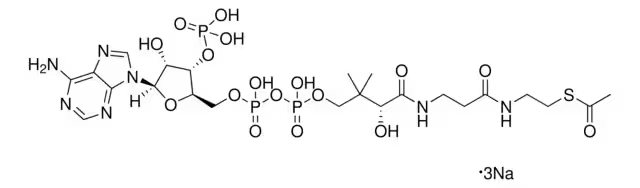
CAS Number102029-73-2
SynonymsACETHYL COENZYME A SODIUM SALT; ACETYL COENZYME A (C2:0) SODIUMPREPARED ENZYMATICA; Acetyl-Coenzym A; acetyl coa; C2:0; Acetyl Coenzyme A Trisodium Salt; coenzyme A acetyl derivative (C2:0),sodium salt; Acetyl Coenzyme A; MFCD00078858
Molecular FormulaC23H38N7O17P3S
Molecular Weight875.52
Purity≥93 (HPLC)%
Density1.9±0.1 g/cm3
Appearancepowder
Symbol
Signal WordWarning
| Chemical & Physical Properties | |
|---|---|
| CAS Number | 102029-73-2 |
| Catalog No. | 2A-9049871 |
| Chinese Name | 乙酰辅酶 A 钠盐 |
| Synonyms | ACETHYL COENZYME A SODIUM SALT; ACETYL COENZYME A (C2:0) SODIUMPREPARED ENZYMATICA; Acetyl-Coenzym A; acetyl coa; C2:0; Acetyl Coenzyme A Trisodium Salt; coenzyme A acetyl derivative (C2:0),sodium salt; Acetyl Coenzyme A; MFCD00078858 |
| Molecular Formula | C23H38N7O17P3S |
| Molecular Weight | 875.52 |
| Purity | ≥93 (HPLC) |
| Density | 1.9±0.1 g/cm3 |
| Appearance | powder |
| Storage Condition | -20 °C |
| Application | Acetyl Coenzyme A trisodium (Acetyl-CoA trisodium) is an important metabolic intermediate. Acetyl Coenzyme A trisodium is the actual molecule of glycolytic pyruvate into the tricarboxylic acid (TCA) c |
| PubChem ID | 24890621 |
| MDL Number | MFCD00078858 |
| SMILES | O[C@H]1[C@](O[C@@H]([C@H]1OP(O)(O)=O)COP(OP(OCC(C)(C)[C@@H](O)C(NCCC(NCCSC(C)=O)=O)=O)(O)=O)(O)=O)([H])N2C3=NC=NC(N)=C3N=C2.[3Na] |
| InChI | 1S/C23H38N7O17P3S.Na/c1-12(31)51-7-6-25-14(32)4-5-26-21(35)18(34)23(2,3)9-44-50(41,42)47-49(39,40)43-8-13-17(46-48(36,37)38)16(33)22(45-13)30-11-29-15-19(24)27-10-28-20(15)30;/h10-11,13,16-18,22,33-34H,4-9H2,1-3H3,(H,25,32)(H,26,35)(H,39,40)(H,41,42)(H2,24,27,28)(H2,36,37,38);/q;+1/p-1/t13-,16-,17-,18?,22-;/m1./s1 |
| InChI Key | HNLIOWFIXSPFEC-WLYMNMRISA-M |
| NACRES Code | NA.51 |
| UNSPSC | 41106305 |
| Hazard Symbols | transportation |
| MSDS | msds/49871_1_102029_73_2.pdf |
| Bioactivity | Acetyl Coenzyme A trisodium (Acetyl-CoA trisodium) is a central metabolic intermediate. Acetyl Coenzyme A trisodium is the actual molecule through which glycolytic pyruvate enters the tricarboxylic acid (TCA) cycle, is a key precursor of lipid synthesis, and is the sole donor of the acetyl groups for acetylation. Acetyl Coenzyme A trisodium acts as a potent allosteric activator of pyruvate carboxylase (PC)[1]. Related Catalog Research Areas >> Metabolic Disease In Vitro Acetyl-coenzyme A (Acetyl-CoA) is a membrane-impermeant molecule constituted by an acetyl moiety (CH3CO) linked to coenzyme A (CoA), a derivative of vitamin B5 and cysteine, through a thioester bond. As thioester bonds are energy rich, the chemical structure of acetyl-CoA facilitates the transfer of the acetyl moiety to a variety of acceptor molecules, including amino groups on proteins[1]. In most mammalian cells, Acetyl-coenzyme A (Acetyl-CoA) is predominantly generated in the mitochondrial matrix by various metabolic circuitries, namely glycolysis, β-oxidation, and the catabolism of branched amino acids. Cytosolic Acetyl-coenzyme A is the precursor of multiple anabolic reactions that underlie the synthesis of fatty acids and steroids, as well as specific amino acids including glutamate, proline, and arginine[1]. In Vivo Mice deprived of food (but with access to water ad libitum) for 24 hr exhibit a significant reduction in total Acetyl-coenzyme A (Acetyl-CoA) levels in several organs, including the heart and muscles, corresponding to a decrease in protein acetylation levels. However, the same experimental conditions have no major effects on Acetyl-coenzyme A concentrations in the brain and actually increase hepatic Acetyl-coenzyme A and protein acetylation levels. Ethanol intake augments Acetyl-coenzyme A levels in hepatic mitochondria[1]. References [1]. Federico Pietrocola, et al. Acetyl coenzyme A: a central metabolite and second messenger. Cell Metab. 2015 Jun 2;21(6):805-21. Chemical & Physical Properties Density 1.9±0.1 g/cm3 Molecular Formula C23H38N7O17P3S Molecular Weight 809.571 Exact Mass 809.125793 PSA 418.36000 LogP -3.89 Index of Refraction 1.718 InChIKey CRTIJMBXIFKWCA-JHJDYNLLSA-N SMILES CC(=O)SCCNC(=O)CCNC(=O)C(O)C(C)(C)COP(=O)(O)OP(=O)(O)OCC1OC(n2cnc3c(N)ncnc32)C(O)C1OP(=O)(O)O.[Na+].[Na+].[Na+] Storage condition -20 °C |
| Use of | Acetyl Coenzyme A trisodium (Acetyl-CoA trisodium) is a central metabolic intermediate. Acetyl Coenzyme A trisodium is the actual molecule through which glycolytic pyruvate enters the tricarboxylic acid (TCA) cycle, is a key precursor of lipid synthesis, and is the sole donor of the acetyl groups for acetylation. Acetyl Coenzyme A trisodium acts as a potent allosteric activator of pyruvate carboxylase (PC)[1]. Properties Name Acetyl coenzyme A sodium salt Synonym More Synonyms Acetyl Coenzyme A trisodium Biological Activity Description Acetyl Coenzyme A trisodium (Acetyl-CoA trisodium) is a central metabolic intermediate. Acetyl Coenzyme A trisodium is the actual molecule through which glycolytic pyruvate enters the tricarboxylic acid (TCA) cycle, is a key precursor of lipid synthesis, and is the sole donor of the acetyl groups for acetylation. Acetyl Coenzyme A trisodium acts as a potent allosteric activator of pyruvate carboxylase (PC)[1]. Related Catalog Research Areas >> Metabolic Disease In Vivo Mice deprived of food (but with access to water ad libitum) for 24 hr exhibit a significant reduction in total Acetyl-coenzyme A (Acetyl-CoA) levels in several organs, including the heart and muscles, corresponding to a decrease in protein acetylation levels. However, the same experimental conditions have no major effects on Acetyl-coenzyme A concentrations in the brain and actually increase hepatic Acetyl-coenzyme A and protein acetylation levels. Ethanol intake augments Acetyl-coenzyme A levels in hepatic mitochondria[1]. References [1]. Federico Pietrocola, et al. Acetyl coenzyme A: a central metabolite and second messenger. Cell Metab. 2015 Jun 2;21(6):805-21. Chemical & Physical Properties Molecular Formula C23H38N7O17P3S Exact Mass 809.125793 PSA 418.36000 LogP -3.89 Index of Refraction 1.718 InChIKey CRTIJMBXIFKWCA-JHJDYNLLSA-N |
| Transport Info | Product name: Purity: 90.0% |
| MSDS Transport Info | Module 14. Shipping information 14.1 UN dangerous goods number European Land Transport Dangerous Regulations: -International Maritime Dangerous Regulations: -International Air Transport Dangerous Regulations: - 14.2 Names specified by the United Nations (UN) European Land Transport Dangerous Regulations: Non-dangerous goods IMDG Code: Non-dangerous goods International air transport dangerous goods regulations: non-dangerous goods 14.3 Transport hazard categories European Land Transport Dangerous Regulations: -International Maritime Dangerous Regulations: -International Air Transport Dangerous Regulations: - 14.4 Package group European Land Transport Dangerous Regulations: -International Maritime Dangerous Regulations: -International Air Transport Dangerous Regulations: - 14.5 Environmental hazards European Land Transport Dangerous Regulations: No International Maritime Transport Dangerous Regulations Maritime Pollutants: No International Air Transport Risk Regulations: No 14.6 Special reminder to users No data available |
| Related Products in Specialty Chemicals | ||
|---|---|---|
| 1-(2-Ethoxyethyl)-1,3-dihydro-2H-benzimidazol-2-one | 101953-61-1 | 2A-9049864 |
| Birch-Me | 101978-01-2 | 2A-9049865 |
| Tetrahydrothien-3-ylamine | 101993-01-5 | 2A-9049867 |
| 3,6,9,12,15,18,21,24,27-Nonaoxaoctacosanoic acid | 102013-72-9 | 2A-9049868 |
| AMPSO sodium salt | 102029-60-7 | 2A-9049870 |
| N-(3-Sulfopropyl)-3,3',5,5'-tetramethylbenzidine sodium salt | 102062-36-2 | 2A-9049874 |
| Azetidin-3-amine dihydrochloride | 102065-86-1 | 2A-9049875 |
| 3-Azetidinamine dihydrochloride | 102065-89-4 | 2A-9049876 |
| Bis(4-biphenylyl)amine | 102113-98-4 | 2A-9049879 |
| 1,1,4,4-Tetramethyl-6-nitro-1,2,3,4-tetrahydronaphthalene | 102121-55-1 | 2A-9049881 |
| Browse all Specialty Chemicals products » | ||
Phone:
630-322-8886
630-322-8887
Email:
Office Locations:
Chicago, IL, USA
San Francisco, CA, USA


 EN
EN


 SDS
SDS