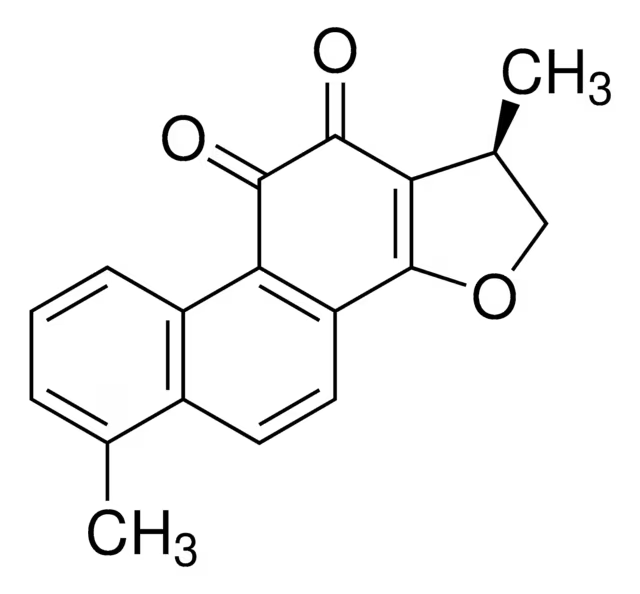
CAS Number87205-99-0
Synonyms1,6-Dimethyl-1,2-dihydrophenanthro[1,2-b]furan-10,11-dione; 1,2-dihydrotanshinone; Tanshinone I,dihydro; dihydrotanshinone 1; 1,2-dihydrotanshinone I; 15,16-dihydrotanshinone I; Dihydrotanshinone I
Molecular FormulaC18H14O3
Molecular Weight278.30
Purity98.00%
Density1.3±0.1 g/cm3
Boiling Point479.2±45.0 °C at 760 mmHg
Melting Point214.0 to 218.0 °C
Appearancered
Symbol
Signal WordWarning
| Chemical & Physical Properties | |
|---|---|
| CAS Number | 87205-99-0 |
| Catalog No. | 2A-9049444 |
| Chinese Name | 二氢丹参酮 I |
| Synonyms | 1,6-Dimethyl-1,2-dihydrophenanthro[1,2-b]furan-10,11-dione; 1,2-dihydrotanshinone; Tanshinone I,dihydro; dihydrotanshinone 1; 1,2-dihydrotanshinone I; 15,16-dihydrotanshinone I; Dihydrotanshinone I |
| Molecular Formula | C18H14O3 |
| Molecular Weight | 278.30 |
| Purity | 98.00 |
| Density | 1.3±0.1 g/cm3 |
| Boiling Point | 479.2±45.0 °C at 760 mmHg |
| Melting Point | 214.0 to 218.0 °C |
| Appearance | red |
| Water Solubility | ethanol: soluble1mg/mL, clear, orange to red |
| Storage Condition | 2-8°C |
| Application | Dihydrotanshinone I is a natural product isolated from Salvia miltiorrhiza and is widely used in the treatment of cardiovascular diseases. |
| PubChem ID | 16523093 |
| SMILES | Cc1cccc2c3c(ccc12)C1=C(C(=O)C3=O)C(C)CO1 |
| InChI | InChI=1S/C18H14O3/c1-9-4-3-5-12-11(9)6-7-13-15(12)17(20)16(19)14-10(2)8-21-18(13)14/h3-7,10H,8H2,1-2H3/t10-/m0/s1 |
| InChI Key | HARGZZNYNSYSGJ-JTQLQIEISA-N |
| Hazard Symbols | transportation |
| Bioactivity | Dihydrotanshinone I is a natural compound extracted from Salvia miltiorrhiza Bunge which has been widely used for treating cardiovascular diseases. Related Catalog Signaling Pathways >> Others >> Others Research Areas >> Cardiovascular Disease Natural Products >> Quinones In Vitro In lipopolysaccharide (LPS)-stimulated human umbilical vein endothelial cells (HUVECs), DHT (10 nM) decreases lectin-like ox-LDL receptor-1 (LOX-1) and NADPH oxidase 4 (NOX4) expression, reactive oxygen species (ROS) production, NF-κB nuclear translocation, ox-LDL endocytosis and monocytes adhesion[1]. Dihydrotanshinone I induces caspase dependent apoptosis induced in HCT116 cells. Dihydrotanshinone I induces concentration and ROS dependent caspase activation. Apoptosis induced by Dihydrotanshinone I is completely prevented by Z-VAD-fmk. Apoptosis induced by Dihydrotanshinone I is significantly inhibited by pretreatment of Z-LEHD-fmk but only is partially inhibited by Z-IETD-fmk. Apoptosis induced by Dihydrotanshinone I is significantly increased by caspase-2 knockdown[3]. In Vivo DHT (10 and 25 mg/kg) significantly attenuates atherosclerotic plaque formation, alteres serum lipid profile, decreases oxidative stress and shrinks necrotic core areas in ApoE-/- mice. DHT dramatically inhibits the enhanced expression of LOX-1, NOX4, and NF-κB in aorta[1]. Dihydrotanshinone I (1, 2, 4 mg/kg) treatment can improve cardiac function, reduce infarct size, ameliorate the variations in myocardial zymogram and histopathological disorders, decrease 20-HETE generation, and regulate apoptosis-related protein in myocardial ischemia-reperfusion rats[2]. Kinase Assay Cells are treated with various concentrations of Dihydrotanshinone I (3.13-20 µM) for 48 h. For the activity assay, Ac-DEVD-AMC (1 µg/µL), Ac-IETD-AMC (1 µg/µL) or Ac-LEDH-AMC (1 µg/µL) and cell lysate are added into Protease Assay Buffer in 96-well plate. Reaction mixtures with lysis buffer are used as negative controls. Cells treated with DMSO (0.1%) are treated as vehicle control. The reaction mixtures are incubated for 1 h at 37°C. The AMC liberated from the substrates is measured using spectrofluorometer of Victor 2 plate reader with an excitation wavelength of 380 nm and an emission wavelength of 430 nm. Animal Admin Male ApoE-/- mice (6-8 weeks old) on C57BL/6J background and age-matched wild-type C57BL/6J controls housed in SPF-grade animal facilities with a 12 h light/dark cycle, at 23°C (±2°C). Starting from 6 weeks, the mice are fed with a HCD (54.35% raw grain, 20% lard, 0.15% cholesterol, 15% sucrose, 0.5% Sodium Cholate, 10% yolk powder) for 12 weeks. All ApoE-/- mice are dosed daily via intragastric gavage with 10 and 25 mg/kg Dihydrotanshinone I dissolved in 0.5% CMC-Na or administered 0.5% CMC-Na alone (vehicle control) (n=8 per group). References [1]. Zhao W, et al. Dihydrotanshinone I Attenuates Atherosclerosis in ApoE-Deficient Mice: Role of NOX4/NF-κB Mediated Lectin-Like Oxidized LDL Receptor-1 (LOX-1) of the Endothelium. Front Pharmacol. 2016 Nov 8;7:418. eCollection 2016. [2]. Wei Y, et al. The cardioprotection of dihydrotanshinone I against myocardial ischemia-reperfusion injury via inhibition of arachidonic acid ω-hydroxylase. Can J Physiol Pharmacol. 2016 Dec;94(12):1267-1275. Epub 2016 Jun 24. [3]. Wang L, et al. Dihydrotanshinone I induced apoptosis and autophagy through caspase dependent pathway in colon cancer. Phytomedicine. 2015 Nov 15;22(12):1079-87. Chemical & Physical Properties Density 1.3±0.1 g/cm3 Boiling Point 479.2±45.0 °C at 760 mmHg Melting Point 214.0 to 218.0 °C Molecular Formula C18H14O3 Molecular Weight 278.302 Flash Point 214.9±28.8 °C Exact Mass 278.094299 PSA 43.37000 LogP 3.90 Appearance of Characters red Vapour Pressure 0.0±1.2 mmHg at 25°C Index of Refraction 1.671 InChIKey HARGZZNYNSYSGJ-JTQLQIEISA-N SMILES Cc1cccc2c3c(ccc12)C1=C(C(=O)C3=O)C(C)CO1 Storage condition 2-8°C Water Solubility ethanol: soluble1mg/mL, clear, orange to red |
| Use of | Dihydrotanshinone I is a natural compound extracted from Salvia miltiorrhiza Bunge which has been widely used for treating cardiovascular diseases. Properties Name (1R)-1,6-dimethyl-1,2-dihydronaphtho[1,2-g][1]benzofuran-10,11-dione Synonym More Synonyms Dihydrotanshinone I Biological Activity Description Dihydrotanshinone I is a natural compound extracted from Salvia miltiorrhiza Bunge which has been widely used for treating cardiovascular diseases. Related Catalog Signaling Pathways >> Others >> Others Research Areas >> Cardiovascular Disease Natural Products >> Quinones References [2]. Wei Y, et al. The cardioprotection of dihydrotanshinone I against myocardial ischemia-reperfusion injury via inhibition of arachidonic acid ω-hydroxylase. Can J Physiol Pharmacol. 2016 Dec;94(12):1267-1275. Epub 2016 Jun 24. [3]. Wang L, et al. Dihydrotanshinone I induced apoptosis and autophagy through caspase dependent pathway in colon cancer. Phytomedicine. 2015 Nov 15;22(12):1079-87. Chemical & Physical Properties Molecular Formula C18H14O3 Exact Mass 278.094299 PSA 43.37000 Appearance of Characters red Index of Refraction 1.671 InChIKey HARGZZNYNSYSGJ-JTQLQIEISA-N |
| Transport Info | Product name: Purity: 98.0% |
| MSDS Transport Info | Module 14. Shipping information 14.1 UN dangerous goods number European Land Transport Danger Regulations: 3077 International Maritime Transport Danger Regulations: 3077 International Air Transport Danger Regulations: 3077 14.2 Names specified by the United Nations (UN) European land transport hazard regulations: ENVIRONMENTALLY HAZARDOUS SUBSTANCE, SOLID, N.O.S. (Dihydrotanshinone I) IMDG: ENVIRONMENTALLY HAZARDOUS SUBSTANCE, SOLID, N.O.S. (Dihydrotanshinone I) International air transport hazard regulations: Environmentally hazardous substance, solid, n.o.s. (Dihydrotanshinone I) 14.3 Transport hazard categories European land transport Dangerous Regulations: 9 International sea transport Dangerous Regulations: 9 International air transport Dangerous Regulations: 9 14.4 Package group European Land Transport Danger Regulations: III International Maritime Transport Danger Regulations: III International Air Transport Danger Regulations: III 14.5 Environmental hazards European Land Transport Dangerous Regulations: Yes International Maritime Transport Dangerous Regulations Maritime Pollutants: Yes International Air Transport Dangerous Regulations: Yes 14.6 Special reminder to users further information Dangerous goods are individually packaged, with liquids exceeding 5 liters or solids exceeding 5 kilograms. The outer packaging of each independent package and the combined independent inner package must have EHS on it. Identification (according to European ADR Regulation 2.2.9.1.10, IMDG Regulation 2.10.3), |
| Related Products in Botanical Reference Standards | ||
|---|---|---|
| Astragaloside I | 84680-75-1 | 2A-9049099 |
| Astragaloside III | 84687-42-3 | 2A-9049102 |
| Octyl thioglucoside | 85618-21-9 | 2A-9049263 |
| Curculigoside | 85643-19-2 | 2A-9049268 |
| 2beta-Hydroxyursolic acid | 87205-98-9 | 2A-9049443 |
| Pseudoginsenoside RT5 | 98474-78-3 | 2A-9049512 |
| Nonyl beta-D-thioglucopyranoside | 98854-15-0 | 2A-9049556 |
| (2E,4S)-4-Hydroxy-3,7-dimethyl-2,6-octadien-1-yl beta-D-glucopyranoside | 100462-37-1 | 2A-9049725 |
| trans-4-Stilbenemethanol | 101093-37-2 | 2A-9049799 |
| Ginsenoside Rh3 | 105558-26-7 | 2A-9050196 |
| Browse all Botanical Reference Standards products » | ||
Phone:
630-322-8886
630-322-8887
Email:
Office Locations:
Chicago, IL, USA
San Francisco, CA, USA


 EN
EN


 SDS
SDS