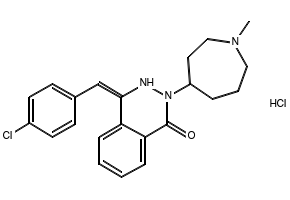
CAS Number79307-93-0
SynonymsAzelastine hydrochloride; 4-((4-Chlorophenyl)methyl)-2-(hexahydro-1-methyl-1H-azepin-4-yl)-1(2H)-phthalazinone hydrochloride; 4-((4-Chlorophenyl)methyl)-2-(hexahydro-1-methyl-1H-azepin-4-yl)phthalazin-1(2H)-one hydrochloride; 4-(4-Chlorobenzyl)-2-(1-methyl-4-azepanyl)-1(2H)-phthalazinone hydrochloride (1:1); 4-(4-chlorobenzyl)-2-(1-methylazepan-4-yl)phthalazin-1(2H)-one hydrochloride; azelastinum [INN_la]; 4-(4-Chlorobenzyl)-2-(1-methylazepan-4-yl)phthalazin-1(2H)-one hydrochloride (1:1); MFCD00242783; 4-(4-Chlorbenzyl)-2-(1-methylazepan-4-yl)phthalazin-1(2H)-onhydrochlorid; 4-(4-chlorobenzyl)-2-(1-méthylazépan-4-yl)phtalazin-1(2H)-one chlorhydrate; Azelastine (hydrochloride)
Molecular FormulaC22H25O1N3Cl2
Molecular Weight418.37
Purity98.00%
Density1.25 g/cm3
Boiling Point533.9ºC at 760 mmHg
Melting Point225-229ºC
AppearanceWhite crystalline powder
| Chemical & Physical Properties | |
|---|---|
| CAS Number | 79307-93-0 |
| Catalog No. | 2A-9048325 |
| Chinese Name | 盐酸氮卓斯汀 |
| Synonyms | Azelastine hydrochloride; 4-((4-Chlorophenyl)methyl)-2-(hexahydro-1-methyl-1H-azepin-4-yl)-1(2H)-phthalazinone hydrochloride; 4-((4-Chlorophenyl)methyl)-2-(hexahydro-1-methyl-1H-azepin-4-yl)phthalazin-1(2H)-one hydrochloride; 4-(4-Chlorobenzyl)-2-(1-methyl-4-azepanyl)-1(2H)-phthalazinone hydrochloride (1:1); 4-(4-chlorobenzyl)-2-(1-methylazepan-4-yl)phthalazin-1(2H)-one hydrochloride; azelastinum [INN_la]; 4-(4-Chlorobenzyl)-2-(1-methylazepan-4-yl)phthalazin-1(2H)-one hydrochloride (1:1); MFCD00242783; 4-(4-Chlorbenzyl)-2-(1-methylazepan-4-yl)phthalazin-1(2H)-onhydrochlorid; 4-(4-chlorobenzyl)-2-(1-méthylazépan-4-yl)phtalazin-1(2H)-one chlorhydrate; Azelastine (hydrochloride) |
| Molecular Formula | C22H25O1N3Cl2 |
| Molecular Weight | 418.37 |
| Purity | 98.00 |
| Density | 1.25 g/cm3 |
| Boiling Point | 533.9ºC at 760 mmHg |
| Melting Point | 225-229ºC |
| Appearance | White crystalline powder |
| Water Solubility | Water solubility: soluble |
| Storage Condition | Ventilated, low-temperature drying, stored separat |
| Application | Azelastine hydrochloride is a second-generation H1 receptor antagonist. |
| PubChem ID | 7847725 |
| MDL Number | MFCD00242783 |
| SMILES | CN1CCCC(n2nc(Cc3ccc(Cl)cc3)c3ccccc3c2=O)CC1.Cl |
| InChI | InChI=1S/C22H24ClN3O.ClH/c1-25-13-4-5-18(12-14-25)26-22(27)20-7-3-2-6-19(20)21(24-26)15-16-8-10-17(23)11-9-16;/h2-3,6-11,18H,4-5,12-15H2,1H3;1H |
| InChI Key | YEJAJYAHJQIWNU-UHFFFAOYSA-N |
| MSDS | msds/48325_1_79307_93_0.pdf |
| Bioactivity | Azelastine HCl is a potent, second-generation, selective, histamine antagonist.Target: Histamine ReceptorAzelastine is a selective H(1)-receptor antagonist that inhibits histamine release and interferes with activation of several other mediators of allergic inflammation. Azelastine can inhibit CHMCs activation and release of IL-6, tryptase, and histamine. On an equimolar basis, azelastine was a more potent inhibitor than olopatadine [1]. Topical azelastine progressively improved itching and conjunctival redness in PAC patients compared to placebo and was at least as effective as levocabastine. Rapid relief is consistent with H(1)-receptor antagonist action, while continued improvement up to 6 weeks may be consistent with mechanisms involving other mediators of allergic inflammation [2]. Azelastine nasal spray was reported to control all rhinitis symptoms, including nasal congestion, regardless of rhinitis diagnosis during the 2-week study period. Patients with seasonal allergic rhinitis and patients with seasonal allergic rhinitis plus nonallergic triggers were identified as patient types most likely to respond to azelastine nasal spray [3]. Related Catalog Signaling Pathways >> GPCR/G Protein >> Histamine Receptor Signaling Pathways >> Immunology/Inflammation >> Histamine Receptor Research Areas >> Inflammation/Immunology References [1]. Kempuraj, D., et al., Azelastine is more potent than olopatadine n inhibiting interleukin-6 and tryptase release from human umbilical cord blood-derived cultured mast cells. Ann Allergy Asthma Immunol, 2002. 88(5): p. 501-6. [2]. Canonica, G.W., et al., Topical azelastine in perennial allergic conjunctivitis. Curr Med Res Opin, 2003. 19(4): p. 321-9. [3]. Lieberman, P., M.A. Kaliner, and W.J. Wheeler, Open-label evaluation of azelastine nasal spray in patients with seasonal allergic rhinitis and nonallergic vasomotor rhinitis. Curr Med Res Opin, 2005. 21(4): p. 611-8. Chemical & Physical Properties Density 1.25 g/cm3 Boiling Point 533.9ºC at 760 mmHg Melting Point 225-229ºC Molecular Formula C22H25Cl2N3O Molecular Weight 418.359 Flash Point 276.7ºC Exact Mass 417.137482 PSA 38.13000 LogP 5.03740 InChIKey YEJAJYAHJQIWNU-UHFFFAOYSA-N SMILES CN1CCCC(n2nc(Cc3ccc(Cl)cc3)c3ccccc3c2=O)CC1.Cl Stability Incompatible with strong oxidizing agents. |
| Use of | Azelastine HCl is a potent, second-generation, selective, histamine antagonist.Target: Histamine ReceptorAzelastine is a selective H(1)-receptor antagonist that inhibits histamine release and interferes with activation of several other mediators of allergic inflammation. Azelastine can inhibit CHMCs activation and release of IL-6, tryptase, and histamine. On an equimolar basis, azelastine was a more potent inhibitor than olopatadine [1]. Topical azelastine progressively improved itching and conjunctival redness in PAC patients compared to placebo and was at least as effective as levocabastine. Rapid relief is consistent with H(1)-receptor antagonist action, while continued improvement up to 6 weeks may be consistent with mechanisms involving other mediators of allergic inflammation [2]. Azelastine nasal spray was reported to control all rhinitis symptoms, including nasal congestion, regardless of rhinitis diagnosis during the 2-week study period. Patients with seasonal allergic rhinitis and patients with seasonal allergic rhinitis plus nonallergic triggers were identified as patient types most likely to respond to azelastine nasal spray [3]. Properties Articles35 Name azelastine hydrochloride Synonym More Synonyms azelastine hydrochloride Biological Activity Description Azelastine HCl is a potent, second-generation, selective, histamine antagonist.Target: Histamine ReceptorAzelastine is a selective H(1)-receptor antagonist that inhibits histamine release and interferes with activation of several other mediators of allergic inflammation. Azelastine can inhibit CHMCs activation and release of IL-6, tryptase, and histamine. On an equimolar basis, azelastine was a more potent inhibitor than olopatadine [1]. Topical azelastine progressively improved itching and conjunctival redness in PAC patients compared to placebo and was at least as effective as levocabastine. Rapid relief is consistent with H(1)-receptor antagonist action, while continued improvement up to 6 weeks may be consistent with mechanisms involving other mediators of allergic inflammation [2]. Azelastine nasal spray was reported to control all rhinitis symptoms, including nasal congestion, regardless of rhinitis diagnosis during the 2-week study period. Patients with seasonal allergic rhinitis and patients with seasonal allergic rhinitis plus nonallergic triggers were identified as patient types most likely to respond to azelastine nasal spray [3]. Related Catalog Signaling Pathways >> GPCR/G Protein >> Histamine Receptor Signaling Pathways >> Immunology/Inflammation >> Histamine Receptor Research Areas >> Inflammation/Immunology References [1]. Kempuraj, D., et al., Azelastine is more potent than olopatadine n inhibiting interleukin-6 and tryptase release from human umbilical cord blood-derived cultured mast cells. Ann Allergy Asthma Immunol, 2002. 88(5): p. 501-6. [2]. Canonica, G.W., et al., Topical azelastine in perennial allergic conjunctivitis. Curr Med Res Opin, 2003. 19(4): p. 321-9. [3]. Lieberman, P., M.A. Kaliner, and W.J. Wheeler, Open-label evaluation of azelastine nasal spray in patients with seasonal allergic rhinitis and nonallergic vasomotor rhinitis. Curr Med Res Opin, 2005. 21(4): p. 611-8. Chemical & Physical Properties Exact Mass 417.137482 PSA 38.13000 LogP 5.03740 InChIKey YEJAJYAHJQIWNU-UHFFFAOYSA-N Stability Incompatible with strong oxidizing agents. |
| Transport Info | Product name: Purity: 98.0% |
| MSDS Transport Info | Module 14. Shipping information United Nations classification: inconsistent with United Nations classification standards Azelastine hydrochloride Modification number: 5 Module 14. Shipping information UN number: not specified |
| Related Products in Specialty Chemicals | ||
|---|---|---|
| 3-Aminothiobenzamide | 78950-36-4 | 2A-9048290 |
| 4,5-Dimethylbenzothiazol-2-amine | 79050-49-0 | 2A-9048296 |
| 3-(Piperidin-4-yl)-3,4-dihydroquinazolin-2(1H)-one | 79098-75-2 | 2A-9048305 |
| 6-Methyl-1H-pyrazolo[3,4-b]pyridin-3-amine | 79173-38-9 | 2A-9048309 |
| Bis(tert-butylcyclopentadienyl)titanium dichloride | 79269-71-9 | 2A-9048318 |
| 2-Morpholinol hydrochloride | 79323-24-3 | 2A-9048326 |
| 7-ACMA | 79349-53-4 | 2A-9048327 |
| 4-Amino-2-aminomethylphenol | 79352-72-0 | 2A-9048331 |
| 5-Iodo-2-pyrimidone | 79387-69-2 | 2A-9048333 |
| Methyl 4,6-dihydroxynicotinate | 79398-27-9 | 2A-9048335 |
| Browse all Specialty Chemicals products » | ||
Phone:
630-322-8886
630-322-8887
Email:
Office Locations:
Chicago, IL, USA
San Francisco, CA, USA


 EN
EN


 SDS
SDS