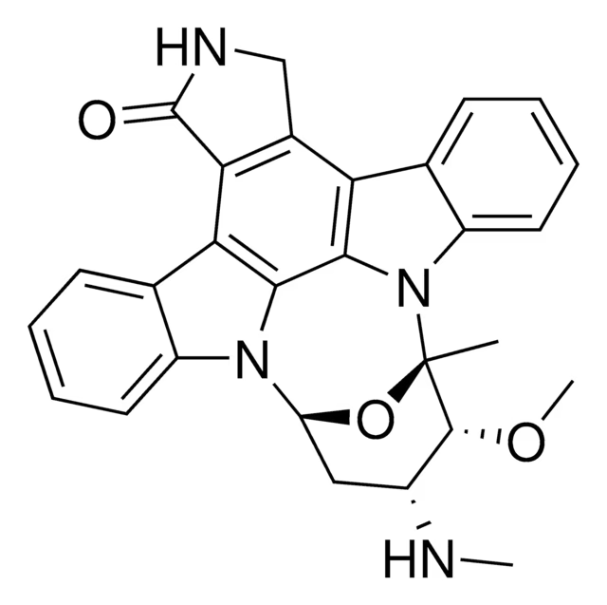
CAS Number62996-74-1
SynonymsStauroporine; Staurosporine; staurosphorine; ANTIBIOTIC M 193; MFCD00077402; Antibiotic 230; antibiotic am 2282; ANTIBIOTIC AM-2282; AM-2282; STSP; Staurosporin
Molecular FormulaC28H26N4O3
Molecular Weight466.53
Purity98.00%
Density1.6±0.1 g/cm3
Boiling Point677.5±55.0 °C at 760 mmHg
Melting Point270ºC
Appearanceoff-white powder
| Chemical & Physical Properties | |
|---|---|
| CAS Number | 62996-74-1 |
| Catalog No. | 2A-9045807 |
| Chinese Name | 星孢菌素 |
| Synonyms | Stauroporine; Staurosporine; staurosphorine; ANTIBIOTIC M 193; MFCD00077402; Antibiotic 230; antibiotic am 2282; ANTIBIOTIC AM-2282; AM-2282; STSP; Staurosporin |
| Molecular Formula | C28H26N4O3 |
| Molecular Weight | 466.53 |
| Purity | 98.00 |
| Density | 1.6±0.1 g/cm3 |
| Boiling Point | 677.5±55.0 °C at 760 mmHg |
| Melting Point | 270ºC |
| Appearance | off-white powder |
| Storage Condition | 0-10°C; store in inert gas; avoid air, heat |
| Application | Staurosporine is a potent, non-selective protein kinase inhibitor with IC50s of 6 nM, 15 nM, 2 nM and 3 nM for PKC, PKA, c-Fgr, and Phosphorylase kinase respectively. |
| HTC | 29419090 |
| PubChem ID | 329755625 |
| SMILES | CNC1CC2OC(C)(C1OC)n1c3ccccc3c3c4c(c5c6ccccc6n2c5c31)C(=O)NC4 |
| InChI | InChI=1S/C28H26N4O3/c1-28-26(34-3)17(29-2)12-20(35-28)31-18-10-6-4-8-14(18)22-23-16(13-30-27(23)33)21-15-9-5-7-11-19(15)32(28)25(21)24(22)31/h4-11,17,20,26,29H,12-13H2,1-3H3,(H,30,33)/t17-,20-,26-,28+/m1/s1 |
| InChI Key | HKSZLNNOFSGOKW-GKHVWRADSA-N |
| Bioactivity | Staurosporine is a potent and non-selective inhibitor of protein kinases with IC50s of 6 nM, 15 nM, 2 nM, and 3 nM for PKC, PKA, c-Fgr, and Phosphorylase kinase respectively. Related Catalog Signaling Pathways >> Protein Tyrosine Kinase/RTK >> PKA Signaling Pathways >> Stem Cell/Wnt >> PKA Signaling Pathways >> Epigenetics >> PKC Signaling Pathways >> TGF-beta/Smad >> PKC Natural Products >> Others Research Areas >> Cancer Target PKC:6 nM (IC50) c-Fgr:2 nM (IC50) Phosphorylase kinase:3 nM (IC50) v-Src:6 nM (IC50) cdc2:9 nM (IC50) TPK-IIB/Syk:16 nM (IC50) Ca2+/CaM PK-I1:20 nM (IC50) MLCK:21 nM (IC50) IR:61 nM (IC50) EGF-R:100 nM (IC50) ERK-1:1500 nM (IC50) CSK:2000 nM (IC50) IGF-IR:6150 nM (IC50) CK2:19500 nM (IC50) CK1:163500 nM (IC50) S6 kinase (70 kDa):5 nM (IC50) PKA:15 nM (IC50) In Vitro Staurosporine, widely used as a protein kinase C (PKC) inhibitor with a broad spectrum of activity, is an alkaloid isolated from the culture broth of Streptomyces staurospores. MC3T3E-1 osteoblasts, expose to Staurosporine (100 nM) for 12 h, release an amount of LDH (12.4±3.1%) that is similar to that release by the control cells(10.0±2.4%), indicating the relative absence of lytic death, which occurs in necrosis. In addition, treatment with Staurosporine (100 nM) results in morphological changes, characteristic of apoptosis: a brightblue fluorescent condensed nuclei seen through a fluorescence microscope after Hoechst 33258-staining, and a reduction of cell volume[2]. In Vivo The inhibitory effect of Staurosporine is statistically significant at around Wk 10 of tumor promotion. Although statistically significant inhibition is not obtained with 10 ng of Staurosporine in later weeks of the experiment, a decreasing tendency in the percentages of tumor bearing mice and in average numbers of tumors per mouse is apparent. Thus, Staurosporine slightly inhibits tumor promotion of Teleocidin, even at the dose at which Staurosporine itself induced tumors[3]. Staurosponne (0.05 and 0.1 mg/kg intraperitoneal) attenuates the impaired perlormance of water maze and passive avoidance tasks, even though the drug administration began 2 weeks after the lesion. Moreover, Staurosporine (0.1 mg/kg) partially reversed the decrease of choline acetyltransferase activity in the fronto-parietal cortex induced by basal forebrain-lesion. These results suggest that Staurosporine attenuates impairment of learning through reversal of damage to cholinergic neurons induced by basal forebrain-lesion[4]. Kinase Assay MC3T3E-1 cells (2×10⁶ cells/group) are treated with 100 nM Staurosporine for various time periods and lysed in a lysis buffer (EB buffer: 1% Triton X-100, 10 mM Tris, pH 7.6, 50 mM NaCl, 1 mg/mL Aprotinin, 5 mM EDTA, 50 mM NaF, 0.1% 2-mercaptoethanol, and 100 μM sodium orthovanadate). The lysate of the cells is subjected to centrifugation at 12 000 g at 4°C for 30 min. Soluble fraction is collected and incubated with anti-JNK1 antibodies. After incubation on ice for 3 h, 100 μL of a 10% solution of formalin-fixed Staphylococcus aureus is added to the anti-JNK1 immunoprecipitates and further incubated on ice for 1 h. The absorbed immune complex is washed twice with EB buffer and PAN buffer (10 mM PIPES buffer, pH 7.0, 1% aprotinin, 100 mM NaCl). The immunecomplex is mixed with 2 μg of GST-c-Jun NT1-79 proteins as a substrate in 30 μL of the reaction buffer containing 2 μM cold ATP, 2 mM DTT, 20 mM MgCl2, 2 μCi [γ33-P]-ATP, and 20 mM Tris-HCl, pH 7.5 at 30°C for 20 min. The reaction is terminated by adding 15 μL of 3× SDS-PAGE sample buffer and boiling at 98°C for 5 min. The proteins are separated on 12% SDS-PAGE and transferred onto a nitrocellulose membrane via the semi-dry electrotransfer system. The membrane is immunoblotted with rabbit anti-JNK1 antibodies and horse radish peoxidaseconjugated anti-rabbit antibodies to visualize the signals measured by an enhanced chemiluminescence system. The gel is dried under a vacuum, and the phosphotransferase activity is visualized by autoradiography and quantified by a PhosphoImager analyzer[2]. Animal Admin Mice[3] Female CD-I mice are used. Various amounts of Staurosporine in 10 μL of acetone are applied to the ears of 8-wk-old CD-I mice. The extent of irritation is expressed as the minimum dose of the compound causing irritation. Induction of HOC in Mouse Skin Staurosporine in 0.1 mL of acetone is applied to the skin of the backs of CD-I mice, and a crude enzyme extract is obtained from the skin 18 h later. HDC activity is expressed as pmol of CO2 released per mg of protein per l h of incubation. Induction of ODC in Mouse Skin Staurosporine in 0.2 mL of acetone is applied to the skin of the backs of CD-I mice. After 4 h, a crude enzyme extract is prepared from the epidermis, and its ODC activity is measured. Enzyme activity is expressed as nmol of CO2 per mg of protein per 30 min of incubation. Rats[4] Male Kbl Wistar rats(weighing 270 to 310 g) are used. In the group which is given Staurosporine for 2 weeks, the water maze task and Staurosporine administration are started 2 weeks after the BF-lesion, and the passive avoidance task is carried out 4 weeks after the BFlesion. The rat received Staurosporine at doses of 0.01, 0.03, 0.1, and 0.3 mg/kg (i.p., N=10 in each group for 2 weeks) 30 mm prior to the water maze training sessions and the passive avoidance task acquisitiontrial. In the group which is given Staurosporine for 4 weeks, the drug is first given 2 weeks after the BF-lesion. The water maze task is carried out 4 weeks after the BF-lesion. The passive avoidance task is carried out 6 weeks after the BF-lesion. The rat received Staurosporine at 0.05, 0.1, and 0.2 mg/kg (i.p., N=10 in each group) once a day for 2 weeks before training, and for 2 weeks after the water maze training sessions and the passive avoidance task acquisition trial. Staurosporine is suspended in 0.3% of sodium carboxymethyl cellulose. The vehicle is administered to the non-lesioned controls and the lesioned controls on the same schedule as the Staurosporine-treated animals. References [1]. Meggio F, et al. Different susceptibility of protein kinases to staurosporine inhibition. Kinetic studies and molecular bases for the resistance of protein kinase CK2. Eur J Biochem. 1995 Nov 15;234(1):317-22. [2]. Chae HJ, et al. Molecular mechanism of staurosporine-induced apoptosis in osteoblasts. Pharmacol Res. 2000 Oct;42(4):373-81. [3]. Yoshizawa S, et al. Tumor-promoting activity of staurosporine, a protein kinase inhibitor on mouse skin.Cancer Res. 1990 Aug 15;50(16):4974-8. [4]. Nabeshima T, et al. Staurosporine facilitates recovery from the basal forebrain-lesion-induced impairment of learning and deficit of cholinergic neuron in rats. J Pharmacol Exp Ther. 1991 May;257(2):562-6. Chemical & Physical Properties Density 1.6±0.1 g/cm3 Boiling Point 677.5±55.0 °C at 760 mmHg Melting Point 270ºC Molecular Formula C28H26N4O3 Molecular Weight 466.531 Flash Point 363.6±31.5 °C Exact Mass 466.200500 PSA 69.45000 LogP 4.40 Vapour Pressure 0.0±2.1 mmHg at 25°C Index of Refraction 1.810 InChIKey HKSZLNNOFSGOKW-GKHVWRADSA-N SMILES CNC1CC2OC(C)(C1OC)n1c3ccccc3c3c4c(c5c6ccccc6n2c5c31)C(=O)NC4 |
| Use of | Staurosporine is a potent and non-selective inhibitor of protein kinases with IC50s of 6 nM, 15 nM, 2 nM, and 3 nM for PKC, PKA, c-Fgr, and Phosphorylase kinase respectively. Properties Articles209 Name staurosporine Synonym More Synonyms Staurosporine Biological Activity Description Staurosporine is a potent and non-selective inhibitor of protein kinases with IC50s of 6 nM, 15 nM, 2 nM, and 3 nM for PKC, PKA, c-Fgr, and Phosphorylase kinase respectively. Related Catalog Signaling Pathways >> Protein Tyrosine Kinase/RTK >> PKA Signaling Pathways >> Stem Cell/Wnt >> PKA Signaling Pathways >> Epigenetics >> PKC Signaling Pathways >> TGF-beta/Smad >> PKC Natural Products >> Others Research Areas >> Cancer PKC:6 nM (IC50) c-Fgr:2 nM (IC50) Phosphorylase kinase:3 nM (IC50) v-Src:6 nM (IC50) cdc2:9 nM (IC50) TPK-IIB/Syk:16 nM (IC50) Ca2+/CaM PK-I1:20 nM (IC50) MLCK:21 nM (IC50) IR:61 nM (IC50) EGF-R:100 nM (IC50) ERK-1:1500 nM (IC50) CSK:2000 nM (IC50) IGF-IR:6150 nM (IC50) CK2:19500 nM (IC50) CK1:163500 nM (IC50) S6 kinase (70 kDa):5 nM (IC50) PKA:15 nM (IC50) References [1]. Meggio F, et al. Different susceptibility of protein kinases to staurosporine inhibition. Kinetic studies and molecular bases for the resistance of protein kinase CK2. Eur J Biochem. 1995 Nov 15;234(1):317-22. [2]. Chae HJ, et al. Molecular mechanism of staurosporine-induced apoptosis in osteoblasts. Pharmacol Res. 2000 Oct;42(4):373-81. [3]. Yoshizawa S, et al. Tumor-promoting activity of staurosporine, a protein kinase inhibitor on mouse skin.Cancer Res. 1990 Aug 15;50(16):4974-8. [4]. Nabeshima T, et al. Staurosporine facilitates recovery from the basal forebrain-lesion-induced impairment of learning and deficit of cholinergic neuron in rats. J Pharmacol Exp Ther. 1991 May;257(2):562-6. Chemical & Physical Properties Molecular Formula C28H26N4O3 Exact Mass 466.200500 PSA 69.45000 Index of Refraction 1.810 InChIKey HKSZLNNOFSGOKW-GKHVWRADSA-N |
| Transport Info | Product Name: Staurosporine |
| Related Products in Specialty Chemicals | ||
|---|---|---|
| 1-Thio-alpha-D-glucopyranose pentaacetate | 62860-10-0 | 2A-9045785 |
| 2-Cyclopropylethylamine | 62893-54-3 | 2A-9045792 |
| 2-Chloro-N-ethyl-6-fluorobenzenemethanamine | 62924-59-8 | 2A-9045793 |
| Ethyl 4-(methylthio)benzoylformate | 62936-31-6 | 2A-9045796 |
| Magnesium valproate | 62959-43-7 | 2A-9045802 |
| 1-(4-Chlorophenyl)cyclobutanemethanamine | 63010-09-3 | 2A-9045813 |
| 8-Fluoroquinolin-4-ol | 63010-71-9 | 2A-9045814 |
| L-tert-Leucine methyl ester hydrochloride | 63038-27-7 | 2A-9045818 |
| Poly-D-leucine | 63038-44-8 | 2A-9045819 |
| 4-Methylphthalonitrile | 63089-50-9 | 2A-9045838 |
| Browse all Specialty Chemicals products » | ||
Phone:
630-322-8886
630-322-8887
Email:
Office Locations:
Chicago, IL, USA
San Francisco, CA, USA


 EN
EN


 SDS
SDS