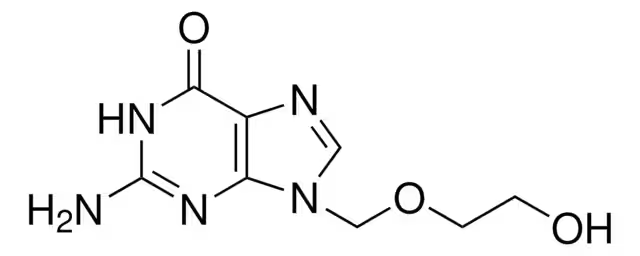
CAS Number59277-89-3
SynonymsZovir; 9-((2-Hydroxyethoxy)methyl)guanine; EINECS 261-685-1; Poviral; aclovir; bw248u; Acyclo-V; Maynar; 9-(2-Hydroxyethoxy)methylguanine; Vimrax; Zoviax; Aciclovir; Zyclir; Cycloviran; 2-Amino-9-((2-hydroxyethoxy)methyl)-1H-purin-6(9H)-one; Viroraxl; Azone; w-248-u; BW 248U; 2-Amino-9-[(2-hydroxyethoxy)methyl]-1,9-dihydro-6H-purin-6-one; 2-amino-9-{[(2-hydroxyethyl)oxy]methyl}-1,9-dihydro-6H-purin-6-one; 9-[(2-Hydroxyethoxy)methyl]guanine; Wellcome 248U; Cargosil; Zovirax; Acyclovir; 9-(2-Hydroxyethyloxymethyl)guanine; ACV; MFCD00057880; Acycloguanosine
Molecular FormulaC8H11N5O3
Molecular Weight225.20
Purity98.00%
Density1.8±0.1 g/cm3
Boiling Point576.5±58.0 °C at 760 mmHg
Melting Point256-257°C
AppearanceWhite to light yellow crystal powder
Symbol
Signal WordWarning
| Chemical & Physical Properties | |
|---|---|
| CAS Number | 59277-89-3 |
| Catalog No. | 2A-9045139 |
| Chinese Name | 阿昔洛韦 |
| Synonyms | Zovir; 9-((2-Hydroxyethoxy)methyl)guanine; EINECS 261-685-1; Poviral; aclovir; bw248u; Acyclo-V; Maynar; 9-(2-Hydroxyethoxy)methylguanine; Vimrax; Zoviax; Aciclovir; Zyclir; Cycloviran; 2-Amino-9-((2-hydroxyethoxy)methyl)-1H-purin-6(9H)-one; Viroraxl; Azone; w-248-u; BW 248U; 2-Amino-9-[(2-hydroxyethoxy)methyl]-1,9-dihydro-6H-purin-6-one; 2-amino-9-{[(2-hydroxyethyl)oxy]methyl}-1,9-dihydro-6H-purin-6-one; 9-[(2-Hydroxyethoxy)methyl]guanine; Wellcome 248U; Cargosil; Zovirax; Acyclovir; 9-(2-Hydroxyethyloxymethyl)guanine; ACV; MFCD00057880; Acycloguanosine |
| Molecular Formula | C8H11N5O3 |
| Molecular Weight | 225.20 |
| Purity | 98.00 |
| Density | 1.8±0.1 g/cm3 |
| Boiling Point | 576.5±58.0 °C at 760 mmHg |
| Melting Point | 256-257°C |
| Appearance | White to light yellow crystal powder |
| Water Solubility | H2O: 0.7 mg/mL |
| Storage Condition | -20℃ |
| Application | Acyclovir can inhibit the thymidine kinase of herpes virus, with an IC50 of 530-750nM. |
| HTC | 2933790090 |
| PubChem ID | 329748935 |
| SMILES | NC1=NC(=O)c2ncn(COCCO)c2N1 |
| InChI | InChI=1S/C8H11N5O3/c9-8-11-6-5(7(15)12-8)10-3-13(6)4-16-2-1-14/h3,14H,1-2,4H2,(H3,9,11,12,15) |
| InChI Key | InChIKey=MKUXAQIIEYXACX-UHFFFAOYSA-N |
| Hazard Symbols | transportation |
| Bioactivity | Acyclovir, a molecule tailored to inactivate the thymidine kinase of the herpesvirus, is a guanosine analogue antiviral drug. It is a drug for HSV infection by GlaxoSmithKline.IC50 Value: 0.53-0.75 uM [3]Target: HSVin vitro: Acyclovir sensitivity was determined in a plaque-reduction assay in Vero cells. IC50 Values were consistently 2-3 fold lower in B2 compared with the H strain of Vero cells. HSV Type 2 strains were 2-10-fold less sensitive than Type 1 strains [2]. in vivo: two patients experienced a recurrence during treatment with oral acyclovir (200 mg 4 times daily) for up to 12 weeks, compared with nine during placebo treatment (P = 0.016). There was no difference between acyclovir and placebo in the time to the next recurrence following completion of treatment [3]. low-dose oral acyclovirmay be effective in the prevention of HSV infection during OKT3 treatment of seropositive patients. Continuation of acyclovir prophylaxis for two to four weeks following the conclusion of OKT3 therapy may prevent occurrence of delayed infections [4].Clinical trial: Acyclovir to Treat Patients Co-infected With HIV and Herpes Viruses in Uganda. Phage2 Related Catalog Signaling Pathways >> Anti-infection >> HSV Research Areas >> Infection References [1]. Li Z, et al. Acyclovir treatment of skin lesions results in immune deviation in mice infected cutaneously with herpes simplex virus. Antivir Chem Chemother. 1999 Sep;10(5):251-7. [2]. Shelley WB, Hashim M, Shelley ED. Acyclovir in the treatment of hand-foot-and-mouth disease. Cutis. 1996 Apr;57(4):232-4. [3]. Collins P, Oliver NM. Sensitivity monitoring of herpes simplex virus isolates from patients receiving acyclovir. J Antimicrob Chemother. 1986 Oct;18 Suppl B:103-12. [4]. Meyrick Thomas RH, Dodd HJ, Yeo JM, Oral acyclovir in the suppression of recurrent non-genital herpes simplex virus infection. Br J Dermatol. 1985 Dec;113(6):731-5. [5]. Tang IY, Maddux MS, Veremis SA, Low-dose oral acyclovir for prevention of herpes simplex virus infection during OKT3 therapy. Transplant Proc. 1989 Feb;21(1 Pt 2):1758-60. Chemical & Physical Properties Density 1.8±0.1 g/cm3 Boiling Point 576.5±58.0 °C at 760 mmHg Melting Point 256-257°C Molecular Formula C8H11N5O3 Molecular Weight 225.205 Flash Point 302.4±32.3 °C Exact Mass 225.086182 PSA 119.05000 LogP -3.31 Vapour Pressure 0.0±1.7 mmHg at 25°C Index of Refraction 1.762 Stability Stable. Incompatible with strong oxidizing agents. Water Solubility H2O: 0.7 mg/mL |
| Use of | Properties Articles117 Name acyclovir Synonym More Synonyms Acyclovir Biological Activity Related Catalog Signaling Pathways >> Anti-infection >> HSV Research Areas >> Infection References [1]. Li Z, et al. Acyclovir treatment of skin lesions results in immune deviation in mice infected cutaneously with herpes simplex virus. Antivir Chem Chemother. 1999 Sep;10(5):251-7. [2]. Shelley WB, Hashim M, Shelley ED. Acyclovir in the treatment of hand-foot-and-mouth disease. Cutis. 1996 Apr;57(4):232-4. [3]. Collins P, Oliver NM. Sensitivity monitoring of herpes simplex virus isolates from patients receiving acyclovir. J Antimicrob Chemother. 1986 Oct;18 Suppl B:103-12. [4]. Meyrick Thomas RH, Dodd HJ, Yeo JM, Oral acyclovir in the suppression of recurrent non-genital herpes simplex virus infection. Br J Dermatol. 1985 Dec;113(6):731-5. [5]. Tang IY, Maddux MS, Veremis SA, Low-dose oral acyclovir for prevention of herpes simplex virus infection during OKT3 therapy. Transplant Proc. 1989 Feb;21(1 Pt 2):1758-60. Chemical & Physical Properties Molecular Formula C8H11N5O3 Exact Mass 225.086182 PSA 119.05000 LogP -3.31 Index of Refraction 1.762 Stability Stable. Incompatible with strong oxidizing agents. |
| Tax Rebate | 13.0% |
| Supervision | None. MFN tariff: 6.5%. Ordinary tariff: 20.0% |
| Transport Info | Product name: Purity: 98.0% |
| MSDS Transport Info | Module 14. Shipping information 14.1 UN dangerous goods number European Land Transport Dangerous Regulations: -International Maritime Dangerous Regulations: -International Air Transport Dangerous Regulations: - 14.2 Names specified by the United Nations (UN) European Land Transport Dangerous Regulations: Non-dangerous goods IMDG Code: Non-dangerous goods International air transport dangerous goods regulations: non-dangerous goods 14.3 Transport hazard categories European Land Transport Dangerous Regulations: -International Maritime Dangerous Regulations: -International Air Transport Dangerous Regulations: - 14.4 Package group European Land Transport Dangerous Regulations: -International Maritime Dangerous Regulations: -International Air Transport Dangerous Regulations: - 14.5 Environmental hazards European Land Transport Dangerous Regulations: No International Maritime Transport Dangerous Regulations Maritime Pollutants: No International Air Transport Risk Regulations: No 14.6 Special reminder to users No data available |
| Related Products in API & Advanced Intermediates | ||
|---|---|---|
| Calcitonin eel | 57014-02-5 | 2A-9044747 |
| Ibuprofen lysinate | 57469-76-8 | 2A-9044836 |
| Ibuprofen lysine | 57469-77-9 | 2A-9044837 |
| Domperidone | 57808-66-9 | 2A-9044908 |
| Meclonazepam | 58662-84-3 | 2A-9045045 |
| Midazolam | 59467-70-8 | 2A-9045184 |
| Midazolam maleate salt | 59467-94-6 | 2A-9045185 |
| Midazolam hydrochloride | 59467-96-8 | 2A-9045186 |
| Citalopram hydrobromide | 59729-32-7 | 2A-9045229 |
| Citalopram | 59729-33-8 | 2A-9045230 |
| Browse all API & Advanced Intermediates products » | ||
Phone:
630-322-8886
630-322-8887
Email:
Office Locations:
Chicago, IL, USA
San Francisco, CA, USA


 EN
EN


 SDS
SDS