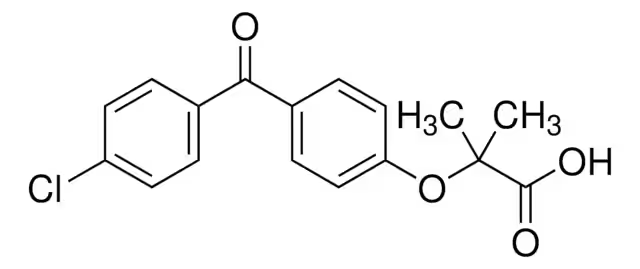
CAS Number42017-89-0
SynonymsProcetofenic acid; 2-(4'-(p-chlorobenzoyl)phenoxy)-2-methylpropionic acid; 2-[4-(4-Chlorobenzoyl)phenoxy]-2-methyl-propanoic acid; Fibricor; Fenofibric acid; 2-[4-(4-Chlorobenzoyl)phenoxy]-2-methylpropanoic acid; EINECS 255-626-9; MFCD00792461; 2-[4-(4-Chlorobenzoyl)phenoxy]-2-methylpropionic acid; 2-(4-(4-chlorobenzoyl)phenoxy)-2-methylpropanoic acid
Molecular FormulaC17H15ClO4
Molecular Weight318.75
Purity98.00%
Density1.3±0.1 g/cm3
Boiling Point486.5±35.0 °C at 760 mmHg
Melting Point176--179ºC
AppearanceWhite or almost white crystalline powder
| Chemical & Physical Properties | |
|---|---|
| CAS Number | 42017-89-0 |
| Catalog No. | 2A-9042894 |
| Chinese Name | 非诺贝特酸 |
| Synonyms | Procetofenic acid; 2-(4'-(p-chlorobenzoyl)phenoxy)-2-methylpropionic acid; 2-[4-(4-Chlorobenzoyl)phenoxy]-2-methyl-propanoic acid; Fibricor; Fenofibric acid; 2-[4-(4-Chlorobenzoyl)phenoxy]-2-methylpropanoic acid; EINECS 255-626-9; MFCD00792461; 2-[4-(4-Chlorobenzoyl)phenoxy]-2-methylpropionic acid; 2-(4-(4-chlorobenzoyl)phenoxy)-2-methylpropanoic acid |
| Molecular Formula | C17H15ClO4 |
| Molecular Weight | 318.75 |
| Purity | 98.00 |
| Density | 1.3±0.1 g/cm3 |
| Boiling Point | 486.5±35.0 °C at 760 mmHg |
| Melting Point | 176--179ºC |
| Appearance | White or almost white crystalline powder |
| Storage Condition | -20°C Freezer |
| Application | Fenofibric acid is the active metabolite of fenofibrate and is a PPAR agonist. The EC50 values for PPARα, PPARγ and PPARδ are 22.4 µM, 1.47 µM and 1.06 µM respectively. Fenofibric acid can also inhi |
| HTC | 2918990090 |
| PubChem ID | 143270 |
| SMILES | CC(C)(Oc1ccc(C(=O)c2ccc(Cl)cc2)cc1)C(=O)O |
| InChI | InChI=1S/C17H15ClO4/c1-17(2,16(20)21)22-14-9-5-12(6-10-14)15(19)11-3-7-13(18)8-4-11/h3-10H,1-2H3,(H,20,21) |
| InChI Key | MQOBSOSZFYZQOK-UHFFFAOYSA-N |
| Bioactivity | Fenofibric acid, an active metabolite of fenofibrate, is a PPAR activitor, with EC50s of 22.4 µM, 1.47 µM, and 1.06 µM for PPARα, PPARγ and PPARδ, respectively; Fenofibric acid also inhibits COX-2 enzyme activity, with an IC50 of 48 nM. Related Catalog Research Areas >> Metabolic Disease Target PPARδ:1.06 μM (EC50) PPARγ:1.47 μM (EC50) PPARα:22.4 μM (EC50) COX-2:48 μM (IC50) In Vitro Fenofibric acid is a PPAR activitor, with EC50s of 22.4 µM, 1.47 µM, and 1.06 µM for PPARα, PPARγ and PPARδ, respectively[1]. Fenofibric acid (10, 25, 50, 75, and 100 nM) dose-dependently inhibits COX-2 enzyme, with IC50 of 48 nM[2]. Fenofibric acid (500 nM) reduces abundance of AOX1 protein in HepG2 cells[3]. Fenofibric acid (100 µM) decreases JNK1/2, c-Jun, and p38 MAPK phosphorylation, and prevents the accumulation of reactive oxygen species, endoplasmic reticulum (ER) stress and disruption of blood retinal barrier (BRB) in response to the combination of high-glucose (HG) and hypoxia in ARPE-19 cells. Fenofibric acid (100 µM) activates IGF-IR/Akt/ERK1/2-mediated survival signaling pathways in ARPE-19 cells under HG conditions and hypoxia[4]. In Vivo Fenofibric acid (1, 5, 10 mg/kg, p.o.) shows anti-inflammatory activity in Wistar rats with acute inflammation induced by carrageenan[2]. Cell Assay ARPE-19 cells are cultured under normoglycemic (5.5 mM D-glucose) or hyperglycemic (25 mM D-glucose) conditions for 18 days at 37°C under 5% (v/v) CO2 in medium DMEM/F12 supplemented with 10% (v/v) fetal serum (FS) and penicillin/streptomycin. ARPE-19 cells are used and the media is changed every 3-4 days. The conditions tested are: (1) Control cells which are maintained in 5.5 mM D-glucose (normal glucose) for 18 days. (2) Cells cultured in 5.5 mM D-glucose treated with 100 µM Fenofibric acid for 72 h (days 16, 17, and 18; 1 application/day). (3) Cells cultured as in (1) or (2) and submitted to hypoxia (1% oxygen) for the last 6 or 24 h. (4) Cells maintained in 25 mM D-glucose (HG) for 18 days. (5) Cells cultured in 25 mM D-glucose treated with 100 µM Fenofibric acid for 72 h (days 16, 17, and 18; 1 application/day). (6)Cells cultured as in (4) or (5) and submitted to hypoxia (1% oxygen) for the last 6 or 24 h[4]. Animal Admin The anti-inflammatory activity of fenofibrate and its active metabolite fenofibric acid is assessed by injecting 0.1 mL of 1% carrageenan solution prepared in saline (sub-plantar) to the right hind paw of the rats. Rats are divided into 6 groups of six animals each. The first group serves as negative control and receives 1% tween-80 in distilled water, 10 mL/kg body mass. Group 2 and 3 receive a single dose of fenofibrate and standard drug diclofenac at 10 mg/kg body mass, whereas groups 4, 5, and 6 receive 3 doses of Fenofibric acid at 1, 5, and 10 mg/kg body mass, respectively. All the drugs are given orally using gavages 60 min before the injection of 0.1 mL of 1% carrageenan through sub-plantar route. The volume of oedema of test and control groups is measured using plethysmometer at 0, 1, 2, and 3 h after induction of inflammation[2]. References [1]. Dietz M, et al. Comparative molecular profiling of the PPARα/γ activator aleglitazar: PPAR selectivity, activity and interaction with cofactors. ChemMedChem. 2012 Jun;7(6):1101-11. [2]. Prasad GS, et al. Anti-inflammatory activity of anti-hyperlipidemic drug, fenofibrate, and its phase-I metabolite fenofibric acid: in silico, in vitro, and in vivo studies. Inflammopharmacology. 2017 Dec 13. [3]. Neumeier M, et al. Aldehyde oxidase 1 is highly abundant in hepatic steatosis and is downregulated by adiponectin and fenofibric acid in hepatocytes in vitro. Biochem Biophys Res Commun. 2006 Nov 24;350(3):731-5. Epub 2006 Sep 27. [4]. Miranda S, et al. Beneficial effects of fenofibrate in retinal pigment epithelium by the modulation of stress and survival signaling under diabetic conditions. J Cell Physiol. 2012 Jun;227(6):2352-62. Chemical & Physical Properties Density 1.3±0.1 g/cm3 Boiling Point 486.5±35.0 °C at 760 mmHg Melting Point 176--179ºC Molecular Formula C17H15ClO4 Molecular Weight 318.752 Flash Point 248.0±25.9 °C Exact Mass 318.065887 PSA 63.60000 LogP 3.86 Vapour Pressure 0.0±1.3 mmHg at 25°C Index of Refraction 1.585 InChIKey MQOBSOSZFYZQOK-UHFFFAOYSA-N SMILES CC(C)(Oc1ccc(C(=O)c2ccc(Cl)cc2)cc1)C(=O)O Storage condition -20°C Freezer |
| Use of | Fenofibric acid, an active metabolite of fenofibrate, is a PPAR activitor, with EC50s of 22.4 µM, 1.47 µM, and 1.06 µM for PPARα, PPARγ and PPARδ, respectively; Fenofibric acid also inhibits COX-2 enzyme activity, with an IC50 of 48 nM. Properties Name fenofibric acid Synonym More Synonyms Fenofibric acid Biological Activity Description Fenofibric acid, an active metabolite of fenofibrate, is a PPAR activitor, with EC50s of 22.4 µM, 1.47 µM, and 1.06 µM for PPARα, PPARγ and PPARδ, respectively; Fenofibric acid also inhibits COX-2 enzyme activity, with an IC50 of 48 nM. Related Catalog Research Areas >> Metabolic Disease PPARδ:1.06 μM (EC50) PPARγ:1.47 μM (EC50) PPARα:22.4 μM (EC50) COX-2:48 μM (IC50) References [1]. Dietz M, et al. Comparative molecular profiling of the PPARα/γ activator aleglitazar: PPAR selectivity, activity and interaction with cofactors. ChemMedChem. 2012 Jun;7(6):1101-11. [2]. Prasad GS, et al. Anti-inflammatory activity of anti-hyperlipidemic drug, fenofibrate, and its phase-I metabolite fenofibric acid: in silico, in vitro, and in vivo studies. Inflammopharmacology. 2017 Dec 13. [3]. Neumeier M, et al. Aldehyde oxidase 1 is highly abundant in hepatic steatosis and is downregulated by adiponectin and fenofibric acid in hepatocytes in vitro. Biochem Biophys Res Commun. 2006 Nov 24;350(3):731-5. Epub 2006 Sep 27. [4]. Miranda S, et al. Beneficial effects of fenofibrate in retinal pigment epithelium by the modulation of stress and survival signaling under diabetic conditions. J Cell Physiol. 2012 Jun;227(6):2352-62. Chemical & Physical Properties Exact Mass 318.065887 PSA 63.60000 Index of Refraction 1.585 InChIKey MQOBSOSZFYZQOK-UHFFFAOYSA-N |
| Tax Rebate | 13.0% |
| Supervision | None. MFN tariff: 6.5%. Ordinary tariff: 30.0% |
| Transport Info | Product name: Summary 2918990090. other carboxylic acids with additional oxygen function and their anhydrides, halides, peroxides and peroxyacids; their halogenated, sulphonated, nitrated or nitrosated derivatives. VAT:17.0%. Tax rebate rate:13.0%. . MFN tariff:6.5%. General tariff:30.0% |
| Related Products in Specialty Chemicals | ||
|---|---|---|
| Sodium tauroglycocholate | 41945-48-6 | 2A-9042883 |
| 2-(3,4-Dichlorophenyl)-2-oxoethylamine hydrochloride | 41995-19-1 | 2A-9042887 |
| 3,5-Dimethylpyridin-2-amine | 41995-30-6 | 2A-9042888 |
| N-Benzyloxycarbonyl-L-lysinyl-L-proline | 42001-60-5 | 2A-9042889 |
| 3,5-Diiodosalicyloyl chloride | 42016-91-1 | 2A-9042892 |
| 2-(Dimethylaminomethyl)-1-cyclohexanone hydrochloride | 42036-65-7 | 2A-9042896 |
| 3-(Methylamino)-1-propanol | 42055-15-2 | 2A-9042898 |
| Biphenyl-4-yl piperidin-4-yl methanone | 42060-83-3 | 2A-9042901 |
| 4-(4-Aminophenyl)-3-methyl-4-oxobutanoic acid | 42075-29-6 | 2A-9042902 |
| S-Methyl 2-methylthiobutyrate | 42075-45-6 | 2A-9042903 |
| Browse all Specialty Chemicals products » | ||
Phone:
630-322-8886
630-322-8887
Email:
Office Locations:
Chicago, IL, USA
San Francisco, CA, USA


 EN
EN


 SDS
SDS