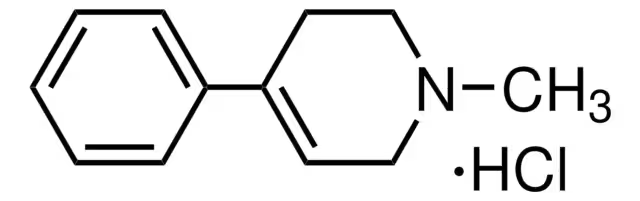
CAS Number23007-85-4
SynonymsMPTP Hydrochloride; 1-Methyl-4-phenyl-1,2,3,6-tetrahydropyridine hydrochloride; Pyridine, 1,2,3,6-tetrahydro-1-methyl-4-phenyl-, hydrochloride (1:1); Pyridine, 1,2,5,6-tetrahydro-1-methyl-4-phenyl-, hydrochloride; 1-Methyl-4-phenyl-1,2,3,6-tetrahydropyridineHydrochloride; 1-Methyl-4-phenyl-1,2,3,6-tetrahydropyridine hydrochloride (1:1); 1-Methyl-4-phenyl-1,2,5,6-tetrahydropyridine hydrochloride; 1-methyl-4-phenyl-3,6-dihydro-2H-pyridine,hydrochloride; 1-methyl-4-phenyl-1,2,3,6-tetrahydropyridinium chloride; MPTP (hydrochloride)
Molecular FormulaC12H16ClN
Molecular Weight209.72
Purity98.00%
Boiling Point258.6ºC at 760mmHg
Melting Point254 - 257 °C
Appearancepowder
Symbol
Signal WordWarning
| Chemical & Physical Properties | |
|---|---|
| CAS Number | 23007-85-4 |
| Catalog No. | 2A-9039138 |
| Chinese Name | 1-甲基-4-苯基-1,2,3,6-四氢吡啶盐酸盐 |
| Synonyms | MPTP Hydrochloride; 1-Methyl-4-phenyl-1,2,3,6-tetrahydropyridine hydrochloride; Pyridine, 1,2,3,6-tetrahydro-1-methyl-4-phenyl-, hydrochloride (1:1); Pyridine, 1,2,5,6-tetrahydro-1-methyl-4-phenyl-, hydrochloride; 1-Methyl-4-phenyl-1,2,3,6-tetrahydropyridineHydrochloride; 1-Methyl-4-phenyl-1,2,3,6-tetrahydropyridine hydrochloride (1:1); 1-Methyl-4-phenyl-1,2,5,6-tetrahydropyridine hydrochloride; 1-methyl-4-phenyl-3,6-dihydro-2H-pyridine,hydrochloride; 1-methyl-4-phenyl-1,2,3,6-tetrahydropyridinium chloride; MPTP (hydrochloride) |
| Molecular Formula | C12H16ClN |
| Molecular Weight | 209.72 |
| Purity | 98.00 |
| Boiling Point | 258.6ºC at 760mmHg |
| Melting Point | 254 - 257 °C |
| Appearance | powder |
| Storage Condition | Room temperature, dry, sealed |
| Packaging | III |
| Application | MPTP hydrochloride is a dopamine neurotoxin that can penetrate the blood-brain barrier and can induce Parkinson's syndrome. |
| HTC | 2933399090 |
| PubChem ID | 24896578 |
| MDL Number | MFCD00012790 |
| SMILES | Cl[H].CN1CCC(=CC1)c2ccccc2 |
| InChI | 1S/C12H15N.ClH/c1-13-9-7-12(8-10-13)11-5-3-2-4-6-11;/h2-7H,8-10H2,1H3;1H |
| InChI Key | KOWJANGMTAZWDT-UHFFFAOYSA-N |
| Beilstein/REAXYS | 3707312 |
| NACRES Code | NA.77 |
| UNSPSC | 12352200 |
| Hazard Symbols | 6.1(b) |
| MSDS | msds/39138_1_23007_85_4.pdf |
| Bioactivity | MPTP hydrochloride is a brain penetrant dopamine neurotoxin, inducing Parkinson's Disease. Related Catalog Signaling Pathways >> Others >> Others Research Areas >> Neurological Disease In Vitro Pretreatment with 50 mM 4-phenylpyridine, reduces IC50 (concentration for 50% inhibition of twitch amplitude) values of MPTP from 53 to 18 mM and d-tubocurarine from 0.7 to 0.3 mM, respectively, in mouse phrenic nerve-diaphragm[3]. In Vivo The toxic effect of MPTP can be completely abolished in vivo by treatment with a monoamine oxidase inhibitor and potentiated by an inhibitor of catechol-O-methyltransferase[1]. Allopurinol potentiated the MPTP (35 mg/kg)-induced decrease in the DOPAC+HVA/DA ratio and increase in striatal AA oxidation of the rat[2]. Gas1 expressions are significantly elevated in the majority of the reactive astrocytes of the brains with LPS or MPTP insults in animal models[4]. Animal Admin For the preparation of the LPS rat model and the MPTP mouse model, the treatments of the animals are performed. Briefly, adult rats receive unilateral injections of LPS (0.5 μL of 10 μg/μL diluted in 0.9% saline) into the medial forebrain bundle (MFB) at the following coordinates, AP-4.2 mm, L 1.5 mm, and V 7.8 mm, and into the contralateral side with the same volume of 0.9% saline. Adult mice are administered intraperitoneal injections of MPTP of 25 mg/kg per day for five continuous days, and the same volume of saline is injected as a control. All the animals are sacrificed at week 1, 2, 3, or 4 after the LPS or MPTP injections. The brain samples are collected for the subsequent immunohistochemistry and western blot experiments. References [1]. Langston J W, Irwin I. MPTP Neurotoxicity: An Overview and Characterization of Phases of Toxicity. II. Selective Accumulation of MPP in the Substantia Nigra: A Key to Neurotoxicity (Question). Life Sci., 1985, 36, No. 3, 201-12. [2]. Desole M S, et al. Further investigation of allopurinol effects on MPTP-induced oxidative stress in the striatum and brain stem of the rat. Source:Pharmacol.Biochem.Behav., 1996, 54, No. 2, 377-83. [3]. Hsu K S, et al. Potentiation of MPTP by 4-Phenylpyridine on the Neuromuscular Blockade in Mouse Phrenic Nerve-Diaphragm. Neuropharmacology, 1993, 32, No. 9, 877-83. [4]. Sun XL, et al. Gas1 up-regulation is inducible and contributes to cell apoptosis in reactive astrocytes in the substantia nigra of LPS and MPTP models. J Neuroinflammation. 2016 Jul 8;13(1):180. Chemical & Physical Properties Boiling Point 258.6ºC at 760mmHg Melting Point 254 - 257 °C Molecular Formula C12H16ClN Molecular Weight 209.715 Flash Point 105.8ºC Exact Mass 209.097122 PSA 3.24000 LogP 3.14540 Vapour Pressure 0.0136mmHg at 25°C InChIKey KOWJANGMTAZWDT-UHFFFAOYSA-N SMILES CN1CC=C(c2ccccc2)CC1.Cl |
| Use of | MPTP hydrochloride is a brain penetrant dopamine neurotoxin, inducing Parkinson's Disease. Properties Articles21 Name 1-Methyl-4-phenyl-1,2,3,6-tetrahydropyridine Hydrochloride Synonym More Synonyms 0MPTP hydrochloride Biological Activity Description MPTP hydrochloride is a brain penetrant dopamine neurotoxin, inducing Parkinson's Disease. Related Catalog Signaling Pathways >> Others >> Others Research Areas >> Neurological Disease References [1]. Langston J W, Irwin I. MPTP Neurotoxicity: An Overview and Characterization of Phases of Toxicity. II. Selective Accumulation of MPP in the Substantia Nigra: A Key to Neurotoxicity (Question). Life Sci., 1985, 36, No. 3, 201-12. [2]. Desole M S, et al. Further investigation of allopurinol effects on MPTP-induced oxidative stress in the striatum and brain stem of the rat. Source:Pharmacol.Biochem.Behav., 1996, 54, No. 2, 377-83. [3]. Hsu K S, et al. Potentiation of MPTP by 4-Phenylpyridine on the Neuromuscular Blockade in Mouse Phrenic Nerve-Diaphragm. Neuropharmacology, 1993, 32, No. 9, 877-83. [4]. Sun XL, et al. Gas1 up-regulation is inducible and contributes to cell apoptosis in reactive astrocytes in the substantia nigra of LPS and MPTP models. J Neuroinflammation. 2016 Jul 8;13(1):180. Chemical & Physical Properties Exact Mass 209.097122 PSA 3.24000 LogP 3.14540 InChIKey KOWJANGMTAZWDT-UHFFFAOYSA-N |
| Tax Rebate | 13.0% |
| Supervision | None. MFN tariff: 6.5%. Ordinary tariff: 20.0% |
| Transport Info | Shipping Name: UN |
| MSDS Transport Info | Module 14. Shipping information European Dangerous Regulations for land transport: 2811 International Dangerous Regulations for sea transport: 2811 International Dangerous Regulations for air transport: 2811 14.2 United Nations shipping name European Land Transport Dangerous Regulations: TOXIC SOLID, ORGANIC, N.O.S. (1-Methyl-4-phenyl-1,2,3,6-tetrahydropyridine hydrochloride) IMDG: TOXIC SOLID, ORGANIC, N.O.S. (1-Methyl-4-phenyl-1,2,3,6-tetrahydropyridine hydrochloride) International air transport hazard regulations: Toxic solid, organic, n.o.s. (1-Methyl-4-phenyl-1,2,3,6-tetrahydropyridine hydrochloride) 14.3 Transport hazard categories European Land Transport Danger Regulations: 6.1 International Maritime Transport Danger Regulations: 6.1 International Air Transport Danger Regulations: 6.1 14.4 Package group European Dangerous Regulations for land transport: II International Dangerous Regulations for sea transport: II International Dangerous Regulations for air transport: II 14.5 Environmental hazards European Land Transport Danger Regulations: No International Maritime Danger Regulations International Air Transport Danger Regulations: No Marine pollutants (yes/no): No 14.6 Special reminder to users No data available |
| Related Products in Pharmaceutical Intermediates | ||
|---|---|---|
| (S)-(+)-3,3-Dimethyl-2-butylamine | 22526-47-2 | 2A-9039019 |
| (1R,2R)-2-(Hydroxymethyl)-1-phenylcyclopropanecarboxylic acid | 22613-99-6 | 2A-9039040 |
| Dimethyl (R)-(+)-methylsuccinate | 22644-27-5 | 2A-9039046 |
| (R)-2-Methyl-1,4-butanediol | 22644-28-6 | 2A-9039047 |
| N-Cbz-3,4-dihydro-1H-isoquinolinecarboxylic acid | 22914-95-0 | 2A-9039105 |
| Ethyl 1-benzyl-1,2,3,6-tetrahydropyridine-4-carboxylate | 23019-62-7 | 2A-9039142 |
| Methyl 6-quinoxalinecarboxylate | 23088-23-5 | 2A-9039169 |
| 5-Bromo-2-methoxybenzenesulfonyl chloride | 23095-05-8 | 2A-9039172 |
| 3-Bromophenyl isocyanate | 23138-55-8 | 2A-9039185 |
| (R)-(-)-1-Benzyloxy-3-(p-tosyloxy)-2-propanol | 23214-66-6 | 2A-9039207 |
| Browse all Pharmaceutical Intermediates products » | ||
Phone:
630-322-8886
630-322-8887
Email:
Office Locations:
Chicago, IL, USA
San Francisco, CA, USA


 EN
EN


 SDS
SDS