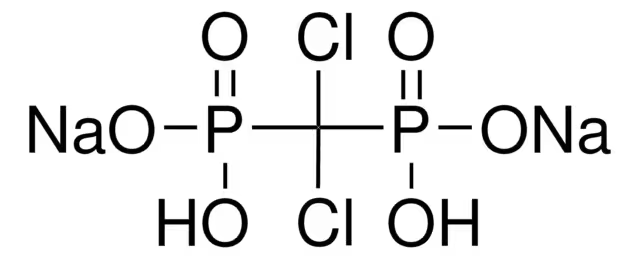
CAS Number22560-50-5
SynonymsClastoban; Clodronic acid disodium salt; Bonefos; UNII-Y05R4GCQ1H; (Dichloromethylene)diphosphonic acid,disodium salt; Phosphonic acid, (dichloromethylene)bis-, sodium salt (1:2); EINECS 245-078-9; MFCD01632786; Clasteon; Lytos; Ossiten; Sodium clodronate; disodium,[dichloro-[hydroxy(oxido)phosphoryl]methyl]-hydroxyphosphinate; Loron; Disodium Clodronate; Mebonat; Clodronate Disodium; Clodronic Acid, Disodium Salt, Hydrate; disodium (dichloromethanediyl)bis[hydrogen (phosphonate)]; Disodium (dichloromethylene)bis[hydrogen (phosphonate)]; Ostac; Dichloromethylenediphosphonic acid disodium salt
Molecular FormulaCH2O6Cl2Na2P2
Molecular Weight288.86
Purity98.00%
Density2.306g/cm3
Boiling Point474.7ºC at 760mmHg
Melting Point>330ºC
Appearancepowder
EINECS245-078-9
Symbol
Signal WordWarning
| Chemical & Physical Properties | |
|---|---|
| CAS Number | 22560-50-5 |
| Catalog No. | 2A-9039030 |
| Chinese Name | 氯屈膦酸二钠 |
| Synonyms | Clastoban; Clodronic acid disodium salt; Bonefos; UNII-Y05R4GCQ1H; (Dichloromethylene)diphosphonic acid,disodium salt; Phosphonic acid, (dichloromethylene)bis-, sodium salt (1:2); EINECS 245-078-9; MFCD01632786; Clasteon; Lytos; Ossiten; Sodium clodronate; disodium,[dichloro-[hydroxy(oxido)phosphoryl]methyl]-hydroxyphosphinate; Loron; Disodium Clodronate; Mebonat; Clodronate Disodium; Clodronic Acid, Disodium Salt, Hydrate; disodium (dichloromethanediyl)bis[hydrogen (phosphonate)]; Disodium (dichloromethylene)bis[hydrogen (phosphonate)]; Ostac; Dichloromethylenediphosphonic acid disodium salt |
| Molecular Formula | CH2O6Cl2Na2P2 |
| Molecular Weight | 288.86 |
| Purity | 98.00 |
| Density | 2.306g/cm3 |
| Boiling Point | 474.7ºC at 760mmHg |
| Melting Point | >330ºC |
| Appearance | powder |
| Storage Condition | -20°C Freezer |
| Application | Clodronic acid (Clodronate) disodium salt, a first-generation bisphosphonate, is an orally active inhibitor of osteoclastic bone resorption. Clodronic acid disodium salt can be used in high bone turno |
| EINECS | 245-078-9 |
| HTC | 2931900090 |
| PubChem ID | 24278371 |
| MDL Number | MFCD01632786 |
| SMILES | [Na+].[Na+].OP([O-])(=O)C(Cl)(Cl)P(O)([O-])=O |
| InChI | 1S/CH4Cl2O6P2.2Na/c2-1(3,10(4,5)6)11(7,8)9;;/h(H2,4,5,6)(H2,7,8,9);;/q;2*+1/p-2 |
| InChI Key | HJKBJIYDJLVSAO-UHFFFAOYSA-L |
| NACRES Code | NA.77 |
| UNSPSC | 12352106 |
| Hazard Symbols | transportation |
| MSDS | msds/39030_1_22560_50_5.pdf |
| Bioactivity | Clodronic acid (Clodronate) disodium salt, a first-generation bisphosphonate, is orally active osteoclastic bone resorption inhibitor. Clodronic acid disodium salt can be used in high bone turnover states, Paget's disease and osteolytic bone metastases[1][2][3]. Related Catalog Signaling Pathways >> Others >> Others Research Areas >> Inflammation/Immunology In Vitro Clodronic acid (Clodronate) disodium salt induces rapid apoptosis in osteoclasts by preventing translocation of ADP into mitochondria after being internalised via resorption. Consequently, ATP production is inhibited, leading to induction of apoptosis by means of release of cytochrome C into the cytoplasm[2]. In Vivo Clodronic acid (Clodronate) disodium salt (6.25-25 mg/kg; p.o.; daily for 28 days) slightly decreases the hindpaw swelling at doses of 12.5 and 25 mg/kg[3]. Animal Model: Male Lewis rats, aged 7 weeks[3] Dosage: 6.25, 12.5, and 25 mg/kg Administration: P.o.; daily for 28 days Result: Hindpaw swelling was significantly smaller than in adjuvant-arthritis (AA)-control at 25 mg/kg on days 21 and 28 (87 and 88% of AA-control, respectively) and at 12.5 mg/kg on day 28. References [1]. Mönkkönen J, et al. Clodronate (dichloromethylene bisphosphonate) inhibits LPS-stimulated IL-6 and TNF production by RAW 264 cells. Life Sci. 1994;54(14):PL229‐PL234. [2]. Tanakol R, et al. Clodronic acid in the treatment of postmenopausal osteoporosis. Clin Drug Investig. 2007;27(6):419‐433. [3]. Itoh F, et al. Effects of clodronate and alendronate on local and systemic changes in bone metabolism in rats with adjuvant arthritis. Inflammation. 2004;28(1):15‐21. Chemical & Physical Properties Density 2.306g/cm3 Boiling Point 474.7ºC at 760mmHg Melting Point >330ºC Molecular Formula CH2Cl2Na2O6P2 Molecular Weight 288.856 Flash Point 240.9ºC Exact Mass 287.849915 PSA 140.34000 LogP 1.30710 Vapour Pressure 2.55E-10mmHg at 25°C InChIKey HJKBJIYDJLVSAO-UHFFFAOYSA-J SMILES O=P([O-])([O-])C(Cl)(Cl)P(=O)([O-])[O-].[Na+].[Na+] Storage condition -20°C Freezer |
| Use of | Clodronic acid (Clodronate) disodium salt, a first-generation bisphosphonate, is orally active osteoclastic bone resorption inhibitor. Clodronic acid disodium salt can be used in high bone turnover states, Paget's disease and osteolytic bone metastases[1][2][3]. Properties Articles39 Name clodronic acid disodium salt Synonym More Synonyms Clodronate Disodium Biological Activity Description Clodronic acid (Clodronate) disodium salt, a first-generation bisphosphonate, is orally active osteoclastic bone resorption inhibitor. Clodronic acid disodium salt can be used in high bone turnover states, Paget's disease and osteolytic bone metastases[1][2][3]. Related Catalog Signaling Pathways >> Others >> Others Research Areas >> Inflammation/Immunology In Vitro Clodronic acid (Clodronate) disodium salt induces rapid apoptosis in osteoclasts by preventing translocation of ADP into mitochondria after being internalised via resorption. Consequently, ATP production is inhibited, leading to induction of apoptosis by means of release of cytochrome C into the cytoplasm[2]. References [2]. Tanakol R, et al. Clodronic acid in the treatment of postmenopausal osteoporosis. Clin Drug Investig. 2007;27(6):419‐433. [3]. Itoh F, et al. Effects of clodronate and alendronate on local and systemic changes in bone metabolism in rats with adjuvant arthritis. Inflammation. 2004;28(1):15‐21. Chemical & Physical Properties Exact Mass 287.849915 PSA 140.34000 LogP 1.30710 InChIKey HJKBJIYDJLVSAO-UHFFFAOYSA-J SMILES O=P([O-])([O-])C(Cl)(Cl)P(=O)([O-])[O-].[Na+].[Na+] |
| Tax Rebate | 13.0% |
| Supervision | AB (Inbound cargo customs clearance form) |
| Transport Info | Product name: Purity: 98.0% |
| MSDS Transport Info | Module 14. Shipping information 14.1 UN dangerous goods number European Land Transport Dangerous Regulations: -International Maritime Dangerous Regulations: -International Air Transport Dangerous Regulations: - 14.2 Names specified by the United Nations (UN) European Land Transport Dangerous Regulations: Non-dangerous goods IMDG Code: Non-dangerous goods International air transport dangerous goods regulations: non-dangerous goods 14.3 Transport hazard categories European Land Transport Dangerous Regulations: -International Maritime Dangerous Regulations: -International Air Transport Dangerous Regulations: - 14.4 Package group European Land Transport Dangerous Regulations: -International Maritime Dangerous Regulations: -International Air Transport Dangerous Regulations: - 14.5 Environmental hazards European Land Transport Dangerous Regulations: No International Maritime Transport Dangerous Regulations Maritime Pollutants: No International Air Transport Risk Regulations: No 14.6 Special reminder to users No data available |
| Related Products in Functional Building Blocks | ||
|---|---|---|
| 3-Amino-4-methylphenylboronic acid | 22237-12-3 | 2A-9038922 |
| 4-Ethoxyphenylboronic acid | 22237-13-4 | 2A-9038923 |
| 2,3,4-Trimethoxy-6-methylbenzaldehyde | 22383-85-3 | 2A-9038980 |
| 1,4-Dioxaspiro[4.5]decan-8-ol | 22428-87-1 | 2A-9038995 |
| 4-Bromo-2-hydroxybenzaldehyde | 22532-62-3 | 2A-9039020 |
| 3,3',4,4'-Biphenyltetracarboxylic acid | 22803-05-0 | 2A-9039075 |
| 2,4-Pyridinedialdoxime | 22866-50-8 | 2A-9039088 |
| 4-(DIFLUOROMETHOXY)-3-(CYCLOPROPYLMETHOXY)-BENZALDEHYDE | 151103-09-2 | 2A-9039097 |
| 2-(2-Bromoethyl)benzaldehyde | 22901-09-3 | 2A-9039101 |
| 3-Ethoxybenzaldehyde | 22924-15-8 | 2A-9039110 |
| Browse all Functional Building Blocks products » | ||
Phone:
630-322-8886
630-322-8887
Email:
Office Locations:
Chicago, IL, USA
San Francisco, CA, USA


 EN
EN


 SDS
SDS