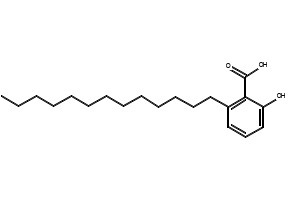
CAS Number20261-38-5
SynonymsBenzoic acid,2-hydroxy-6-tridecyl; 6-n-Tridecylsalicylic acid; 6-tridecyl anacardic acid; 2-Hydroxy-6-tridecylbenzoic acid,6-Tridecylsalicylic acid,Ginkgoneolic acid; Ginkgoneolic acid; 6-tridecylsalicylic acid; 2-Hydroxy-6-tridecylbenzoic acid; Ginkgolic Acid; 6-tridecyl phenol; Ginkgolic acid C13:0; Ginkgolic Acid (C13:0)
Molecular FormulaC20H32O3
Molecular Weight320.47
Purity98.00%
Density1.0±0.1 g/cm3
Boiling Point449.5±33.0 °C at 760 mmHg
Symbol
Signal WordWarning
| Chemical & Physical Properties | |
|---|---|
| CAS Number | 20261-38-5 |
| Catalog No. | 2A-9038347 |
| Chinese Name | 银杏酸C13:0 |
| Synonyms | Benzoic acid,2-hydroxy-6-tridecyl; 6-n-Tridecylsalicylic acid; 6-tridecyl anacardic acid; 2-Hydroxy-6-tridecylbenzoic acid,6-Tridecylsalicylic acid,Ginkgoneolic acid; Ginkgoneolic acid; 6-tridecylsalicylic acid; 2-Hydroxy-6-tridecylbenzoic acid; Ginkgolic Acid; 6-tridecyl phenol; Ginkgolic acid C13:0; Ginkgolic Acid (C13:0) |
| Molecular Formula | C20H32O3 |
| Molecular Weight | 320.47 |
| Purity | 98.00 |
| Density | 1.0±0.1 g/cm3 |
| Boiling Point | 449.5±33.0 °C at 760 mmHg |
| Storage Condition | 2-8°C |
| Application | Ginkgolic Acid C13:0 is a natural anti-caries drug with antibacterial activity. |
| HTC | 29163990 |
| MDL Number | C20H32O3 |
| SMILES | CCCCCCCCCCCCCc1cccc(O)c1C(=O)O |
| InChI | InChI=1S/C20H32O3/c1-2-3-4-5-6-7-8-9-10-11-12-14-17-15-13-16-18(21)19(17)20(22)23/h13,15-16,21H,2-12,14H2,1H3,(H,22,23) |
| InChI Key | VEPUCZUJLKAVNM-UHFFFAOYSA-N |
| Hazard Symbols | transportation |
| MSDS | msds/38347_1_20261_38_5.pdf |
| Bioactivity | Ginkgolic Acid (C13:0) is a natural anticariogenic agent in that it exhibits antimicrobial activity against S. mutans and suppresses the specific virulence factors associated with its cariogenicity.IC50 value: Inhibiting the biofilm formation of S. mutans (MBIC (50) = 4 μg/mL); reduced 1-day-developed biofilm of S. mutans by 50 % or more at low concentration (MBRC (50) = 32 μg/mL).Target:In vitro: Ginkgolic Acid (C13:0) inhibited not only the growth of S. mutans planktonic cells at minimum inhibitory concentration (MIC) of 4 μg/mL and minimum bactericidal concentration (MBC) of 8 μg/mL but also the acid production and adherence to saliva-coated hydroxyapatite of S. mutans at sub-MIC concentration. In addition, this agent was effective in inhibiting the biofilm formation of S. mutans (MBIC (50) = 4 μg/mL), and it reduced 1-day-developed biofilm of S. mutans by 50 % or more at low concentration (MBRC (50) = 32 μg/mL). Furthermore Ginkgolic Acid (C13:0) disrupted biofilm integrity effectively [1]. In vivo: Related Catalog Signaling Pathways >> Others >> Others References [1]. He J, et al. Effects of ginkgoneolic acid on the growth, acidogenicity, adherence, and biofilm of Streptococcus mutans in vitro. Folia Microbiol (Praha). 2013 Mar;58(2):147-53. Chemical & Physical Properties Density 1.0±0.1 g/cm3 Boiling Point 449.5±33.0 °C at 760 mmHg Molecular Formula C20H32O3 Molecular Weight 320.466 Flash Point 239.8±21.9 °C Exact Mass 320.235138 PSA 57.53000 LogP 8.90 Vapour Pressure 0.0±1.2 mmHg at 25°C Index of Refraction 1.519 InChIKey VEPUCZUJLKAVNM-UHFFFAOYSA-N SMILES CCCCCCCCCCCCCc1cccc(O)c1C(=O)O Storage condition 2-8°C |
| Use of | Ginkgolic Acid (C13:0) is a natural anticariogenic agent in that it exhibits antimicrobial activity against S. mutans and suppresses the specific virulence factors associated with its cariogenicity.IC50 value: Inhibiting the biofilm formation of S. mutans (MBIC (50) = 4 μg/mL); reduced 1-day-developed biofilm of S. mutans by 50 % or more at low concentration (MBRC (50) = 32 μg/mL).Target:In vitro: Ginkgolic Acid (C13:0) inhibited not only the growth of S. mutans planktonic cells at minimum inhibitory concentration (MIC) of 4 μg/mL and minimum bactericidal concentration (MBC) of 8 μg/mL but also the acid production and adherence to saliva-coated hydroxyapatite of S. mutans at sub-MIC concentration. In addition, this agent was effective in inhibiting the biofilm formation of S. mutans (MBIC (50) = 4 μg/mL), and it reduced 1-day-developed biofilm of S. mutans by 50 % or more at low concentration (MBRC (50) = 32 μg/mL). Furthermore Ginkgolic Acid (C13:0) disrupted biofilm integrity effectively [1]. In vivo: Properties Name 2-hydroxy-6-tridecylbenzoic acid Synonym More Synonyms Ginkgolic acid C13:0 Biological Activity Description Ginkgolic Acid (C13:0) is a natural anticariogenic agent in that it exhibits antimicrobial activity against S. mutans and suppresses the specific virulence factors associated with its cariogenicity.IC50 value: Inhibiting the biofilm formation of S. mutans (MBIC (50) = 4 μg/mL); reduced 1-day-developed biofilm of S. mutans by 50 % or more at low concentration (MBRC (50) = 32 μg/mL).Target:In vitro: Ginkgolic Acid (C13:0) inhibited not only the growth of S. mutans planktonic cells at minimum inhibitory concentration (MIC) of 4 μg/mL and minimum bactericidal concentration (MBC) of 8 μg/mL but also the acid production and adherence to saliva-coated hydroxyapatite of S. mutans at sub-MIC concentration. In addition, this agent was effective in inhibiting the biofilm formation of S. mutans (MBIC (50) = 4 μg/mL), and it reduced 1-day-developed biofilm of S. mutans by 50 % or more at low concentration (MBRC (50) = 32 μg/mL). Furthermore Ginkgolic Acid (C13:0) disrupted biofilm integrity effectively [1]. In vivo: Related Catalog Signaling Pathways >> Others >> Others References [1]. He J, et al. Effects of ginkgoneolic acid on the growth, acidogenicity, adherence, and biofilm of Streptococcus mutans in vitro. Folia Microbiol (Praha). 2013 Mar;58(2):147-53. Chemical & Physical Properties Molecular Formula C20H32O3 Exact Mass 320.235138 PSA 57.53000 Index of Refraction 1.519 InChIKey VEPUCZUJLKAVNM-UHFFFAOYSA-N |
| Transport Info | Product name: Purity: 98.0% |
| MSDS Transport Info | Module 14. Shipping information 14.1 UN dangerous goods number European Land Transport Dangerous Regulations: -International Maritime Dangerous Regulations: -International Air Transport Dangerous Regulations: - 14.2 Names specified by the United Nations (UN) European Land Transport Dangerous Regulations: Non-dangerous goods IMDG Code: Non-dangerous goods International air transport dangerous goods regulations: non-dangerous goods 14.3 Transport hazard categories European Land Transport Dangerous Regulations: -International Maritime Dangerous Regulations: -International Air Transport Dangerous Regulations: - 14.4 Package group European Land Transport Dangerous Regulations: -International Maritime Dangerous Regulations: -International Air Transport Dangerous Regulations: - 14.5 Environmental hazards European Land Transport Dangerous Regulations: No International Maritime Transport Dangerous Regulations Maritime Pollutants: No International Air Transport Risk Regulations: No 14.6 Special reminder to users No data available See reverse side of invoice or packing slip. |
| Related Products in Specialty Chemicals | ||
|---|---|---|
| Melamine polyphosphate | 20208-95-1 | 2A-9038335 |
| Tantalum (V) tetraethoxide 2,4-pentanedionate | 20219-33-4 | 2A-9038337 |
| 4-Amino-N-(3-(2-hydroxyethyl)sulfonylphenyl)benzamide | 20241-68-3 | 2A-9038342 |
| 2,4,4,6-Tetrabromo-2,5-cyclohexadienone | 20244-61-5 | 2A-9038344 |
| Nicotinoyl chloride hydrochloride | 20260-53-1 | 2A-9038346 |
| Reactive Orange 16 | 20262-58-2 | 2A-9038348 |
| 2-Methoxypyridin-3-amine | 20265-38-7 | 2A-9038351 |
| 4-Chlorobenzenamine hydrochloride | 20265-96-7 | 2A-9038353 |
| Sodium methanesulphinate | 20277-69-4 | 2A-9038356 |
| Butyl pyruvate | 20279-44-1 | 2A-9038357 |
| Browse all Specialty Chemicals products » | ||
Phone:
630-322-8886
630-322-8887
Email:
Office Locations:
Chicago, IL, USA
San Francisco, CA, USA


 EN
EN


 SDS
SDS