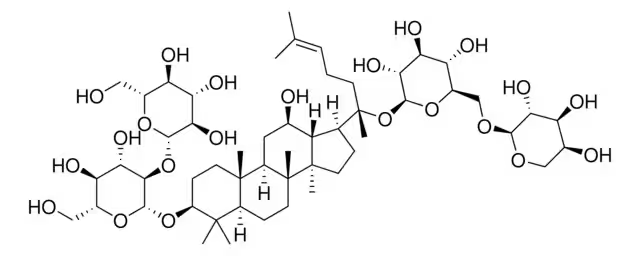
CAS Number11021-13-9
SynonymsGinsenosideRb2; GINSENOSIDE RB2; ginsenosidec; MFCD00221755; EINECS 234-251-4
Molecular FormulaC53H90O22
Molecular Weight1079.27
Purity98.00%
Density1.4±0.1 g/cm3
Boiling Point1117.1±65.0 °C at 760 mmHg
Melting Point197-199ºC
Appearancewhite powder
Symbol
Signal WordWarning
| Chemical & Physical Properties | |
|---|---|
| CAS Number | 11021-13-9 |
| Catalog No. | 2A-9034983 |
| Chinese Name | 人参皂苷Rb2 |
| Synonyms | GinsenosideRb2; GINSENOSIDE RB2; ginsenosidec; MFCD00221755; EINECS 234-251-4 |
| Molecular Formula | C53H90O22 |
| Molecular Weight | 1079.27 |
| Purity | 98.00 |
| Density | 1.4±0.1 g/cm3 |
| Boiling Point | 1117.1±65.0 °C at 760 mmHg |
| Melting Point | 197-199ºC |
| Appearance | white powder |
| Storage Condition | 2-8°C |
| Application | Ginsenoside Rb2 is one of the main bioactive components of ginseng extract. Ginsenoside Rb2 can upregulate GPR120 gene expression. |
| PubChem ID | 12013896 |
| SMILES | CC(C)=CCCC(C)(OC1OC(COC2OCC(O)C(O)C2O)C(O)C(O)C1O)C1CCC2(C)C1C(O)CC1C3(C)CCC(OC4OC(CO)C(O)C(O)C4OC4OC(CO)C(O)C(O)C4O)C(C)(C)C3CCC12C |
| InChI | InChI=1S/C53H90O22/c1-23(2)10-9-14-53(8,75-47-43(67)39(63)37(61)29(72-47)22-69-45-41(65)34(58)26(57)21-68-45)24-11-16-52(7)33(24)25(56)18-31-50(5)15-13-32(49(3,4)30(50)12-17-51(31,52)6)73-48-44(40(64)36(60)28(20-55)71-48)74-46-42(66)38(62)35(59)27(19-54)70-46/h10,24-48,54-67H,9,11-22H2,1-8H3/t24-,25+,26-,27+,28+,29+,30-,31+,32-,33-,34-,35+,36+,37+,38-,39?,40-,41+,42+,43+,44+,45-,46-,47-,48-,50-,51+,52+,53-/m0/s1 |
| InChI Key | NODILNFGTFIURN-GZPRDHCNSA-N |
| Hazard Symbols | transportation |
| Bioactivity | Ginsenoside Rb2 is one of the main bioactive components of ginseng extracts. Rb2 can upregulate GPR120 gene expression. Related Catalog Signaling Pathways >> GPCR/G Protein >> GPR120 Research Areas >> Inflammation/Immunology Natural Products >> Terpenoids and Glycosides Target GPR120[1] In Vitro Ginsenoside Rb2 pre-treatment enhances the anti-inflammatory effect of α-linolenic acid (ALA) and that the enhancing effect is strictly dependent on GPR120 activation. Ginsenoside Rb2 exerts anti-inflammatory effect in lipopolysaccharide (LPS)-stimulated mouse macrophage RAW264.7 cells in vitro by increasing GPR120 expression and subsequently enhancing ω-3 fatty acid-induced GPR120 activation. Ginsenoside Rb2 improves glucose metabolism in hepatocytes by activating AMPK and reduces cholesterol and triacylglycerol levels in 3T3-L1 cells by reducing oxidative damage. Ginsenoside Rb2 exerts anti-apoptosis effects in murine bone marrow-derived mesenchymal stem cells (BMMSCs). MTT assay results show no obvious cytotoxicity of Ginsenoside Rb2 (up to 100 μM) toward RAW264.7 cells in the absence or presence of ALA. The influence of Rb2 on GPR120 expression in RAW264.7 macrophages is investigated by treating the cells with Ginsenoside Rb2 (0.1-100 μM) for 12 h followed by harvesting and lysis. Subsequent Western blot analysis shows that expression of GPR120 is dose-dependently upregulated by Ginsenoside Rb2. Real-time PCR results indicate that incubation of RAW264.7 macrophages with Ginsenoside Rb2 (10 μM) for 12 h leads to a 2.8-fold increase in GPR120 mRNA expression. In addition, this increase in GPR120 expression stimulated by Ginsenoside Rb2 is time dependent and begins as early as 6 h. These results indicate that Rb2 upregulates GPR120 expression in a dose- and time-dependent manner in RAW264.7 macrophages[1]. In Vivo Ginsenoside Rb2 is an antiviral reagent to protect against rotavirus (RV) infection. When various dosages of Ginsenoside Rb2 (25 to 250 mg/kg) are administered 3, 2 or 1 days before virus challenge, treatment with this Ginsenoside at the dosage of 75 mg/kg 3 days before virus infection most effectively reduces rotavirus (RV) -induced diarrhea. In addition, consecutive administration of Ginsenoside Rb2 (75 mg/kg) 3, 2, and 1 day before virus infection is more effective than single administration on day-3. The consecutive administration of Ginsenoside Rb2 also reduces virus titers in the bowels of RV-infected mice[2]. Cell Assay Cell viability is determined using the MTT assay. RAW264.7 cells (2×10⁴ cells/well) are plated in 96-well plates and cultured overnight in growth medium. The cells are then incubated with Ginsenoside Rb2 (0.1, 1, 10 and 100 μM) at the indicated concentrations in the absence or presence of ALA for 48 h before addition of the MTT reagent (0.5 mg/mL). After incubation for 4 h, the medium is removed, and the formazan crystals formed are dissolved with 100 μL DMSO. Absorbance at a wavelength of 492 nm is measured using a FlexStation 3[1]. Animal Admin Mice[2] Groups of five BALB/c newborn mice are inoculated p.o. with RV-SA11 (1.5×10⁶ plaque-forming units (PFU)/mouse) and administered p.o. with the indicated doses of Ginsenoside Rb2 on the indicated days. In order to examine the protective effect of Ginsenoside Rb2 on RV infection, newborn mice are treated orally with 75 mg/kg of this Ginsenoside 3, 2 or 1 day before RV infection, and the severity of diarrhea of RV-infected mice i calculated. In addition, in an experiment in which various doses of Ginsenoside Rb2 ranging from 25 to 250 mg/kg are administered to mice 3 days before RV infection, Ginsenoside Rb2 at the dose of 75 mg/kg elicits higher protective activity compared to either of the dose of 25 to 250 mg/kg. References [1]. Huang Q, et al. Ginsenoside Rb2 enhances the anti-inflammatory effect of ω-3 fatty acid in LPS-stimulated RAW264.7 macrophages by upregulating GPR120 expression. Acta Pharmacol Sin. 2017 Feb;38(2):192-200. [2]. Yang H, et al. Ginsenoside-Rb2and 20(S)-Ginsenoside-Rg3 from Koreanred ginseng prevent rotavirus infection in newborn mice. J Microbiol Biotechnol. 2018 Jan 11. Chemical & Physical Properties Density 1.4±0.1 g/cm3 Boiling Point 1117.1±65.0 °C at 760 mmHg Melting Point 197-199ºC Molecular Formula C53H90O22 Molecular Weight 1079.269 Flash Point 629.4±34.3 °C Exact Mass 1078.592407 PSA 357.06000 LogP 4.73 Vapour Pressure 0.0±0.6 mmHg at 25°C Index of Refraction 1.622 InChIKey NODILNFGTFIURN-GZPRDHCNSA-N SMILES CC(C)=CCCC(C)(OC1OC(COC2OCC(O)C(O)C2O)C(O)C(O)C1O)C1CCC2(C)C1C(O)CC1C3(C)CCC(OC4OC(CO)C(O)C(O)C4OC4OC(CO)C(O)C(O)C4O)C(C)(C)C3CCC12C Storage condition 2-8°C |
| Use of | Properties Articles26 Name ginsenoside Rb2 Synonym More Synonyms Ginsenoside Rb2 Biological Activity Related Catalog Signaling Pathways >> GPCR/G Protein >> GPR120 Research Areas >> Inflammation/Immunology Natural Products >> Terpenoids and Glycosides References [2]. Yang H, et al. Ginsenoside-Rb2and 20(S)-Ginsenoside-Rg3 from Koreanred ginseng prevent rotavirus infection in newborn mice. J Microbiol Biotechnol. 2018 Jan 11. Chemical & Physical Properties Molecular Formula C53H90O22 Exact Mass 1078.592407 PSA 357.06000 Index of Refraction 1.622 InChIKey NODILNFGTFIURN-GZPRDHCNSA-N |
| Transport Info | Product name: Purity: 98.0% |
| MSDS Transport Info | Module 14. Shipping information 14.1 UN dangerous goods number European Land Transport Dangerous Regulations: -International Maritime Dangerous Regulations: -International Air Transport Dangerous Regulations: - 14.2 Names specified by the United Nations (UN) European Land Transport Dangerous Regulations: Non-dangerous goods IMDG Code: Non-dangerous goods International air transport dangerous goods regulations: non-dangerous goods 14.3 Transport hazard categories European Land Transport Dangerous Regulations: -International Maritime Dangerous Regulations: -International Air Transport Dangerous Regulations: - 14.4 Package group European Land Transport Dangerous Regulations: -International Maritime Dangerous Regulations: -International Air Transport Dangerous Regulations: - 14.5 Environmental hazards European Land Transport Dangerous Regulations: No International Maritime Transport Dangerous Regulations Maritime Pollutants: No International Air Transport Risk Regulations: No 14.6 Special reminder to users No data available See reverse side of invoice or packing slip. |
| Related Products in Botanical Reference Standards | ||
|---|---|---|
| 2-Hydroxybenzyl beta-D-glucopyranoside | 7724-09-6 | 2A-9033951 |
| Protopanaxadiol | 7755-01-3 | 2A-9033982 |
| Saponin | 8047-15-2 | 2A-9034333 |
| Phytosterols | 68441-03-2 | 2A-9034706 |
| Allyl-tetra-O-acetyl-beta-D-glucopyranoside | 10343-15-4 | 2A-9034807 |
| 2-Nitrophenyl 2-acetamido-2-deoxy-beta-D-glucopyranoside | 13264-92-1 | 2A-9035463 |
| Oleanolic acid beta-D-glucopyranosyl ester | 14162-53-9 | 2A-9036032 |
| Anthocyanin | 18466-51-8 | 2A-9036066 |
| Isochlorogenic acid B | 14534-61-3 | 2A-9036247 |
| Phenylethyl beta-D-galactopyranoside | 14861-16-6 | 2A-9036362 |
| Browse all Botanical Reference Standards products » | ||
Phone:
630-322-8886
630-322-8887
Email:
Office Locations:
Chicago, IL, USA
San Francisco, CA, USA


 EN
EN


 SDS
SDS