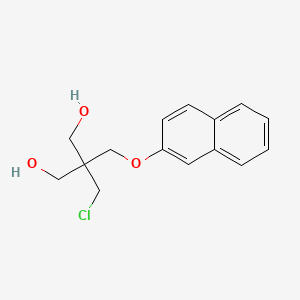
CAS Number9007-20-9
Synonyms2-(Chloromethyl)-2-[(2-naphthyloxy)methyl]-1,3-propanediol; poly(acrylic acid); Carbomer 940
Molecular FormulaC15H17O3Cl1
Molecular Weight280.75
Purity98.00%
Density1.3±0.1 g/cm3
Boiling Point502.0±45.0 °C at 760 mmHg
Melting Point12.5ºC
Appearancewhite loose powder
| Chemical & Physical Properties | |
|---|---|
| CAS Number | 9007-20-9 |
| Catalog No. | 2A-9034458 |
| Chinese Name | 卡波姆940 |
| Synonyms | 2-(Chloromethyl)-2-[(2-naphthyloxy)methyl]-1,3-propanediol; poly(acrylic acid); Carbomer 940 |
| Molecular Formula | C15H17O3Cl1 |
| Molecular Weight | 280.75 |
| Purity | 98.00 |
| Density | 1.3±0.1 g/cm3 |
| Boiling Point | 502.0±45.0 °C at 760 mmHg |
| Melting Point | 12.5ºC |
| Appearance | white loose powder |
| Storage Condition | Room temperature, dry, sealed |
| Application | Carbomer copolymers can be used as excipients, such as bioadhesives, emulsifiers, release modifiers, suspending agents, tablet binders, tackifiers, etc. Pharmaceutical excipients or pharmaceutical aux |
| HTC | 3906909090 |
| MDL Number | MFCD01698140 |
| SMILES | OCC(CO)(CCl)COc1ccc2ccccc2c1 |
| InChI | InChI=1S/C3H4O2/c1-2-3(4)5/h2H,1H2,(H,4,5) |
| InChI Key | PLZJMCNBPWEGNQ-UHFFFAOYSA-N |
| MSDS | msds/34458_1_9007_20_9.pdf |
| Bioactivity | Carbomer copolymer can be used as an excipient, such as Bioadhesives, emulsifiers, release modifiers, suspending agents, tablet binders, viscosity enhancers, etc. Pharmaceutical excipients, or pharmaceutical auxiliaries, refer to other chemical substances used in the pharmaceutical process other than pharmaceutical ingredients. Pharmaceutical excipients generally refer to inactive ingredients in pharmaceutical preparations, which can improve the stability, solubility and processability of pharmaceutical preparations. Pharmaceutical excipients also affect the absorption, distribution, metabolism, and elimination (ADME) processes of co-administered drugs[1]. Related Catalog Research Areas >> Others Signaling Pathways >> Others >> Others References [1]. Elder DP, et al. Pharmaceutical excipients - quality, regulatory and biopharmaceutical considerations. Eur J Pharm Sci. 2016 May 25;87:88-99. Chemical & Physical Properties Density 1.3±0.1 g/cm3 Boiling Point 502.0±45.0 °C at 760 mmHg Melting Point 12.5ºC Molecular Formula C3H4O2 Molecular Weight 280.747 Flash Point 257.4±28.7 °C Exact Mass 280.086609 PSA 37.30000 LogP 4.01 Vapour Pressure 0.0±1.4 mmHg at 25°C Index of Refraction 1.619 InChIKey PLZJMCNBPWEGNQ-UHFFFAOYSA-N SMILES OCC(CO)(CCl)COc1ccc2ccccc2c1 |
| Use of | Carbomer copolymer can be used as an excipient, such as Bioadhesives, emulsifiers, release modifiers, suspending agents, tablet binders, viscosity enhancers, etc. Pharmaceutical excipients, or pharmaceutical auxiliaries, refer to other chemical substances used in the pharmaceutical process other than pharmaceutical ingredients. Pharmaceutical excipients generally refer to inactive ingredients in pharmaceutical preparations, which can improve the stability, solubility and processability of pharmaceutical preparations. Pharmaceutical excipients also affect the absorption, distribution, metabolism, and elimination (ADME) processes of co-administered drugs[1]. Properties Name Carbomer Synonym More Synonyms POLY(ACRYLIC ACID) Biological Activity Description Carbomer copolymer can be used as an excipient, such as Bioadhesives, emulsifiers, release modifiers, suspending agents, tablet binders, viscosity enhancers, etc. Pharmaceutical excipients, or pharmaceutical auxiliaries, refer to other chemical substances used in the pharmaceutical process other than pharmaceutical ingredients. Pharmaceutical excipients generally refer to inactive ingredients in pharmaceutical preparations, which can improve the stability, solubility and processability of pharmaceutical preparations. Pharmaceutical excipients also affect the absorption, distribution, metabolism, and elimination (ADME) processes of co-administered drugs[1]. Related Catalog Research Areas >> Others Signaling Pathways >> Others >> Others References [1]. Elder DP, et al. Pharmaceutical excipients - quality, regulatory and biopharmaceutical considerations. Eur J Pharm Sci. 2016 May 25;87:88-99. Chemical & Physical Properties Molecular Formula C3H4O2 Exact Mass 280.086609 PSA 37.30000 Index of Refraction 1.619 InChIKey PLZJMCNBPWEGNQ-UHFFFAOYSA-N |
| Transport Info | Product Name: Carbomer |
| Related Products in Functional & Formulation | ||
|---|---|---|
| 2-Pentafluorophenoxyethanol | 2192-55-4 | 2A-9028123 |
| Ammonium lauryl sulfate | 2235-54-3 | 2A-9028196 |
| N,N-Diphenyl-p-phenylenediamine | 2350-01-8 | 2A-9028347 |
| Sodium methylparaben | 5026-62-0 | 2A-9031389 |
| N,N-Diethyl-p-phenylenediamine sulfate | 6283-63-2 | 2A-9032663 |
| p-Phenylenediamine sulfate | 16245-77-5 | 2A-9036843 |
| Acrylates copolymer | 25133-97-5 | 2A-9039649 |
| Glyceryl monostearate | 31566-31-1 | 2A-9040914 |
| Sodium propylparaben | 35285-69-9 | 2A-9041659 |
| Butylparaben sodium salt | 36457-20-2 | 2A-9041819 |
| Browse all Functional & Formulation products » | ||
Phone:
630-322-8886
630-322-8887
Email:
Office Locations:
Chicago, IL, USA
San Francisco, CA, USA


 EN
EN


 SDS
SDS