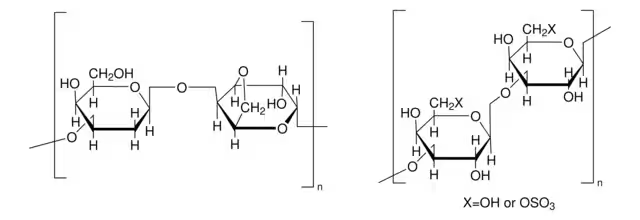
CAS Number9002-18-0
Synonyms4-(2-{4-Formyl-6-methyl-5-oxo-3-[(phosphonooxy)methyl]-2(5H)-pyridinylidene}hydrazino)benzoic acid; Agar (bacteriological); EINECS 232-658-1; MFCD00217113; Agar-Agar; Gelose; Agar Agar AGAR
Molecular Formula(C12H18O9)n
Molecular Weight336.33500
Purity98.00%
Melting Point85-95 °C
Appearanceshredded
EINECS232-658-1
Symbol
Signal WordWarning
| Chemical & Physical Properties | |
|---|---|
| CAS Number | 9002-18-0 |
| Catalog No. | 2A-9034383 |
| Chinese Name | 琼脂 |
| Synonyms | 4-(2-{4-Formyl-6-methyl-5-oxo-3-[(phosphonooxy)methyl]-2(5H)-pyridinylidene}hydrazino)benzoic acid; Agar (bacteriological); EINECS 232-658-1; MFCD00217113; Agar-Agar; Gelose; Agar Agar AGAR |
| Molecular Formula | (C12H18O9)n |
| Molecular Weight | 336.33500 |
| Purity | 98.00 |
| Melting Point | 85-95 °C |
| Appearance | shredded |
| Water Solubility | H2O: 1.5% with heat | SOLUBLE IN HOT WATER |
| Storage Condition | 1. Food-grade plastic bag coated with kraft paper |
| Application | Agar is a jelly-like substance containing agarose and agar gel. Agar can be isolated from the cell walls of red algal species such as Gelidium and Gracilaria (Ogonori). The gelling and melting of agar |
| EINECS | 232-658-1 |
| HTC | 13023100 |
| PubChem ID | 176259368 |
| SMILES | COC1C(O)C(CO)OC(OC2C3COC2C(O)C(C)O3)C1O |
| InChI | InChI=1S/C14H24O9/c1-5-8(16)13-11(7(21-5)4-20-13)23-14-10(18)12(19-2)9(17)6(3-15)22-14/h5-18H,3-4H2,1-2H3/t5?,6-,7?,8-,9+,10-,11?,12+,13+,14?/m1/s1 |
| InChI Key | GYYDPBCUIJTIBM-DYOGSRDZSA-N |
| Hazard Symbols | transportation |
| Safety Description | S24/25 |
| Bioactivity | Agar is a jelly like substance that contains agarose and agar gel. Agar can be isolated from the cell walls of red algae species such as Gelidium and Gracilaria (Ogonori). The gelation and melting of Agar is based on the hydrogen bridge (physical gels), so the gelation is reversible. Agar is widely used in food additives, plant tissue culture, microorganisms culture media, fingerprint recognition, and medical fields[1][2]. Related Catalog Research Areas >> Others In Vitro Preparation of sulfamethadiazole-loaded agar beads [3] (1) Dissolve 1.5 g agar in 20 mL water, heat until completely dissolved, and then cool to about 70°C. (2) Add 2 g of sulfamethadiazole to the suspension in (1), and use a 3 mL plastic syringe to drop the mixture into a 100 mL graduated cylinder containing Burgess reagent (the graduated cylinder is soaked in ice water). (3) After filtration, the beads were vacuum dried at room temperature (20°C) for 24 h. References [1]. Patel J, Soni D, Raol G, et al. Agar-Agar bioplastic synthesis and its characterization[J]. 2019. [2]. Armisen R, Gaiatas F. Agar[M]//Handbook of hydrocolloids. Woodhead Publishing, 2009: 82-107. [3]. Nakano M, et al. Sustained release of sulphamethizole from agar beads. J Pharm Pharmacol. 1979 Dec;31(12):869-72. Chemical & Physical Properties Melting Point 85-95 °C Molecular Formula C14H24O9 Molecular Weight 336.33500 Exact Mass 336.14200 PSA 127.07000 Appearance of Characters shredded InChIKey GYYDPBCUIJTIBM-DYOGSRDZSA-N SMILES COC1C(O)C(CO)OC(OC2C3COC2C(O)C(C)O3)C1O Storage condition BELOW +15°C Stability Stable. Incompatible with strong oxidizing agents. Water Solubility H2O: 1.5% with heat | SOLUBLE IN HOT WATER |
| Use of | Agar is a jelly like substance that contains agarose and agar gel. Agar can be isolated from the cell walls of red algae species such as Gelidium and Gracilaria (Ogonori). The gelation and melting of Agar is based on the hydrogen bridge (physical gels), so the gelation is reversible. Agar is widely used in food additives, plant tissue culture, microorganisms culture media, fingerprint recognition, and medical fields[1][2]. Properties Articles73 Name (2R,3S,4S,5R)-2-(hydroxymethyl)-6-[[(4R,5S)-4-hydroxy-3-methyl-2,6-dioxabicyclo[3.2.1]octan-8-yl]oxy]-4-methoxyoxane-3,5-diol Synonym More Synonyms Agar Biological Activity Description Agar is a jelly like substance that contains agarose and agar gel. Agar can be isolated from the cell walls of red algae species such as Gelidium and Gracilaria (Ogonori). The gelation and melting of Agar is based on the hydrogen bridge (physical gels), so the gelation is reversible. Agar is widely used in food additives, plant tissue culture, microorganisms culture media, fingerprint recognition, and medical fields[1][2]. Related Catalog Research Areas >> Others References [1]. Patel J, Soni D, Raol G, et al. Agar-Agar bioplastic synthesis and its characterization[J]. 2019. [2]. Armisen R, Gaiatas F. Agar[M]//Handbook of hydrocolloids. Woodhead Publishing, 2009: 82-107. [3]. Nakano M, et al. Sustained release of sulphamethizole from agar beads. J Pharm Pharmacol. 1979 Dec;31(12):869-72. Chemical & Physical Properties Molecular Formula C14H24O9 Exact Mass 336.14200 PSA 127.07000 Appearance of Characters shredded InChIKey GYYDPBCUIJTIBM-DYOGSRDZSA-N Stability Stable. Incompatible with strong oxidizing agents. Water Solubility H2O: 1.5% with heat | SOLUBLE IN HOT WATER |
| Transport Info | Product name: Purity: 0.0% |
| MSDS Transport Info | Module 14. Shipping information 14.1 UN dangerous goods number European Land Transport Dangerous Regulations: -International Maritime Dangerous Regulations: -International Air Transport Dangerous Regulations: - 14.2 Names specified by the United Nations (UN) European Land Transport Dangerous Regulations: Non-dangerous goods IMDG Code: Non-dangerous goods International air transport dangerous goods regulations: non-dangerous goods 14.3 Transport hazard categories European Land Transport Dangerous Regulations: -International Maritime Dangerous Regulations: -International Air Transport Dangerous Regulations: - 14.4 Package group European Land Transport Dangerous Regulations: -International Maritime Dangerous Regulations: -International Air Transport Dangerous Regulations: - 14.5 Environmental hazards European Land Transport Dangerous Regulations: No International Maritime Transport Dangerous Regulations Maritime Pollutants: No International Air Transport Risk Regulations: No 14.6 Special reminder to users No data available |
| Related Products in Food Additives | ||
|---|---|---|
| 5-Nitrovanillin | 6635-20-7 | 2A-9033048 |
| Lemongrass Oil | 8007-02-1 | 2A-9034244 |
| Guar gum | 9000-30-0 | 2A-9034353 |
| Apple Pectin | 9000-69-5 | 2A-0202077 |
| Gelatin | 9000-70-8 | 2A-9034360 |
| Carboxymethyl cellulose | 9004-32-4 | 2A-9034418 |
| Sodium alginate | 9005-38-3 | 2A-9034441 |
| Agarose | 9012-36-6 | 2A-9034475 |
| Pectinase | 9032-75-1 | 2A-9034491 |
| Amylopectin | 9037-22-3 | 2A-9034499 |
| Browse all Food Additives products » | ||
Phone:
630-322-8886
630-322-8887
Email:
Office Locations:
Chicago, IL, USA
San Francisco, CA, USA


 EN
EN


 SDS
SDS