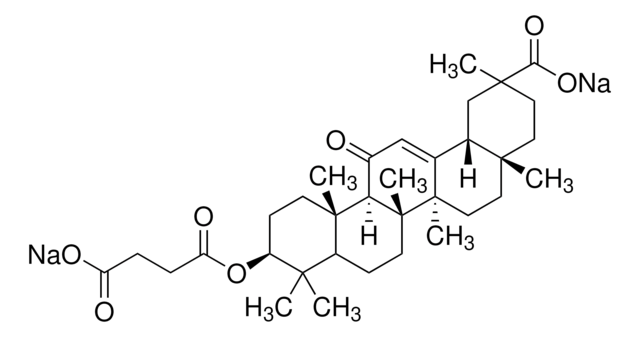
CAS Number7421-40-1
Synonymssodium carbenoxolone; pyrogastrone; CARBENOXOLONE SODIUM; EINECS 231-044-0; ulcus-tablinen; neogel; sanodin; Carbenoxolon-Dinatriumsalz; duogastrone; Carbenoxalone Sodium; carbenoxolone disodium; Biogastrone; MFCD00079043
Molecular FormulaC34H48O7Na2
Molecular Weight614.72
Purity≥98%
Boiling Point687.4ºC at 760 mmHg
Appearancepowder
EINECS231-044-0
| Chemical & Physical Properties | |
|---|---|
| CAS Number | 7421-40-1 |
| Catalog No. | 2A-9033645 |
| Chinese Name | 甘珀酸钠 |
| Synonyms | sodium carbenoxolone; pyrogastrone; CARBENOXOLONE SODIUM; EINECS 231-044-0; ulcus-tablinen; neogel; sanodin; Carbenoxolon-Dinatriumsalz; duogastrone; Carbenoxalone Sodium; carbenoxolone disodium; Biogastrone; MFCD00079043 |
| Molecular Formula | C34H48O7Na2 |
| Molecular Weight | 614.72 |
| Purity | ≥98 |
| Boiling Point | 687.4ºC at 760 mmHg |
| Appearance | powder |
| Storage Condition | Warehouse low temperature ventilation and drying |
| Application | Carbenoxolone disodium is the active metabolite of glycyrrhizic acid (HY-N0184) and an inhibitor of human 11β-HSD and bacterial 3α, 20β-HSD. Carbenoxolone disodium is an uncoupler of gap junctions and |
| EINECS | 231-044-0 |
| PubChem ID | 57654021 |
| MDL Number | MFCD00079043 |
| SMILES | [Na].[H][C@@]12C[C@](C)(CC[C@]1(C)CC[C@]3(C)C2=CC(=O)[C@]4([H])[C@@]5(C)CC[C@H](OC(=O)CCC(O)=O)C(C)(C)[C@]5([H])CC[C@@]34C)C(O)=O |
| InChI | 1S/C34H50O7.2Na/c1-29(2)23-10-13-34(7)27(32(23,5)12-11-24(29)41-26(38)9-8-25(36)37)22(35)18-20-21-19-31(4,28(39)40)15-14-30(21,3)16-17-33(20,34)6;;/h18,21,23-24,27H,8-17,19H2,1-7H3,(H,36,37)(H,39,40);;/q;2*+1/p-2/t21-,23?,24-,27+,30+,31?,32-,33+,34+;;/m0../s1 |
| InChI Key | BQENDLAVTKRQMS-FDPMUVMVSA-L |
| NACRES Code | NA.22 |
| UNSPSC | 12352108 |
| MSDS | msds/33645_1_7421_40_1.pdf |
| Bioactivity | Carbenoxolone disodium is the active metabolite of Glycyrrhizic acid (HY-N0184) and the inhibitor of human 11β-HSD and bacterial 3α, 20β-HSD[1]. Carbenoxolone disodium is an uncoupling agent for gap junctions and a potent inhibitor of Vaccinia virus replication[2]. Carbenoxolone disodium is used for the study of peptic, esophageal and oral ulceration and inflammation. Related Catalog Research Areas >> Infection Research Areas >> Inflammation/Immunology Signaling Pathways >> Cytoskeleton >> Gap Junction Protein Target IC50: human 11β-HSD; bacterial 3α, 20β-HSD[1]; gap junction; Vaccinia virus[2] In Vitro Carbenoxolone disodium (6-150 μM; pre-treatment 1 hour) inhibits Vaccinia virus (VACV) replication in a gap junction-independent in HaCaT cells, and it has toxicity effects on VACV-A5L-EGFP infected cells at 48 h[2]. Carbenoxolone (30 μM; pre-treatment 1 hour) does not upregulate PP2A expression, but induces the late protein A27 expression in hacat cells[2]. Cell Viability Assay[2] Cell Line: HaCaT cells Concentration: 6 μM, 12 μM, 30 μM, 60 μM, 150 μM Incubation Time: Pre-treatment 1 hour Result: Had no toxicity until 48 hours at high dose in virus-infected cells. Western Blot Analysis[2] Cell Line: HaCaT cells Concentration: 30 μM Incubation Time: Pre-treatment 1 hour Result: Presented an obvious upregulation of A27. In Vivo Carbenoxolone (intraperitoneal injection; 100, 200 and 300 mg/kg; 30, 60 and 60 min before Diazepam) does not induce a muscle relaxant activity and shows muscle relaxant activity compared to normal saline, and this effect was more than diazepam in the traction test[3]. Carbenoxolone (intraperitoneal injection; 100, 200 and 300 mg/kg; 30, 60 and 60 min before Pentylenetetrazole) significantly increases sleeping time and decreases latency in mice as a dose-dependent manner in Pentylenetetrazole (PTZ) Seizure model. The ED50 value is 83.3 mg/kg (%95 CL:556.29)[3]. Animal Model: Male BALB/c mice[3] Dosage: 100, 200 and 300 mg/kg Administration: Intraperitoneal injection; 30, 60 and 60 min before Pentylenetetrazole Result: Significantly increased the sleeping time in mice. References [1]. W L Duax, et al. Steroid Dehydrogenase Structures, Mechanism of Action, and Disease. Vitam Horm. 2000;58:121-48. [2]. Hossein Hosseinzadeh, et al. Anticonvulsant, Sedative and Muscle Relaxant Effects of Carbenoxolone in Mice. BMC Pharmacol. 2003 Apr 29;3:3. [3]. Ismar R Haga, et al. Carbenoxolone-mediated Cytotoxicity Inhibits Vaccinia Virus Replication in a Human Keratinocyte Cell Line. Sci Rep. 2018 Nov 16;8(1):16956. Chemical & Physical Properties Boiling Point 687.4ºC at 760 mmHg Molecular Formula C34H48Na2O7 Molecular Weight 614.72000 Flash Point 211.6ºC Exact Mass 614.32000 PSA 123.63000 LogP 4.15890 InChIKey BQENDLAVTKRQMS-UHFFFAOYSA-L SMILES CC1(C(=O)[O-])CCC2(C)CCC3(C)C(=CC(=O)C4C5(C)CCC(OC(=O)CCC(=O)[O-])C(C)(C)C5CCC43C)C2C1.[Na+].[Na+] |
| Use of | Carbenoxolone disodium is the active metabolite of Glycyrrhizic acid (HY-N0184) and the inhibitor of human 11β-HSD and bacterial 3α, 20β-HSD[1]. Carbenoxolone disodium is an uncoupling agent for gap junctions and a potent inhibitor of Vaccinia virus replication[2]. Carbenoxolone disodium is used for the study of peptic, esophageal and oral ulceration and inflammation. Properties Name Carbenoxolone disodium,(3β,20β)-3-(3-Carboxy-1-oxopropoxy)-11-oxoolean-12-en-29-oicaciddisodium Synonym More Synonyms Carbenoxolone disodium Biological Activity Description Carbenoxolone disodium is the active metabolite of Glycyrrhizic acid (HY-N0184) and the inhibitor of human 11β-HSD and bacterial 3α, 20β-HSD[1]. Carbenoxolone disodium is an uncoupling agent for gap junctions and a potent inhibitor of Vaccinia virus replication[2]. Carbenoxolone disodium is used for the study of peptic, esophageal and oral ulceration and inflammation. Related Catalog Research Areas >> Infection Research Areas >> Inflammation/Immunology Signaling Pathways >> Cytoskeleton >> Gap Junction Protein IC50: human 11β-HSD; bacterial 3α, 20β-HSD[1]; gap junction; Vaccinia virus[2] References [1]. W L Duax, et al. Steroid Dehydrogenase Structures, Mechanism of Action, and Disease. Vitam Horm. 2000;58:121-48. [2]. Hossein Hosseinzadeh, et al. Anticonvulsant, Sedative and Muscle Relaxant Effects of Carbenoxolone in Mice. BMC Pharmacol. 2003 Apr 29;3:3. [3]. Ismar R Haga, et al. Carbenoxolone-mediated Cytotoxicity Inhibits Vaccinia Virus Replication in a Human Keratinocyte Cell Line. Sci Rep. 2018 Nov 16;8(1):16956. Chemical & Physical Properties Molecular Formula C34H48Na2O7 Exact Mass 614.32000 PSA 123.63000 LogP 4.15890 InChIKey BQENDLAVTKRQMS-UHFFFAOYSA-L |
| Transport Info | Product Name: Carbenic acid disodium salt |
| Related Products in Specialty Chemicals | ||
|---|---|---|
| N-(2-Acetamido)iminodiacetic acid monosodium salt | 7415-22-7 | 2A-9033636 |
| Molindone | 7416-34-4 | 2A-9033639 |
| 2-Methoxyphenethyl alcohol | 7417-18-7 | 2A-9033640 |
| 3,5-Dimethoxyphenethyl alcohol | 7417-20-1 | 2A-9033641 |
| 3,4-Dimethoxyphenethyl alcohol | 7417-21-2 | 2A-9033642 |
| L-2-Hydroxyphenylalanine | 7423-92-9 | 2A-9033647 |
| DL-4-Chlorophenylalanine | 7424-00-2 | 2A-9033650 |
| Methyl Bromopyruvate | 7425-63-0 | 2A-9033651 |
| 2-(4-Methoxyphenyl)propan-2-ol | 7428-99-1 | 2A-9033652 |
| Sinapine thiocyanate | 7431-77-8 | 2A-9033654 |
| Browse all Specialty Chemicals products » | ||
Phone:
630-322-8886
630-322-8887
Email:
Office Locations:
Chicago, IL, USA
San Francisco, CA, USA


 EN
EN


 SDS
SDS