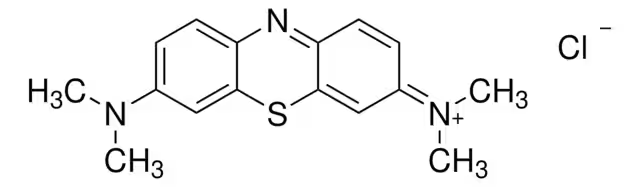
CAS Number7220-79-3
SynonymsPhenothiazinium, 3,7-bis(dimethylamino)-, chloride, hydrate (1:1:3); BASIC BLUE 9 HYDRATE; METHYLENE BLUE TS; Methylene Blue trihy; MFCD00150008; EINECS 200-515-2; 3,7-Bis(dimethylamino)phenothiazin-5-ium chloride hydrate (1:1:3); 3,7-bis(dimethylamino)phenothiazin-5-ium chloride hydrate(1:1:3); METHYLENE BLUE HYDRATE; Methylene Blue; 3,7-bis(dimethylamino)phenazathionium chloride trihydrate; Methylene Blue BB; 3,7-Bis(dimethylamino)phenothiazin-5-ium chloride trihydrate
Molecular FormulaC16H24ClN3O3S
Molecular Weight373.90
Purity98.00%
Density0.98 g/mL at 25 °C
Melting Point190 °C (dec.) (lit.)
Appearancepowder
Symbol
Signal WordWarning
| Chemical & Physical Properties | |
|---|---|
| CAS Number | 7220-79-3 |
| Catalog No. | 2A-9033500 |
| Chinese Name | 亚甲基蓝 |
| Synonyms | Phenothiazinium, 3,7-bis(dimethylamino)-, chloride, hydrate (1:1:3); BASIC BLUE 9 HYDRATE; METHYLENE BLUE TS; Methylene Blue trihy; MFCD00150008; EINECS 200-515-2; 3,7-Bis(dimethylamino)phenothiazin-5-ium chloride hydrate (1:1:3); 3,7-bis(dimethylamino)phenothiazin-5-ium chloride hydrate(1:1:3); METHYLENE BLUE HYDRATE; Methylene Blue; 3,7-bis(dimethylamino)phenazathionium chloride trihydrate; Methylene Blue BB; 3,7-Bis(dimethylamino)phenothiazin-5-ium chloride trihydrate |
| Molecular Formula | C16H24ClN3O3S |
| Molecular Weight | 373.90 |
| Purity | 98.00 |
| Density | 0.98 g/mL at 25 °C |
| Melting Point | 190 °C (dec.) (lit.) |
| Appearance | powder |
| Water Solubility | 4 g/100 mL |
| Storage Condition | Seal in a cool, dry place. |
| Application | Methylene blue trihydrate (C.I. Basic Blue 9 trihydrate) is an inhibitor of guanylyl cyclase (sGC), monoamine oxidase A (MAO-A) and NO synthase (NOS). Methylene blue trihydrate is a vasopressor common |
| MDL Number | MFCD00012111 |
| SMILES | [Cl-].CN(C)c1ccc2N=C3C=C\C(C=C3Sc2c1)=[N+](/C)C |
| InChI | 1S/C16H18N3S.ClH/c1-18(2)11-5-7-13-15(9-11)20-16-10-12(19(3)4)6-8-14(16)17-13;/h5-10H,1-4H3;1H/q+1;/p-1 |
| InChI Key | CXKWCBBOMKCUKX-UHFFFAOYSA-M |
| Beilstein/REAXYS | 3599847 |
| NACRES Code | NA.05 |
| UNSPSC | 12352107 |
| Hazard Symbols | 6.1 |
| MSDS | msds/33500_1_7220_79_3.pdf |
| Bioactivity | Methylene blue trihydrate (C.I. Basic Blue 9 trihydrate) is a guanylyl cyclase (sGC), monoamine oxidase A (MAO-A) and NO synthase (NOS) inhibitor. Methylene blue trihydrate is a vasopressor and is often used as a dye in several medical procedures. Methylene blue trihydrate has antinociception, antimalarial, antidepressant and anxiolytic activity effects. Methylene Blue trihydrate has the potential for methemoglobinemias, neurodegenerative disorders and ifosfamide-induced encephalopathytreatment[1][2][3]. Related Catalog Research Areas >> Cancer Research Areas >> Infection Signaling Pathways >> Immunology/Inflammation >> NO Synthase Signaling Pathways >> Neuronal Signaling >> Monoamine Oxidase Research Areas >> Neurological Disease Signaling Pathways >> GPCR/G Protein >> Guanylate Cyclase Target Guanylyl cyclase (sGC)[1]. Monoamine oxidase A (MAO-A)[1]. NO synthase (NOS)[1] In Vitro By acting as an alternative electron acceptor/donor Methylene blue restores mitochondrial function, improves neuronal energy production and inhibits the formation of superoxide[1]. Methylene blue inhibits cytochrome P450 (CYP) isozymes. Methylene blue is an odorless, water soluble, dark blue-green crystalline powder, which turns blue whenever mixed in solution. Methylene blue is a vasopressor that impacts the NO synthetic pathway by inhibiting inducible NOS and inhibiting the subsequent activation of sGC. In addition, by binding to the iron heme moiety of sGC and causing enzyme inhibition, Methylene blue blocks accumulation of cyclic GMP (cGMP), competing directly with NO in its ability to activate soluble guanylyl cyclase[3]. In Vivo Methylene Blue (1, 5, and 25 μg/rat) significantly decreases sevoflurane minimum alveolar anesthetic concentration (MAC) and brain cyclic guanosine monophosphate (cGMP) content in a dose-dependent manner in male Sprague-Dawley rats (7-week-old, 200-250 g)[2]. Methylene blue is used as a dye in chromoendoscopy, and is sprayed onto the mucosa of the gastrointestinal tract in order to identify dysplasia, or pre-cancerous lesions[2]. Methylene blue is able to restore vascular tone, normalize mean arterial pressures (MAP), and reduce vasopressor usage[3]. References [1]. Delport A, et al. Methylene blue and its analogues as antidepressant compounds. Metab Brain Dis. 2017 Oct;32(5):1357-1382. [2]. Masaki E, et al. Methylene blue, a soluble guanylyl cyclase inhibitor, reduces the sevoflurane minimum alveolar anesthetic concentration and decreases the brain cyclic guanosine monophosphate content in rats. Anesth Analg. 1999 Aug;89(2):484-9. [3]. McCartney SL, et al. Intraoperative vasoplegia: methylene blue to the rescue! Curr Opin Anaesthesiol. 2018 Feb;31(1):43-49. Chemical & Physical Properties Density 0.98 g/mL at 25 °C Melting Point 190 °C (dec.)(lit.) Molecular Formula C16H24ClN3O3S Molecular Weight 373.898 Flash Point 14 °C Exact Mass 373.122681 PSA 75.07000 InChIKey XQAXGZLFSSPBMK-UHFFFAOYSA-M SMILES CN(C)c1ccc2nc3ccc(=[N+](C)C)cc-3sc2c1.O.O.O.[Cl-] Storage condition Store at RT. Stability Stable. Incompatible with bases, reducing agents, strong oxidizing agents. Water Solubility 4 g/100 mL |
| Use of | Methylene blue trihydrate (C.I. Basic Blue 9 trihydrate) is a guanylyl cyclase (sGC), monoamine oxidase A (MAO-A) and NO synthase (NOS) inhibitor. Methylene blue trihydrate is a vasopressor and is often used as a dye in several medical procedures. Methylene blue trihydrate has antinociception, antimalarial, antidepressant and anxiolytic activity effects. Methylene Blue trihydrate has the potential for methemoglobinemias, neurodegenerative disorders and ifosfamide-induced encephalopathytreatment[1][2][3]. Properties Articles211 Name Methylene Blue trihydrate Synonym More Synonyms Methylene Blue trihydrate Biological Activity Description Methylene blue trihydrate (C.I. Basic Blue 9 trihydrate) is a guanylyl cyclase (sGC), monoamine oxidase A (MAO-A) and NO synthase (NOS) inhibitor. Methylene blue trihydrate is a vasopressor and is often used as a dye in several medical procedures. Methylene blue trihydrate has antinociception, antimalarial, antidepressant and anxiolytic activity effects. Methylene Blue trihydrate has the potential for methemoglobinemias, neurodegenerative disorders and ifosfamide-induced encephalopathytreatment[1][2][3]. Related Catalog Research Areas >> Cancer Research Areas >> Infection Signaling Pathways >> Immunology/Inflammation >> NO Synthase Signaling Pathways >> Neuronal Signaling >> Monoamine Oxidase Research Areas >> Neurological Disease Signaling Pathways >> GPCR/G Protein >> Guanylate Cyclase Guanylyl cyclase (sGC)[1]. Monoamine oxidase A (MAO-A)[1]. NO synthase (NOS)[1] In Vitro By acting as an alternative electron acceptor/donor Methylene blue restores mitochondrial function, improves neuronal energy production and inhibits the formation of superoxide[1]. Methylene blue inhibits cytochrome P450 (CYP) isozymes. Methylene blue is an odorless, water soluble, dark blue-green crystalline powder, which turns blue whenever mixed in solution. Methylene blue is a vasopressor that impacts the NO synthetic pathway by inhibiting inducible NOS and inhibiting the subsequent activation of sGC. In addition, by binding to the iron heme moiety of sGC and causing enzyme inhibition, Methylene blue blocks accumulation of cyclic GMP (cGMP), competing directly with NO in its ability to activate soluble guanylyl cyclase[3]. References [1]. Delport A, et al. Methylene blue and its analogues as antidepressant compounds. Metab Brain Dis. 2017 Oct;32(5):1357-1382. [2]. Masaki E, et al. Methylene blue, a soluble guanylyl cyclase inhibitor, reduces the sevoflurane minimum alveolar anesthetic concentration and decreases the brain cyclic guanosine monophosphate content in rats. Anesth Analg. 1999 Aug;89(2):484-9. [3]. McCartney SL, et al. Intraoperative vasoplegia: methylene blue to the rescue! Curr Opin Anaesthesiol. 2018 Feb;31(1):43-49. Chemical & Physical Properties Exact Mass 373.122681 PSA 75.07000 InChIKey XQAXGZLFSSPBMK-UHFFFAOYSA-M Storage condition Store at RT. Stability Stable. Incompatible with bases, reducing agents, strong oxidizing agents. |
| Transport Info | Product name: Purity: 98.0% |
| MSDS Transport Info | Module 14. Shipping information 14.1 UN number European Land Transport Danger Regulations: 1170 International Maritime Transport Danger Regulations: 1170 International Air Transport Danger Regulations: 1170 14.2 Names specified by the United Nations (UN) European Land Transport Danger Regulations: ETHANOL SOLUTION International Maritime Dangerous Regulations: ETHANOL SOLUTION International Air Transport Danger Regulations: Ethanol solution 14.3 Transport hazard categories European land transport Dangerous Regulations: 3 International sea transport Dangerous Regulations: 3 International air transport Dangerous Regulations: 3 14.4 Package group European Dangerous Regulations for land transport: II International Dangerous Regulations for sea transport: II International Dangerous Regulations for air transport: II 14.5 Environmental hazards European Land Transport Dangerous Regulations: No International Maritime Transport Dangerous Regulations Maritime Pollutants: No International Air Transport Risk Regulations: No 14.6 Special precautions for users No data available |
| Related Products in Pigments & Additives | ||
|---|---|---|
| Acid Red 106 | 6844-74-2 | 2A-9033182 |
| Pigment Red 175 | 6985-92-8 | 2A-9033335 |
| Pigment Red 171 | 6985-95-1 | 2A-9033336 |
| Pigment Brown 25 | 6992-11-6 | 2A-9033341 |
| Solvent Blue 59 | 6994-46-3 | 2A-9033344 |
| Solvent Yellow 114 | 7576-65-0 | 2A-9033808 |
| Pigment Red 48:1 | 7585-41-3 | 2A-9033814 |
| Solvent Yellow 33 | 8003-22-3 | 2A-9034215 |
| Direct Yellow 44 | 8005-52-5 | 2A-9034222 |
| Calcium phosphate monobasic | 10031-30-8 | 2A-9034566 |
| Browse all Pigments & Additives products » | ||
Phone:
630-322-8886
630-322-8887
Email:
Office Locations:
Chicago, IL, USA
San Francisco, CA, USA


 EN
EN


 SDS
SDS