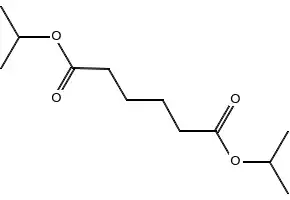
CAS Number6938-94-9
SynonymsHexanedioic acid, bis(1-methylethyl) ester; MFCD00026391; Diisopropyl adipate; bis(1-methylethyl) hexanedioate; Adipic acid diisopropyl ester; Adipic acid isopropyl ester; Adipic acid, diisopropyl ester; Diisopropyl hexanedioate; Isopropyl adipate; EINECS 230-072-0
Molecular FormulaC12H22O4
Molecular Weight230.30
Purity98.00%
Density1.0±0.1 g/cm3
Boiling Point252.6±8.0 °C at 760 mmHg
Melting Point-1 °C
AppearanceLiquid;Colorless to Almost colorless clear liquid
Symbol
Signal WordWarning
| Chemical & Physical Properties | |
|---|---|
| CAS Number | 6938-94-9 |
| Catalog No. | 2A-9033260 |
| Chinese Name | 己二酸二异丙酯 |
| Synonyms | Hexanedioic acid, bis(1-methylethyl) ester; MFCD00026391; Diisopropyl adipate; bis(1-methylethyl) hexanedioate; Adipic acid diisopropyl ester; Adipic acid isopropyl ester; Adipic acid, diisopropyl ester; Diisopropyl hexanedioate; Isopropyl adipate; EINECS 230-072-0 |
| Molecular Formula | C12H22O4 |
| Molecular Weight | 230.30 |
| Purity | 98.00 |
| Density | 1.0±0.1 g/cm3 |
| Boiling Point | 252.6±8.0 °C at 760 mmHg |
| Melting Point | -1 °C |
| Appearance | Liquid;Colorless to Almost colorless clear liquid |
| Storage Condition | room temperature |
| Application | Diisopropyl adipate is an alternative plasticizer and TRPA1 activator. Diisopropyl adipate activates TRPA1 and enhances FITC-induced contact hypersensitivity (CHS). Diisopropyl adipate is also an ingr |
| HTC | 2917120090 |
| SMILES | CC(C)OC(=O)CCCCC(=O)OC(C)C |
| InChI | InChI=1S/C12H22O4/c1-9(2)15-11(13)7-5-6-8-12(14)16-10(3)4/h9-10H,5-8H2,1-4H3 |
| InChI Key | ZDQWESQEGGJUCH-UHFFFAOYSA-N |
| Hazard Symbols | transportation |
| MSDS | msds/33260_1_6938_94_9.pdf |
| Bioactivity | Diisopropyl adipate is an alternative plasticizer and a TRPA1 activator. Diisopropyl adipate activates TRPA1 and enhances FITC-induced contact hypersensitivity (CHS).Diisopropyl adipate also serves as an ingredient in cosmetics and drug formulations topically applied to the skin. Diisopropyl adipate can be used as an excipient, such as emollients, plasticizers. Pharmaceutical excipients, or pharmaceutical auxiliaries, refer to other chemical substances used in the pharmaceutical process other than pharmaceutical ingredients. Pharmaceutical excipients generally refer to inactive ingredients in pharmaceutical preparations, which can improve the stability, solubility and processability of pharmaceutical preparations. Pharmaceutical excipients also affect the absorption, distribution, metabolism, and elimination (ADME) processes of co-administered drugs[1][2]. Related Catalog Signaling Pathways >> Membrane Transporter/Ion Channel >> TRP Channel Research Areas >> Others References [1]. Kurohane K, et al. Adjuvant Effect of an Alternative Plasticizer, Diisopropyl Adipate, on a Contact Hypersensitivity Mouse Model: Link with Sensory Ion Channel TRPA1 Activation. Biol Pharm Bull. 2015;38(7):1054-62. [2]. Elder DP, et al. Pharmaceutical excipients - quality, regulatory and biopharmaceutical considerations. Eur J Pharm Sci. 2016 May 25;87:88-99. Chemical & Physical Properties Density 1.0±0.1 g/cm3 Boiling Point 252.6±8.0 °C at 760 mmHg Melting Point -1 °C Molecular Formula C12H22O4 Molecular Weight 230.30 Flash Point 109.8±16.9 °C Exact Mass 230.151810 PSA 52.60000 LogP 2.79 Vapour Pressure 0.0±0.5 mmHg at 25°C Index of Refraction 1.435 InChIKey ZDQWESQEGGJUCH-UHFFFAOYSA-N SMILES CC(C)OC(=O)CCCCC(=O)OC(C)C |
| Use of | Diisopropyl adipate is an alternative plasticizer and a TRPA1 activator. Diisopropyl adipate activates TRPA1 and enhances FITC-induced contact hypersensitivity (CHS).Diisopropyl adipate also serves as an ingredient in cosmetics and drug formulations topically applied to the skin. Diisopropyl adipate can be used as an excipient, such as emollients, plasticizers. Pharmaceutical excipients, or pharmaceutical auxiliaries, refer to other chemical substances used in the pharmaceutical process other than pharmaceutical ingredients. Pharmaceutical excipients generally refer to inactive ingredients in pharmaceutical preparations, which can improve the stability, solubility and processability of pharmaceutical preparations. Pharmaceutical excipients also affect the absorption, distribution, metabolism, and elimination (ADME) processes of co-administered drugs[1][2]. Properties Name Adipic Acid Diisopropyl Ester Synonym More Synonyms Isopropyl adipate Biological Activity Description Diisopropyl adipate is an alternative plasticizer and a TRPA1 activator. Diisopropyl adipate activates TRPA1 and enhances FITC-induced contact hypersensitivity (CHS).Diisopropyl adipate also serves as an ingredient in cosmetics and drug formulations topically applied to the skin. Diisopropyl adipate can be used as an excipient, such as emollients, plasticizers. Pharmaceutical excipients, or pharmaceutical auxiliaries, refer to other chemical substances used in the pharmaceutical process other than pharmaceutical ingredients. Pharmaceutical excipients generally refer to inactive ingredients in pharmaceutical preparations, which can improve the stability, solubility and processability of pharmaceutical preparations. Pharmaceutical excipients also affect the absorption, distribution, metabolism, and elimination (ADME) processes of co-administered drugs[1][2]. Related Catalog Signaling Pathways >> Membrane Transporter/Ion Channel >> TRP Channel Research Areas >> Others References [2]. Elder DP, et al. Pharmaceutical excipients - quality, regulatory and biopharmaceutical considerations. Eur J Pharm Sci. 2016 May 25;87:88-99. Chemical & Physical Properties Molecular Formula C12H22O4 Exact Mass 230.151810 PSA 52.60000 Index of Refraction 1.435 InChIKey ZDQWESQEGGJUCH-UHFFFAOYSA-N SMILES CC(C)OC(=O)CCCCC(=O)OC(C)C |
| Tax Rebate | 13.0% |
| Supervision | A. Customs clearance form for inbound goods B. Customs clearance form for outbound goods |
| Inspection | R. Hygiene supervision and inspection of imported food S. Hygiene supervision and inspection of exported food |
| Transport Info | Product name: Purity: 99.0% |
| MSDS Transport Info | Module 14. Shipping information 14.1 UN dangerous goods number European Land Transport Dangerous Regulations: -International Maritime Dangerous Regulations: -International Air Transport Dangerous Regulations: - 14.2 Names specified by the United Nations (UN) European Land Transport Dangerous Regulations: Non-dangerous goods IMDG Code: Non-dangerous goods International air transport dangerous goods regulations: non-dangerous goods 14.3 Transport hazard categories European Land Transport Dangerous Regulations: -International Maritime Dangerous Regulations: -International Air Transport Dangerous Regulations: - 14.4 Package group European Land Transport Dangerous Regulations: -International Maritime Dangerous Regulations: -International Air Transport Dangerous Regulations: - 14.5 Environmental hazards European Land Transport Dangerous Regulations: No International Maritime Transport Dangerous Regulations Maritime Pollutants: No International Air Transport Risk Regulations: No 14.6 Special reminder to users No data available |
| Related Products in Specialty Chemicals | ||
|---|---|---|
| 4-Amino-2-methylbenzoic acid methyl ester | 6933-47-7 | 2A-9033252 |
| Clorprenaline hydrochloride | 6933-90-0 | 2A-9033253 |
| cis-2-Aminocyclohexanol hydrochloride | 6936-47-6 | 2A-9033255 |
| Ethyl 4-aminobutyrate hydrochloride | 6937-16-2 | 2A-9033257 |
| 1-Bromodocosane | 6938-66-5 | 2A-9033258 |
| N-tert-Butylglycine hydrochloride | 6939-23-7 | 2A-9033261 |
| 3-Bromophthalide | 6940-49-4 | 2A-9033264 |
| 4-Chloro-2,5-dimethoxynitrobenzene | 6940-53-0 | 2A-9033266 |
| 4-Bromophthalimide | 6941-75-9 | 2A-9033269 |
| Methyl 2-bromo-5-nitrobenzoate | 6942-36-5 | 2A-9033270 |
| Browse all Specialty Chemicals products » | ||
Phone:
630-322-8886
630-322-8887
Email:
Office Locations:
Chicago, IL, USA
San Francisco, CA, USA


 EN
EN


 SDS
SDS