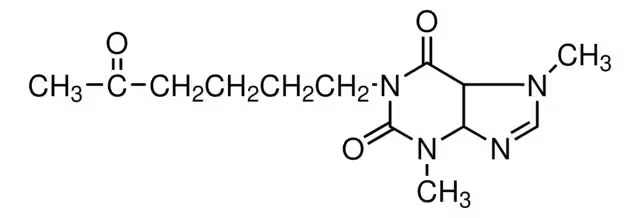
CAS Number6493-05-6
SynonymsAzupentat; 3,7-dimethyl-1-(5-oxohexyl)purine-2,6-dione; 3,7-Dimethyl-1-(5-oxohexyl)-3,7-dihydro-1H-purine-2,6-dione; EINECS 229-374-5; Durapental; Agapurin Retard; Trental; Pentoxifylline; PTX; Rentylin; Pentoxil; MFCD00063379; Oxpentifylline
Molecular FormulaC13H18N4O3
Molecular Weight278.31
Purity98.00%
Density1.3±0.1 g/cm3
Boiling Point531.3±56.0 °C at 760 mmHg
Melting Point98-100°C
Appearancesolid
EINECS229-374-5
| Chemical & Physical Properties | |
|---|---|
| CAS Number | 6493-05-6 |
| Catalog No. | 2A-9032943 |
| Chinese Name | 己酮可可碱 |
| Synonyms | Azupentat; 3,7-dimethyl-1-(5-oxohexyl)purine-2,6-dione; 3,7-Dimethyl-1-(5-oxohexyl)-3,7-dihydro-1H-purine-2,6-dione; EINECS 229-374-5; Durapental; Agapurin Retard; Trental; Pentoxifylline; PTX; Rentylin; Pentoxil; MFCD00063379; Oxpentifylline |
| Molecular Formula | C13H18N4O3 |
| Molecular Weight | 278.31 |
| Purity | 98.00 |
| Density | 1.3±0.1 g/cm3 |
| Boiling Point | 531.3±56.0 °C at 760 mmHg |
| Melting Point | 98-100°C |
| Appearance | solid |
| Water Solubility | H2O: ≥43 mg/mL |
| Storage Condition | Store at RT |
| Application | Pentoxifylline is a competitive non-selective phosphodiesterase (PDE) inhibitor. |
| EINECS | 229-374-5 |
| HTC | 2933990090 |
| PubChem ID | 24278190 |
| MDL Number | MFCD00063379 |
| SMILES | CN1C=NC2C1C(=O)N(CCCCC(C)=O)C(=O)N2C |
| InChI | 1S/C13H20N4O3/c1-9(18)6-4-5-7-17-12(19)10-11(14-8-15(10)2)16(3)13(17)20/h8,10-11H,4-7H2,1-3H3 |
| InChI Key | MQGNNJQTNFHNHK-UHFFFAOYSA-N |
| NACRES Code | NA.77 |
| UNSPSC | 41106305 |
| MSDS | msds/32943_1_6493_05_6.pdf |
| Bioactivity | Pentoxifylline is a competitive nonselective phosphodiesterase inhibitor.Target: PDEPentoxifylline is a competitive nonselective phosphodiesterase inhibitor which raises intracellular cAMP, activates PKA, inhibits TNF and leukotriene synthesis, and reduces inflammation and innate immunity. In addition, pentoxifylline improves red blood cell deformability, reduces blood viscosity and decreases the potential for platelet aggregation and thrombus formation. Pentoxifylline is also an antagonist at adenosine 2 receptors [1]. Pentoxifylline is generally well tolerated. Based on the totality of the available evidence, it is possible that pentoxifylline could have a place in the treatment of IC as a means of improving walking distance and as a complimentary treatment assuming all other essential measures such as lifestyle change, exercise and treatment for secondary prevention have been taken into account [2]. Pentoxifylline reduce AST and ALT levels and may improve liver histological scores in patients with NALFD/NASH, but did not appear to affect cytokines. Large, prospective, and well-designed randomized, controlled studies are needed to address this issue [3]. Related Catalog Signaling Pathways >> Autophagy >> Autophagy Signaling Pathways >> Metabolic Enzyme/Protease >> Phosphodiesterase (PDE) Research Areas >> Cardiovascular Disease References [1]. http://en.wikipedia.org/wiki/Pentoxifylline [2]. Salhiyyah, K., et al., Pentoxifylline for intermittent claudication. Cochrane Database Syst Rev, 2012. 1: p. CD005262. [3]. Li, W., et al., Systematic review on the treatment of pentoxifylline in patients with non-alcoholic fatty liver disease. Lipids Health Dis, 2011. 10: p. 49. Chemical & Physical Properties Density 1.3±0.1 g/cm3 Boiling Point 531.3±56.0 °C at 760 mmHg Melting Point 98-100°C Molecular Formula C13H18N4O3 Molecular Weight 278.307 Flash Point 275.1±31.8 °C Exact Mass 278.137878 PSA 78.89000 LogP 0.32 Vapour Pressure 0.0±1.4 mmHg at 25°C Index of Refraction 1.621 InChIKey BYPFEZZEUUWMEJ-UHFFFAOYSA-N SMILES CC(=O)CCCCn1c(=O)c2c(ncn2C)n(C)c1=O Storage condition Store at RT Water Solubility H2O: ≥43 mg/mL |
| Use of | Pentoxifylline is a competitive nonselective phosphodiesterase inhibitor.Target: PDEPentoxifylline is a competitive nonselective phosphodiesterase inhibitor which raises intracellular cAMP, activates PKA, inhibits TNF and leukotriene synthesis, and reduces inflammation and innate immunity. In addition, pentoxifylline improves red blood cell deformability, reduces blood viscosity and decreases the potential for platelet aggregation and thrombus formation. Pentoxifylline is also an antagonist at adenosine 2 receptors [1]. Pentoxifylline is generally well tolerated. Based on the totality of the available evidence, it is possible that pentoxifylline could have a place in the treatment of IC as a means of improving walking distance and as a complimentary treatment assuming all other essential measures such as lifestyle change, exercise and treatment for secondary prevention have been taken into account [2]. Pentoxifylline reduce AST and ALT levels and may improve liver histological scores in patients with NALFD/NASH, but did not appear to affect cytokines. Large, prospective, and well-designed randomized, controlled studies are needed to address this issue [3]. Properties Articles53 Name Pentoxifylline Synonym More Synonyms Pentoxifylline Biological Activity Description Pentoxifylline is a competitive nonselective phosphodiesterase inhibitor.Target: PDEPentoxifylline is a competitive nonselective phosphodiesterase inhibitor which raises intracellular cAMP, activates PKA, inhibits TNF and leukotriene synthesis, and reduces inflammation and innate immunity. In addition, pentoxifylline improves red blood cell deformability, reduces blood viscosity and decreases the potential for platelet aggregation and thrombus formation. Pentoxifylline is also an antagonist at adenosine 2 receptors [1]. Pentoxifylline is generally well tolerated. Based on the totality of the available evidence, it is possible that pentoxifylline could have a place in the treatment of IC as a means of improving walking distance and as a complimentary treatment assuming all other essential measures such as lifestyle change, exercise and treatment for secondary prevention have been taken into account [2]. Pentoxifylline reduce AST and ALT levels and may improve liver histological scores in patients with NALFD/NASH, but did not appear to affect cytokines. Large, prospective, and well-designed randomized, controlled studies are needed to address this issue [3]. Related Catalog Signaling Pathways >> Autophagy >> Autophagy Signaling Pathways >> Metabolic Enzyme/Protease >> Phosphodiesterase (PDE) Research Areas >> Cardiovascular Disease References [1]. http://en.wikipedia.org/wiki/Pentoxifylline [2]. Salhiyyah, K., et al., Pentoxifylline for intermittent claudication. Cochrane Database Syst Rev, 2012. 1: p. CD005262. [3]. Li, W., et al., Systematic review on the treatment of pentoxifylline in patients with non-alcoholic fatty liver disease. Lipids Health Dis, 2011. 10: p. 49. Chemical & Physical Properties Molecular Formula C13H18N4O3 Exact Mass 278.137878 PSA 78.89000 Index of Refraction 1.621 InChIKey BYPFEZZEUUWMEJ-UHFFFAOYSA-N Storage condition Store at RT |
| Tax Rebate | 13.0% |
| Supervision | None. MFN tariff: 6.5%. Ordinary tariff: 20.0% |
| Transport Info | Product name: Purity: 98.0% |
| MSDS Transport Info | Module 14. Shipping information United Nations classification: inconsistent with United Nations classification standards UN number: not specified |
| Related Products in Specialty Chemicals | ||
|---|---|---|
| L(-)-Carvone | 6485-40-1 | 2A-9032934 |
| L-Phenylglycinamide | 6485-52-5 | 2A-9032935 |
| D(-)-Phenylglycinamide | 6485-67-2 | 2A-9032937 |
| Triisopropylsilane | 6485-79-6 | 2A-9032938 |
| Potassium oxalate monohydrate | 6487-48-5 | 2A-9032941 |
| 2-Methoxy-6,7,8,9-tetrahydrobenzocyclohepten-5-one | 6500-65-8 | 2A-9032948 |
| 3,5,6-Trichloro-2-pyridinol | 6515-38-4 | 2A-9032954 |
| Ethyl 2-methoxy-6-methylbenzoate | 6520-83-8 | 2A-9032956 |
| 4-Methylphenethyl bromide | 6529-51-7 | 2A-9032960 |
| 4-Chlorophenethyl bromide | 6529-53-9 | 2A-9032961 |
| Browse all Specialty Chemicals products » | ||
Phone:
630-322-8886
630-322-8887
Email:
Office Locations:
Chicago, IL, USA
San Francisco, CA, USA


 EN
EN


 SDS
SDS