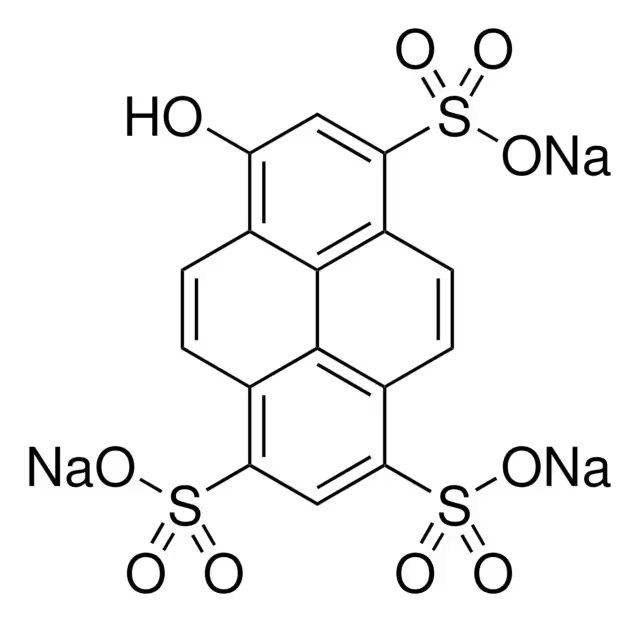
CAS Number6358-69-6
SynonymsTrisodium 8-hydroxy-1,3,6-pyrenetrisulfonate; Solvent Green 7; trisodium,8-hydroxypyrene-1,3,6-trisulfonate; EINECS 228-783-6; 1,3,6-Pyrenetrisulfonic acid, 8-hydroxy-, sodium salt (1:3); MFCD00037575; trisodium 8-hydroxypyrene-1,3,6-trisulfonate
Molecular FormulaC16H7Na3O10S3
Molecular Weight524.39
Purity≥96%
Density2.15
Boiling Point171-178 °C10 mm Hg(lit.)
Melting Point>300 °C (lit.)
AppearanceYellow to green-yellow powder
EINECS228-783-6
| Chemical & Physical Properties | |
|---|---|
| CAS Number | 6358-69-6 |
| Catalog No. | 2A-9032798 |
| Chinese Name | 8-羟基-1,3,6-芘三磺酸三钠 |
| Synonyms | Trisodium 8-hydroxy-1,3,6-pyrenetrisulfonate; Solvent Green 7; trisodium,8-hydroxypyrene-1,3,6-trisulfonate; EINECS 228-783-6; 1,3,6-Pyrenetrisulfonic acid, 8-hydroxy-, sodium salt (1:3); MFCD00037575; trisodium 8-hydroxypyrene-1,3,6-trisulfonate |
| Molecular Formula | C16H7Na3O10S3 |
| Molecular Weight | 524.39 |
| Purity | ≥96 |
| Density | 2.15 |
| Boiling Point | 171-178 °C10 mm Hg(lit.) |
| Melting Point | >300 °C (lit.) |
| Appearance | Yellow to green-yellow powder |
| Water Solubility | 300 g/L (25 ºC) |
| Storage Condition | Avoid light, keep in a cool and dry place, sealed |
| Application | Pyranine is a pH-sensitive fluorescent probe. |
| EINECS | 228-783-6 |
| HTC | 3204170000 |
| PubChem ID | 57654236 |
| MDL Number | MFCD00037575 |
| SMILES | [Na+].[Na+].[Na+].Oc1cc(c2ccc3c(cc(c4ccc1c2c34)S([O-])(=O)=O)S([O-])(=O)=O)S([O-])(=O)=O |
| InChI | 1S/C16H10O10S3.3Na/c17-11-5-12(27(18,19)20)8-3-4-10-14(29(24,25)26)6-13(28(21,22)23)9-2-1-7(11)15(8)16(9)10;;;/h1-6,17H,(H,18,19,20)(H,21,22,23)(H,24,25,26);;;/q;3*+1/p-3 |
| InChI Key | KXXXUIKPSVVSAW-UHFFFAOYSA-K |
| Beilstein/REAXYS | 4107272 |
| NACRES Code | NA.22 |
| UNSPSC | 12352100 |
| MSDS | msds/32798_1_6358_69_6.pdf |
| Bioactivity | Pyranine as a new class of fluorescent chemosensor for the Cu+ ion is reported. Related Catalog Signaling Pathways >> Others >> Others Dye Reagents Research Areas >> Others In Vitro Pyranine is capable of discriminating ranges of cations from the Cu+ ion, even in competing environment. Pyranine displays a rapid fluorescence response (t1/2=1.66 min) towards the Cu+ ion, and the micromolar detection limit enables the detection of the ion in environmental samples. The observed stoichiometry of complexation between Pyranine and Cu+ is 2:1[1]. The pH-sensitive fluorescent indicator Pyranine is studied to determine its usefulness as probes for the living cornea and anterior chamber. Pyranine has properties which render it almost ideally suited for this purpose. Adequate concentrations are reached in the cornea and anterior chamber after topical administration; measurements can be made by fluorophotometry for many hours. The pH is calculated by measuring the ratio of fluorescent intensity at two excitation wavelengths, I463/I404, a measurement which is dependent on pH but independent of the concentration of the fluorophore and other variables which can alter the intensity. In the rabbit eye, Pyranine in the cornea and anterior chamber is observed to undergo easily measurable changes in fluorescent ratios associated with lid closure and contact lens wear, indicating its sensitivity to mild changes in pH[2]. Pyranine (Py) is a fluorescence probe[3]. Cell Assay PAAm-κC composite gels are prepared by free-radical copolymerization using 0.71 g of AAm, 0.01 g of BIS (N, N'-methylenebisacrylamide), 0.008 g of APS (ammonium persulfate) and 2 µl of TEMED (tetramethylethylenediamine) are dissolved in 5 mL of distilled water (pH 6.5) by heating. The heated mixture solution is held at 80°C. Then different amounts of κ-carrageenan (0.5, 1, 1.5, 2, 2.5 and 3 (w/v) % κC) are added. Pyranine (Py) is used in the PAAm-κC composites as a fluorescence probe, which is a derivative of pyrene possessing three SO3- groups, which can form bonds with positive charges on the gel. Pyranine (Py) concentration is kept constant at 4×10⁻⁴ M, for all experiments. The solution is stirred (200 rpm) for 15 min to achieve a homogenous sample solution. All samples are deoxygenated by bubbling nitrogen for 10 min just before the polymerization process. The drying and swelling experiments of disc-shaped PAAm-κC composite gels prepared are performed in air and in water, respectively, at various temperatures (30, 40, 50, and 60°C). A model LS-50 spectrometer equipped with a temperature controller is used for fluorescence intensity measurements, which are made at a 90° position and spectral bandwidths are kept at 5 nm. Disc-shaped gel samples are placed on the wall of a 1-cm path-length square quartz cell filled with air and/or water for the drying and swelling experiments[3]. References [1]. Saha T, et al. In vitro sensing of Cu(+) through a green fluorescence rise of pyranine. Photochem Photobiol Sci. 2014 Oct;13(10):1427-33. [2]. Thomas JV, et al. The fluorescent indicator pyranine is suitable for measuring stromal and cameral pH in vivo. Exp Eye Res. 1990 Mar;50(3):241-9. [3]. Evingür GA, et al. Kinetic models for the dynamical behavior of polyacrylamide (PAAm)-κ-carrageenan (κC) composite gels. J Biol Phys. 2015 Jan;41(1):37-47. Chemical & Physical Properties Density 2.15 Boiling Point 171-178 °C10 mm Hg(lit.) Melting Point 62-63.5 °C(lit.) Molecular Formula C16H7Na3O10S3 Molecular Weight 524.385 Flash Point 250 °C Exact Mass 523.889465 PSA 216.97000 LogP 4.24430 InChIKey KXXXUIKPSVVSAW-UHFFFAOYSA-K SMILES O=S(=O)([O-])c1cc(O)c2ccc3c(S(=O)(=O)[O-])cc(S(=O)(=O)[O-])c4ccc1c2c34.[Na+].[Na+].[Na+] Water Solubility 300 g/L (25 ºC) |
| Use of | Pyranine as a new class of fluorescent chemosensor for the Cu+ ion is reported. Properties Articles41 Name pyranine Synonym More Synonyms Solvent Green 7 Biological Activity Description Pyranine as a new class of fluorescent chemosensor for the Cu+ ion is reported. Related Catalog Signaling Pathways >> Others >> Others Dye Reagents Research Areas >> Others References [1]. Saha T, et al. In vitro sensing of Cu(+) through a green fluorescence rise of pyranine. Photochem Photobiol Sci. 2014 Oct;13(10):1427-33. [2]. Thomas JV, et al. The fluorescent indicator pyranine is suitable for measuring stromal and cameral pH in vivo. Exp Eye Res. 1990 Mar;50(3):241-9. [3]. Evingür GA, et al. Kinetic models for the dynamical behavior of polyacrylamide (PAAm)-κ-carrageenan (κC) composite gels. J Biol Phys. 2015 Jan;41(1):37-47. Chemical & Physical Properties Molecular Formula C16H7Na3O10S3 Exact Mass 523.889465 PSA 216.97000 LogP 4.24430 InChIKey KXXXUIKPSVVSAW-UHFFFAOYSA-K |
| Tax Rebate | 9.0% |
| Supervision | None MFN tariff: 5.5% Ordinary tariff: 30.0% |
| Transport Info | Product name: Purity: 98.0% |
| MSDS Transport Info | Module 14. Shipping information United Nations classification: inconsistent with United Nations classification standards UN number: not specified |
| Related Products in Specialty Chemicals | ||
|---|---|---|
| 4,4-Diethoxybutylamine | 6346-09-4 | 2A-9032785 |
| 4,6-Dihydroxynaphthalene-2-sulphonic acid | 6357-93-3 | 2A-9032786 |
| 2-Amino-4-chloro-5-nitrophenol | 6358-02-7 | 2A-9032787 |
| 2-Chloro-5-aminophenol | 6358-06-1 | 2A-9032788 |
| 2,5-Dimethoxy-4-chloroaniline | 6358-64-1 | 2A-9032797 |
| Mordant Red 15 | 6359-29-1 | 2A-9032802 |
| Mordant Green 26 | 6359-73-5 | 2A-9032803 |
| Mordant Yellow 8 | 6359-83-7 | 2A-9032805 |
| Mordant Orange 3 | 6359-86-0 | 2A-9032806 |
| 6-Acetamido-4-hydroxynaphthalene-2-sulphonic acid | 6361-41-7 | 2A-9032809 |
| Browse all Specialty Chemicals products » | ||
Phone:
630-322-8886
630-322-8887
Email:
Office Locations:
Chicago, IL, USA
San Francisco, CA, USA


 EN
EN


 SDS
SDS