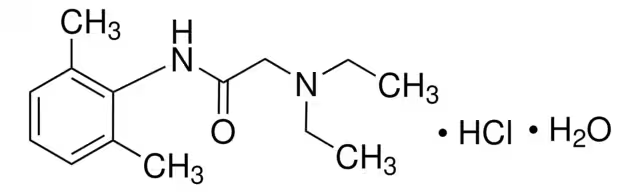
CAS Number6108-05-0
Synonyms2-(diéthylamino)-N-(2,6-diméthylphényl)acétamide chlorhydrate hydrate; Xyloneural; MFCD00150329; 2-(Diethylamino)-2',6'-acetoxylidide Hydrochloride Hydrate; Lidocaine Hydrochloride Monohydrate; Lidocaine hydrochloride anhydrous; 2-(diethylamino)-N-(2,6-dimethylphenyl)acetamide hydrochloride hydrate; 2-(Diethylamino)-N-(2,6-dimethylphenyl)acetamidhydrochloridhydrat; Acetamide, 2-(diethylamino)-N-(2,6-dimethylphenyl)-, hydrochloride, hydrate (1:1:1); EINECS 200-803-8; Xylocard; N-(2,6-Dimethylphenyl)-N,N-diethylglycinamide hydrochloride hydrate; Linocaine hydrochloride; 2-(Diethylamino)-N-(2,6-dimethylphenyl)acetamide Monohydrochloride Monohydrate; Lidocaine HCl
Molecular FormulaC14H25ClN2O2
Molecular Weight288.81
Purity99%
Boiling Point350.8ºC at 760 mmHg
Melting Point68.5ºC
Appearancesolid
EINECS200-803-8
| Chemical & Physical Properties | |
|---|---|
| CAS Number | 6108-05-0 |
| Catalog No. | 2A-9032487 |
| Chinese Name | 盐酸利多卡因 |
| Synonyms | 2-(diéthylamino)-N-(2,6-diméthylphényl)acétamide chlorhydrate hydrate; Xyloneural; MFCD00150329; 2-(Diethylamino)-2',6'-acetoxylidide Hydrochloride Hydrate; Lidocaine Hydrochloride Monohydrate; Lidocaine hydrochloride anhydrous; 2-(diethylamino)-N-(2,6-dimethylphenyl)acetamide hydrochloride hydrate; 2-(Diethylamino)-N-(2,6-dimethylphenyl)acetamidhydrochloridhydrat; Acetamide, 2-(diethylamino)-N-(2,6-dimethylphenyl)-, hydrochloride, hydrate (1:1:1); EINECS 200-803-8; Xylocard; N-(2,6-Dimethylphenyl)-N,N-diethylglycinamide hydrochloride hydrate; Linocaine hydrochloride; 2-(Diethylamino)-N-(2,6-dimethylphenyl)acetamide Monohydrochloride Monohydrate; Lidocaine HCl |
| Molecular Formula | C14H25ClN2O2 |
| Molecular Weight | 288.81 |
| Purity | 99 |
| Boiling Point | 350.8ºC at 760 mmHg |
| Melting Point | 68.5ºC |
| Appearance | solid |
| Water Solubility | H2O: soluble |
| Storage Condition | room temperature, dry |
| Application | Lidocaine hydrochloride hydrate (lidocaine hydrochloride hydrate) inhibits sodium channels involving complex voltage and usage dependence. Hydrated lidocaine hydrochloride reduces the growth, migratio |
| EINECS | 200-803-8 |
| HTC | 2924299090 |
| PubChem ID | 329823258 |
| MDL Number | MFCD00150329 |
| SMILES | Cl[H].[H]O[H].CCN(CC)CC(=O)Nc1c(C)cccc1C |
| InChI | 1S/C14H22N2O.ClH.H2O/c1-5-16(6-2)10-13(17)15-14-11(3)8-7-9-12(14)4;;/h7-9H,5-6,10H2,1-4H3,(H,15,17);1H;1H2 |
| InChI Key | YECIFGHRMFEPJK-UHFFFAOYSA-N |
| NACRES Code | NA.24 |
| UNSPSC | 41116107 |
| MSDS | msds/32487_1_6108_05_0.pdf |
| Bioactivity | Lidocaine hydrochloride hydrate (Lignocaine hydrochloride hydrate) inhibits sodium channels involving complex voltage and using dependence. Lidocaine hydrochloride hydrate decreases growth, migration and invasion of gastric carcinoma cells via up-regulating miR-145 expression and further inactivation of MEK/ERK and NF-κB signaling pathways. Lidocaine hydrochloride hydrate is an amide derivative and has potential for the research of ventricular arrhythmia[1][2]. Related Catalog Signaling Pathways >> Membrane Transporter/Ion Channel >> Sodium Channel Signaling Pathways >> Apoptosis >> Apoptosis Research Areas >> Cancer Signaling Pathways >> MAPK/ERK Pathway >> MEK Research Areas >> Cardiovascular Disease Signaling Pathways >> MAPK/ERK Pathway >> ERK Signaling Pathways >> Stem Cell/Wnt >> ERK Target ERK NF-κB MEK In Vitro Lidocaine (Lignocaine) (10 nM; 48 hours) decreases significantly cell proliferation[2]. Lidocaine (1-10 nM; 24-72 hours) inhibits cell viability and achieves the most suppressing effects at the concentration of 10 nM and treatment time 48 hours[2]. Lidocaine (10 nM; 48 hours) increases significantly the apoptotic cell rate[2]. Lidocaine (10 nM; 48 hours) down-regulates Cyclin D1 and up-regulates p21 expression significantly[2]. Cell Proliferation Assay[2] Cell Line: The human gastric cancer cell line MKN45 Concentration: 10 nM Incubation Time: 48 hours Result: Decreased significantly cell proliferation. Cell Viability Assay[2] Cell Line: The human gastric cancer cell line MKN45 Concentration: 1, 5 and 10 nM Incubation Time: 24, 48, 72 hours Result: Inhibited MKN45 cell viability. Apoptosis Analysis[2] Cell Line: The human gastric cancer cell line MKN45 Concentration: 10 nM Incubation Time: 48 hours Result: Increased significantly the apoptotic cell rate. Western Blot Analysis[2] Cell Line: The human gastric cancer cell line MKN45 Concentration: 10 nM Incubation Time: 48 hours Result: Down-regulated Cyclin D1 and up-regulated p21 expression significantly. In Vivo Lidocaine (Lignocaine) causes completely reversible tail nerve block in rats. Mechanical nociception block produced by lidocaine has slower onset and faster recovery compared with thermal nociception block[3]. References [1]. Cummins TR, et al. Setting up for the block: the mechanism underlying lidocaine's use-dependent inhibition of sodium channels. J Physiol. 2007 Jul 1;582(Pt 1):11. [2]. Sui H, et al. Lidocaine inhibits growth, migration and invasion of gastric carcinoma cells by up-regulation of miR-145. BMC Cancer. 2019 Mar 15;19(1):233. [3]. Li Z, et al. Evaluation of the antinociceptive effects of lidocaine and bupivacaine on the tail nerves of healthy rats. Basic Clin Pharmacol Toxicol. 2013 Jul;113(1):31-6. Chemical & Physical Properties Boiling Point 350.8ºC at 760 mmHg Melting Point 68.5ºC Molecular Formula C14H25ClN2O2 Molecular Weight 288.814 Flash Point 166ºC Exact Mass 288.160461 PSA 41.57000 LogP 3.39440 InChIKey YECIFGHRMFEPJK-UHFFFAOYSA-N SMILES CCN(CC)CC(=O)Nc1c(C)cccc1C.Cl.O Water Solubility H2O: soluble |
| Use of | Lidocaine hydrochloride hydrate (Lignocaine hydrochloride hydrate) inhibits sodium channels involving complex voltage and using dependence. Lidocaine hydrochloride hydrate decreases growth, migration and invasion of gastric carcinoma cells via up-regulating miR-145 expression and further inactivation of MEK/ERK and NF-κB signaling pathways. Lidocaine hydrochloride hydrate is an amide derivative and has potential for the research of ventricular arrhythmia[1][2]. Properties Articles131 Name lidocaine hydrochloride monohydrate Synonym More Synonyms Lidocaine HCl Biological Activity Description Lidocaine hydrochloride hydrate (Lignocaine hydrochloride hydrate) inhibits sodium channels involving complex voltage and using dependence. Lidocaine hydrochloride hydrate decreases growth, migration and invasion of gastric carcinoma cells via up-regulating miR-145 expression and further inactivation of MEK/ERK and NF-κB signaling pathways. Lidocaine hydrochloride hydrate is an amide derivative and has potential for the research of ventricular arrhythmia[1][2]. Related Catalog Signaling Pathways >> Membrane Transporter/Ion Channel >> Sodium Channel Signaling Pathways >> Apoptosis >> Apoptosis Research Areas >> Cancer Signaling Pathways >> MAPK/ERK Pathway >> MEK Research Areas >> Cardiovascular Disease Signaling Pathways >> MAPK/ERK Pathway >> ERK Signaling Pathways >> Stem Cell/Wnt >> ERK In Vivo Lidocaine (Lignocaine) causes completely reversible tail nerve block in rats. Mechanical nociception block produced by lidocaine has slower onset and faster recovery compared with thermal nociception block[3]. References [1]. Cummins TR, et al. Setting up for the block: the mechanism underlying lidocaine's use-dependent inhibition of sodium channels. J Physiol. 2007 Jul 1;582(Pt 1):11. [2]. Sui H, et al. Lidocaine inhibits growth, migration and invasion of gastric carcinoma cells by up-regulation of miR-145. BMC Cancer. 2019 Mar 15;19(1):233. [3]. Li Z, et al. Evaluation of the antinociceptive effects of lidocaine and bupivacaine on the tail nerves of healthy rats. Basic Clin Pharmacol Toxicol. 2013 Jul;113(1):31-6. Chemical & Physical Properties Exact Mass 288.160461 PSA 41.57000 LogP 3.39440 InChIKey YECIFGHRMFEPJK-UHFFFAOYSA-N Water Solubility H2O: soluble |
| Tax Rebate | 13.0% |
| Supervision | None. MFN tariff: 6.5%. Ordinary tariff: 30.0% |
| Transport Info | Product name: Summary 2924299090. other cyclic amides (including cyclic carbamates) and their derivatives; salts thereof. VAT:17.0%. Tax rebate rate:13.0%. . MFN tariff:6.5%. General tariff:30.0% |
| Related Products in Specialty Chemicals | ||
|---|---|---|
| Potassium tartrate hemihydrate | 6100-19-2 | 2A-9032478 |
| Potassium tetroxalate dihydrate | 6100-20-5 | 2A-9032479 |
| 2-Methyl-1-morpholino-2-propanamine | 6105-75-5 | 2A-9032482 |
| Disodium succinate hexahydrate | 6106-21-4 | 2A-9032485 |
| Disodium tartrate dihydrate | 6106-24-7 | 2A-9032486 |
| Lithium acetate dihydrate | 6108-17-4 | 2A-9032488 |
| 2-Butene-1,4-diol | 6117-80-2 | 2A-9032491 |
| Crotonyl alcohol | 6117-91-5 | 2A-9032492 |
| Sodium cacodylate trihydrate | 6131-99-3 | 2A-9032500 |
| Sodium carbonate decahydrate | 6132-02-1 | 2A-9032501 |
| Browse all Specialty Chemicals products » | ||
Phone:
630-322-8886
630-322-8887
Email:
Office Locations:
Chicago, IL, USA
San Francisco, CA, USA


 EN
EN


 SDS
SDS