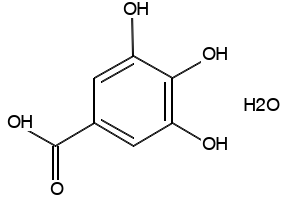
CAS Number5995-86-8
SynonymsBenzoic acid, 3,4,5-trihydroxy-, hydrate (1:1); Gallic acid monohydrate; 3,4,5-Trihydroxybenzoic acid hydrate (1:1); MFCD00002510; 3,4,5-trihydroxybenzoic acid,hydrate; EINECS 205-749-9
Molecular FormulaC7H8O6
Molecular Weight188.14
Purity98.00%
Density1.694
Boiling Point596.6ºC at 760 mmHg
Melting Point252 °C (dec.)(lit.)
AppearanceOff-white to beige powder
Symbol
Signal WordWarning
| Chemical & Physical Properties | |
|---|---|
| CAS Number | 5995-86-8 |
| Catalog No. | 2A-9032383 |
| Chinese Name | 没食子酸水合物 |
| Synonyms | Benzoic acid, 3,4,5-trihydroxy-, hydrate (1:1); Gallic acid monohydrate; 3,4,5-Trihydroxybenzoic acid hydrate (1:1); MFCD00002510; 3,4,5-trihydroxybenzoic acid,hydrate; EINECS 205-749-9 |
| Molecular Formula | C7H8O6 |
| Molecular Weight | 188.14 |
| Purity | 98.00 |
| Density | 1.694 |
| Boiling Point | 596.6ºC at 760 mmHg |
| Melting Point | 252 °C (dec.)(lit.) |
| Appearance | Off-white to beige powder |
| Water Solubility | 15 g/l (20 ºC) |
| Storage Condition | 1. It is hygroscopic and is easily oxidized under |
| Application | Gallic acid (3,4,5-Trihydroxybenzoic acid) hydrate is a natural polyhydroxyphenolic compound that inhibits the free radical scavenging effect of cyclooxygenase-2 (COX-2). Gallic acid hydrate has multi |
| HTC | 2918290000 |
| MDL Number | MFCD00149098 |
| SMILES | O.O=C(O)c1cc(O)c(O)c(O)c1 |
| InChI | InChI=1S/C7H6O5/c8-4-1-3(7(11)12)2-5(9)6(4)10/h1-2,8-10H,(H,11,12)/p-1 |
| InChI Key | IUTKPPDDLYYMBE-UHFFFAOYSA-N |
| Hazard Symbols | transportation |
| MSDS | msds/32383_1_5995_86_8.pdf |
| Bioactivity | Gallic acid (3,4,5-Trihydroxybenzoic acid) hydrate is a natural polyhydroxyphenolic compound and an free radical scavenger to inhibit cyclooxygenase-2 (COX-2)[1]. Gallic acid hydrate has various activities, such as antimicrobial, antioxidant, antimicrobial, anti-inflammatory, and anticance activities[2]. Related Catalog Signaling Pathways >> Apoptosis >> Apoptosis Research Areas >> Cancer Signaling Pathways >> Apoptosis >> Ferroptosis Research Areas >> Inflammation/Immunology Signaling Pathways >> Immunology/Inflammation >> COX Target COX-2 Human Endogenous Metabolite In Vitro Gallic acid is an antioxidant which can inhibit both COX-2[1]. After 18 h treatment with Gallic acid, the number of viable neutrophils is dramatically decreased from 40.3% to 27.7%, highly comparable with 26.4% for untreated neutrophils. Gallic acid fails to attenuate isoproterenol-induced myocytolysis[3]. In Vivo The food intake (2.6±0.08 g/day, p=0.69) and the body weight (2.5±0.69 g, p=0.76) of the Gallic acid group do not differ significantly from those of the control group (food intake; 2.41±0.14 g/day and the body weight; 2.83±0.84 g/day). The blood glucose tolerance in the Gallic acid group is significantly improved after 2 weeks of treatment. The blood glucose tolerance of the Gallic acid group after a treatment period of 2 weeks is also significantly better than that of the control group at 90 and 120 min ( p<0.05). The serum triglyceride concentration in the Gallic acid group (0.67±0.03 mM, p<0.05) is significantly reduced relative to that of the control group (1.08±0.20 mM). The total cholesterol concentration is similar in the control (3.19±0.27 mM) and Gallic acid (3.01±0.18 mM) groups[2]. References [1]. Amaravani M, et al. COX-2 structural analysis and docking studies with gallic acid structural analogues. Springerplus. 2012 Dec;1(1):58. [2]. Bak EJ, et al. Gallic acid improves glucose tolerance and triglyceride concentration in diet-induced obesity mice. Scand J Clin Lab Invest. 2013 Dec;73(8):607-14. [3]. Cheng Y, et al. Plant Natural Products Calycosin and Gallic Acid Synergistically Attenuate Neutrophil Infiltration and Subsequent Injury in Isoproterenol-Induced Myocardial Infarction: A Possible Role for Leukotriene B4 12-Hydroxydehydrogenase? Oxid Med Cell Longev. 2015;2015:434052. [4]. Felipe Hugo Alencar Fernandes, et al. Gallic Acid: Review of the Methods of Determination and Quantification. Crit Rev Anal Chem Chemical & Physical Properties Density 1.694 Boiling Point 596.6ºC at 760 mmHg Melting Point 252 °C (dec.)(lit.) Molecular Formula C7H8O6 Molecular Weight 188.135 Flash Point 250 °C Exact Mass 188.032089 PSA 107.22000 LogP 0.43730 InChIKey IUTKPPDDLYYMBE-UHFFFAOYSA-N SMILES O.O=C(O)c1cc(O)c(O)c(O)c1 Water Solubility 15 g/l (20 ºC) |
| Use of | Gallic acid (3,4,5-Trihydroxybenzoic acid) hydrate is a natural polyhydroxyphenolic compound and an free radical scavenger to inhibit cyclooxygenase-2 (COX-2)[1]. Gallic acid hydrate has various activities, such as antimicrobial, antioxidant, antimicrobial, anti-inflammatory, and anticance activities[2]. Properties Articles39 Name Gallic acid monohydrate Synonym More Synonyms Gallic acid hydrate Biological Activity Description Gallic acid (3,4,5-Trihydroxybenzoic acid) hydrate is a natural polyhydroxyphenolic compound and an free radical scavenger to inhibit cyclooxygenase-2 (COX-2)[1]. Gallic acid hydrate has various activities, such as antimicrobial, antioxidant, antimicrobial, anti-inflammatory, and anticance activities[2]. Related Catalog Signaling Pathways >> Apoptosis >> Apoptosis Research Areas >> Cancer Signaling Pathways >> Apoptosis >> Ferroptosis Research Areas >> Inflammation/Immunology Signaling Pathways >> Immunology/Inflammation >> COX Human Endogenous Metabolite In Vitro Gallic acid is an antioxidant which can inhibit both COX-2[1]. After 18 h treatment with Gallic acid, the number of viable neutrophils is dramatically decreased from 40.3% to 27.7%, highly comparable with 26.4% for untreated neutrophils. Gallic acid fails to attenuate isoproterenol-induced myocytolysis[3]. References [1]. Amaravani M, et al. COX-2 structural analysis and docking studies with gallic acid structural analogues. Springerplus. 2012 Dec;1(1):58. [2]. Bak EJ, et al. Gallic acid improves glucose tolerance and triglyceride concentration in diet-induced obesity mice. Scand J Clin Lab Invest. 2013 Dec;73(8):607-14. [3]. Cheng Y, et al. Plant Natural Products Calycosin and Gallic Acid Synergistically Attenuate Neutrophil Infiltration and Subsequent Injury in Isoproterenol-Induced Myocardial Infarction: A Possible Role for Leukotriene B4 12-Hydroxydehydrogenase? Oxid Med Cell Longev. 2015;2015:434052. [4]. Felipe Hugo Alencar Fernandes, et al. Gallic Acid: Review of the Methods of Determination and Quantification. Crit Rev Anal Chem Chemical & Physical Properties Molecular Formula C7H8O6 Exact Mass 188.032089 PSA 107.22000 LogP 0.43730 InChIKey IUTKPPDDLYYMBE-UHFFFAOYSA-N |
| Tax Rebate | 9.0% |
| Supervision | A. Customs clearance form for inbound goods B. Customs clearance form for outbound goods |
| Inspection | R. Hygiene supervision and inspection of imported food S. Hygiene supervision and inspection of exported food |
| Transport Info | Product name: Purity: 98.0% |
| MSDS Transport Info | Module 14. Shipping information 14.1 UN dangerous goods number European Land Transport Dangerous Regulations: -International Maritime Dangerous Regulations: -International Air Transport Dangerous Regulations: - 14.2 Names specified by the United Nations (UN) European Land Transport Dangerous Regulations: Non-dangerous goods IMDG Code: Non-dangerous goods International air transport dangerous goods regulations: non-dangerous goods 14.3 Transport hazard categories European Land Transport Dangerous Regulations: -International Maritime Dangerous Regulations: -International Air Transport Dangerous Regulations: - 14.4 Package group European Land Transport Dangerous Regulations: -International Maritime Dangerous Regulations: -International Air Transport Dangerous Regulations: - 14.5 Environmental hazards European Land Transport Dangerous Regulations: No International Maritime Transport Dangerous Regulations Maritime Pollutants: No International Air Transport Risk Regulations: No 14.6 Special reminder to users No data available |
| Related Products in Botanical Reference Standards | ||
|---|---|---|
| 4,4'-Dicyanostilbene | 5216-36-4 | 2A-9031536 |
| Cyclohexyl beta-D-glucopyranoside | 5284-99-1 | 2A-9031595 |
| Isopropyl beta-D-glucopyranoside | 5391-17-3 | 2A-9031734 |
| Biochanin A-beta-D-glucoside | 5928-26-7 | 2A-9032324 |
| 4-Nitrophenyl 2,3,4,6-tetra-O-acetyl-beta-D-glucopyranoside | 5987-78-0 | 2A-9032375 |
| Chlorogenic acid hemihydrate | 6001-76-9 | 2A-9032388 |
| Coptisine chloride | 6020-18-4 | 2A-9032406 |
| 2-Naphthyl beta-D-glucopyranoside | 6044-30-0 | 2A-9032428 |
| Methyl 2-Acetamido-2-deoxy-alpha-D-glucopyranoside | 6082-04-8 | 2A-9032460 |
| Oleanolic acid benzoate | 6153-31-7 | 2A-9032531 |
| Browse all Botanical Reference Standards products » | ||
Phone:
630-322-8886
630-322-8887
Email:
Office Locations:
Chicago, IL, USA
San Francisco, CA, USA


 EN
EN


 SDS
SDS