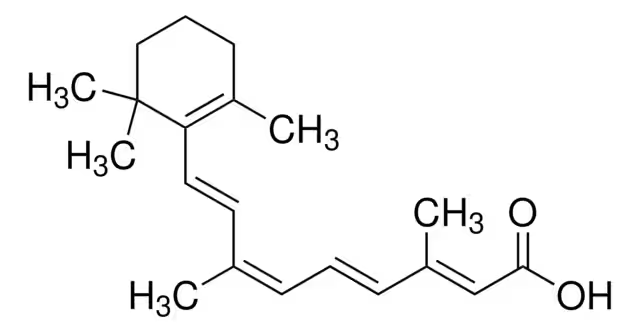
CAS Number5300-03-8
Synonyms9-cis-Tretinoin,Alitretinoin; Alitretinoin; (2E,4E,6Z,8E)-3,7-dimethyl-9-(2,6,6-trimethylcyclohex-1-en-1-yl)nona-2,4,6,8-tetraenoic acid; 9-cis-retinoic acid; MFCD00270072; 9Z-retinoic acid; 9-cis-Tretinoin; 9-cis Retinoic Acid; Panretin Gel; (2E,4E,6Z,8E)-3,7-dimethyl-9-(2,6,6-trimethylcyclohexen-1-yl)nona-2,4,6,8-tetraenoic acid; 9(Z)-Retinoic acid
Molecular FormulaC20H28O2
Molecular Weight300.44
Purity≥98 (HPLC)%
Density1.0±0.1 g/cm3
Boiling Point462.8±14.0 °C at 760 mmHg
Melting Point189-190 °C
Appearancepowder
Symbol
Signal WordWarning
| Chemical & Physical Properties | |
|---|---|
| CAS Number | 5300-03-8 |
| Catalog No. | 2A-9031606 |
| Chinese Name | 9-顺式视黄酸 |
| Synonyms | 9-cis-Tretinoin,Alitretinoin; Alitretinoin; (2E,4E,6Z,8E)-3,7-dimethyl-9-(2,6,6-trimethylcyclohex-1-en-1-yl)nona-2,4,6,8-tetraenoic acid; 9-cis-retinoic acid; MFCD00270072; 9Z-retinoic acid; 9-cis-Tretinoin; 9-cis Retinoic Acid; Panretin Gel; (2E,4E,6Z,8E)-3,7-dimethyl-9-(2,6,6-trimethylcyclohexen-1-yl)nona-2,4,6,8-tetraenoic acid; 9(Z)-Retinoic acid |
| Molecular Formula | C20H28O2 |
| Molecular Weight | 300.44 |
| Purity | ≥98 (HPLC) |
| Density | 1.0±0.1 g/cm3 |
| Boiling Point | 462.8±14.0 °C at 760 mmHg |
| Melting Point | 189-190 °C |
| Appearance | powder |
| Storage Condition | -20℃ Avoid light, keep in a cool and dry place, se |
| Application | 9-cis-Retinoic acid (ALRT1057), a vitamin A derivative, is a potent RAR/RXR agonist. 9-cis-Retinoic acid can induce apoptosis, regulate cell cycle and has anti-cancer, anti-inflammatory and neuroprote |
| HTC | 2916209090 |
| PubChem ID | 24899373 |
| MDL Number | MFCD00270072 |
| SMILES | CC1=C(\C=C\C(C)=C/C=C/C(C)=C/C(O)=O)C(C)(C)CCC1 |
| InChI | 1S/C20H28O2/c1-15(8-6-9-16(2)14-19(21)22)11-12-18-17(3)10-7-13-20(18,4)5/h6,8-9,11-12,14H,7,10,13H2,1-5H3,(H,21,22)/b9-6+,12-11+,15-8-,16-14+ |
| InChI Key | SHGAZHPCJJPHSC-ZVCIMWCZSA-N |
| NACRES Code | NA.77 |
| UNSPSC | 12352106 |
| Hazard Symbols | transportation |
| MSDS | msds/31606_1_5300_03_8.pdf |
| Bioactivity | 9-cis-Retinoic acid (ALRT1057), a vitamin A derivative, is a potent RAR/RXR agonist. 9-cis-Retinoic acid induces apoptosis, regulates cell cycle and has anticancer, anti-inflammatory and neuroprotection activities[1][2][3][4][5]. Related Catalog Signaling Pathways >> Apoptosis >> Apoptosis Research Areas >> Cancer Research Areas >> Inflammation/Immunology Research Areas >> Neurological Disease Signaling Pathways >> Metabolic Enzyme/Protease >> RAR/RXR In Vitro 9-cis-Retinoic acid (1-10 μM; 0-5 days; CA 9-22 and NA cells) treatment significantly decreases proliferation in a dose-dependent manner in CA 9-22 and NA cells[1]. 9-cis-Retinoic acid (1 μM; 24 hours) treatment significantly increases PPARγ functional activity by >200% in CA 9-22 and NA aerodigestive cells[1]. 9-cis-Retinoic acid treatment results in the formation of a nuclear PPARγ-RXRα heterodimer supershift complex in CA 9-22 cells[1]. 9-cis-Retinoic acid inhibits proliferation and induces apoptosis in cutaneous T-cell lymphoma (CTCL) in a dose-dependent and time-dependent manner. 9-cis-Retinoic acid also induces G0/G1 cell cycle arrest by downregulation of cyclin D1. 9-cis-Retinoic acid significantly decreases phosphorylation of JAK1, STAT3, and STAT5 and downregulated Bcl-xL and cyclin D1[2]. Cell Proliferation Assay[1] Cell Line: CA 9-22 and NA cells Concentration: 1 μM, 10 μM Incubation Time: 0 day, 1 day, 3 days, 5 days Result: Significantly decreased proliferation. In Vivo 9-cis-Retinoic acid (1 mg/kg; intravenous injection; daily; for 10 days; male C57BL/6J mice) treatment significantly decreases the serum ALT and AST level, alleviates hepatic necrosis of the bile duct ligation (BDL)-mice[3]. Animal Model: Male C57BL/6J mice (6-8 weeks; 19-22 g) treatment with bile duct ligated[3] Dosage: 1 mg/kg Administration: Intravenous injection; daily; for 10 days Result: Significantly decreased the serum ALT and AST level, alleviated hepatic necrosis. References [1]. Raul Rosas, et al. Retinoids Augment Thiazolidinedione PPARγ Activation in Oral Cancer Cells. Anticancer Res. 2020 Jun;40(6):3071-3080. [2]. Hua Yang, et al. Effects of 9-cis-retinoic Acid on the Proliferation and Apoptosis of Cutaneous T-cell Lymphoma Cells. Anticancer Drugs. 2019 Jan;30(1):56-64. [3]. Zhiqing Yuan, et al. 9-cis-retinoic Acid Elevates MRP3 Expression by Inhibiting Sumoylation of RXRα to Alleviate Cholestatic Liver Injury. Biochem Biophys Res Commun. 2018 Sep 3;503(1):188-194. [4]. V M Manzano, et al. Human Renal Mesangial Cells Are a Target for the Anti-Inflammatory Action of 9-cis Retinoic Acid. Br J Pharmacol. 2000 Dec;131(8):1673-83. [5]. Gro H Mathisen, et al. Delayed Translocation of NGFI-B/RXR in Glutamate Stimulated Neurons Allows Late Protection by 9-cis Retinoic Acid. Biochem Biophys Res Commun. 2011 Oct 14;414(1):90-5. Chemical & Physical Properties Density 1.0±0.1 g/cm3 Boiling Point 462.8±14.0 °C at 760 mmHg Melting Point 189-191ºC Molecular Formula C20H28O2 Molecular Weight 300.435 Flash Point 350.6±11.0 °C Exact Mass 300.208923 PSA 37.30000 LogP 6.83 Vapour Pressure 0.0±2.5 mmHg at 25°C Index of Refraction 1.556 InChIKey SHGAZHPCJJPHSC-ZVCIMWCZSA-N SMILES CC(C=CC1=C(C)CCCC1(C)C)=CC=CC(C)=CC(=O)O Storage condition −20°C Stability Store Dry in Freezer at -20°C for up to 1 year; in Solution at -20°C for up to 3 Months. |
| Use of | 9-cis-Retinoic acid (ALRT1057), a vitamin A derivative, is a potent RAR/RXR agonist. 9-cis-Retinoic acid induces apoptosis, regulates cell cycle and has anticancer, anti-inflammatory and neuroprotection activities[1][2][3][4][5]. Properties Articles50 Name 9-cis-retinoic acid Synonym More Synonyms Alitretinoin Biological Activity Description 9-cis-Retinoic acid (ALRT1057), a vitamin A derivative, is a potent RAR/RXR agonist. 9-cis-Retinoic acid induces apoptosis, regulates cell cycle and has anticancer, anti-inflammatory and neuroprotection activities[1][2][3][4][5]. Related Catalog Signaling Pathways >> Apoptosis >> Apoptosis Research Areas >> Cancer Research Areas >> Inflammation/Immunology Research Areas >> Neurological Disease Signaling Pathways >> Metabolic Enzyme/Protease >> RAR/RXR References [1]. Raul Rosas, et al. Retinoids Augment Thiazolidinedione PPARγ Activation in Oral Cancer Cells. Anticancer Res. 2020 Jun;40(6):3071-3080. [2]. Hua Yang, et al. Effects of 9-cis-retinoic Acid on the Proliferation and Apoptosis of Cutaneous T-cell Lymphoma Cells. Anticancer Drugs. 2019 Jan;30(1):56-64. [3]. Zhiqing Yuan, et al. 9-cis-retinoic Acid Elevates MRP3 Expression by Inhibiting Sumoylation of RXRα to Alleviate Cholestatic Liver Injury. Biochem Biophys Res Commun. 2018 Sep 3;503(1):188-194. [4]. V M Manzano, et al. Human Renal Mesangial Cells Are a Target for the Anti-Inflammatory Action of 9-cis Retinoic Acid. Br J Pharmacol. 2000 Dec;131(8):1673-83. [5]. Gro H Mathisen, et al. Delayed Translocation of NGFI-B/RXR in Glutamate Stimulated Neurons Allows Late Protection by 9-cis Retinoic Acid. Biochem Biophys Res Commun. 2011 Oct 14;414(1):90-5. Chemical & Physical Properties Molecular Formula C20H28O2 Exact Mass 300.208923 PSA 37.30000 Index of Refraction 1.556 InChIKey SHGAZHPCJJPHSC-ZVCIMWCZSA-N SMILES CC(C=CC1=C(C)CCCC1(C)C)=CC=CC(C)=CC(=O)O |
| Tax Rebate | 9.0% |
| Supervision | A. Customs clearance form for inbound goods B. Customs clearance form for outbound goods |
| Inspection | R. Imported food hygiene supervision and inspection S. Export food hygiene supervision and inspection M. Imported commodity inspection N. Exported commodity inspection |
| Transport Info | Product name: Purity: 98.0% |
| MSDS Transport Info | Module 14. Shipping information 14.1 UN dangerous goods number European Land Transport Dangerous Regulations: -International Maritime Dangerous Regulations: -International Air Transport Dangerous Regulations: - 14.2 Names specified by the United Nations (UN) European Land Transport Dangerous Regulations: Non-dangerous goods IMDG Code: Non-dangerous goods International air transport dangerous goods regulations: non-dangerous goods 14.3 Transport hazard categories European Land Transport Dangerous Regulations: -International Maritime Dangerous Regulations: -International Air Transport Dangerous Regulations: - 14.4 Package group European Land Transport Dangerous Regulations: -International Maritime Dangerous Regulations: -International Air Transport Dangerous Regulations: - 14.5 Environmental hazards European Land Transport Dangerous Regulations: No International Maritime Transport Dangerous Regulations Maritime Pollutants: No International Air Transport Risk Regulations: No 14.6 Special reminder to users No data available See reverse side of invoice or packing slip. |
| Related Products in Specialty Chemicals | ||
|---|---|---|
| 4,4'-Methylenebis(N-sec-butylaniline) | 5285-60-9 | 2A-9031596 |
| 3-Methyl-2-buten-1-thiol | 5287-45-6 | 2A-9031597 |
| 1-Benzyl-2-pyrrolidinone | 5291-77-0 | 2A-9031599 |
| Dimethyl nitroterephthalate | 5292-45-5 | 2A-9031602 |
| (1-Methyl-2-piperidnyl)methanamine | 5298-72-6 | 2A-9031605 |
| Isosorbide dimethyl ether | 5306-85-4 | 2A-9031611 |
| 2-Chloro-5-methyl-1,4-phenylenediamine | 5307-03-9 | 2A-9031613 |
| 1,4-Diamino-2-nitrobenzene | 5307-14-2 | 2A-9031614 |
| 1-(5-Methylpyridin-2-yl)ethanone | 5308-63-4 | 2A-9031617 |
| 4-(4-Methoxyphenyl)cyclohexanone | 5309-16-0 | 2A-9031618 |
| Browse all Specialty Chemicals products » | ||
Phone:
630-322-8886
630-322-8887
Email:
Office Locations:
Chicago, IL, USA
San Francisco, CA, USA


 EN
EN


 SDS
SDS