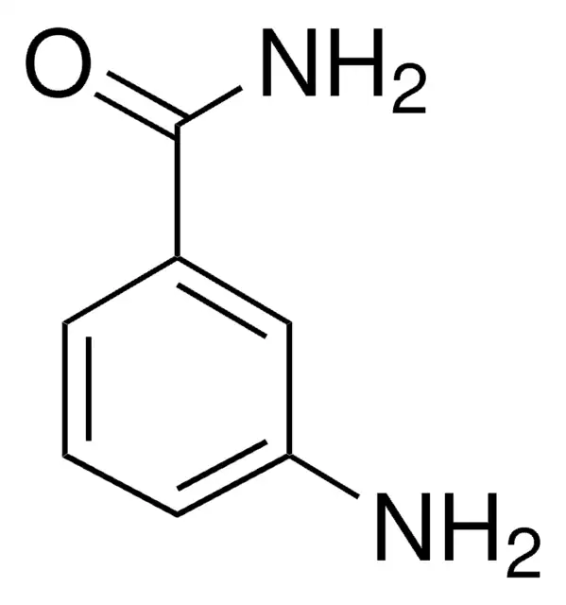
CAS Number3544-24-9
Synonymsmeta-aminobenzoylamine; m-Aminobenzamide; 3-Aminobenzimide; Benzamide,m-amino; 3-Aminobenzamide; 3-Amino-benzamide; MFCD00007989; EINECS 222-586-9; Benzamide,3-amino; INO1001; meta-aminobenzamide; 3-NH2-Ph-CO-NH2; 5-amino-benzamide; INO-1001
Molecular FormulaH2NC6H4CONH2
Molecular Weight136.15
Purity≥99 (TLC)%
Density1.2±0.1 g/cm3
Boiling Point329.6±25.0 °C at 760 mmHg
Melting Point115-116 °C (lit.)
Appearancepowder
EINECS222-586-9
Symbol
Signal WordWarning
| Chemical & Physical Properties | |
|---|---|
| CAS Number | 3544-24-9 |
| Catalog No. | 2A-9029926 |
| Chinese Name | 3-氨基苯甲酰胺 |
| Synonyms | meta-aminobenzoylamine; m-Aminobenzamide; 3-Aminobenzimide; Benzamide,m-amino; 3-Aminobenzamide; 3-Amino-benzamide; MFCD00007989; EINECS 222-586-9; Benzamide,3-amino; INO1001; meta-aminobenzamide; 3-NH2-Ph-CO-NH2; 5-amino-benzamide; INO-1001 |
| Molecular Formula | H2NC6H4CONH2 |
| Molecular Weight | 136.15 |
| Purity | ≥99 (TLC) |
| Density | 1.2±0.1 g/cm3 |
| Boiling Point | 329.6±25.0 °C at 760 mmHg |
| Melting Point | 115-116 °C (lit.) |
| Appearance | powder |
| Water Solubility | ethanol: 50 mg/mL, clear, faintly yellow |
| Storage Condition | Keep sealed. |
| Application | 3-Aminobenzamide is a potent PARP inhibitor with an IC50 value of approximately 50 nM for PARP in CHO cells. |
| EINECS | 222-586-9 |
| HTC | 2924299090 |
| PubChem ID | 24278206 |
| MDL Number | MFCD00007989 |
| SMILES | NC(=O)c1cccc(N)c1 |
| InChI | 1S/C7H8N2O/c8-6-3-1-2-5(4-6)7(9)10/h1-4H,8H2,(H2,9,10) |
| InChI Key | GSCPDZHWVNUUFI-UHFFFAOYSA-N |
| NACRES Code | NA.77 |
| UNSPSC | 12352200 |
| Hazard Symbols | transportation |
| MSDS | msds/29926_1_3544_24_9.pdf |
| Bioactivity | 3-Aminobenzamide is a potent inhibitor of PARP with IC50 of appr 50 nM in CHO cells, and acts as a mediator of oxidant-induced myocyte dysfunction during reperfusion. Related Catalog Research Areas >> Cancer Target PARP:50 nM (IC50) In Vitro 3-Aminobenzamide (>1 μM) causes more than 95% inhibition of PARP activity without significant cellular toxicity. INO-1001 significantly sensitizes CHO cells by blocking most of the DNA repair occurring between radiation fractions[1]. 3-Aminobenzamide significantly improves endothelial function by enhancing the acetylcholine-induced, endothelium-dependent, nitric oxide mediated vasorelaxation after exposure with 400 μM H2O2[2]. In Vivo In a db/db (Leprdb/db) mouse model, 3-Aminobenzamide ameliorates diabetes-induced albumin excretion and mesangial expansion, and also decreases diabetes-induced podocyte depletion[3]. 3-Aminobenzamide (1.6 mg/kg via intracerebral injection) prevents NAD+ depletion and improves water maze performance after controlled cortical impact (CCI) in mice[4]. Kinase Assay PARP activity is measured with a PARP Activity Assay Kit. This method measures relative PARP activity by determining the level of incorporation of 3H-NAD into trichloroacetic acid (TCA) precipitable material in the presence of sheared genomic DNA, which activates PARP. The reaction mixture is added directly to washed cultures in 12-well culture plates and the reaction is allowed to proceed for 60 minutes at 37°C before the cells are removed mechanically, transferred to a microcentrifuge tube, and precipitated with ice-cold 5% TCA. Animal Admin Male db/db (Leprdb/db) mice, together with nondiabetic control db/m mice on C57BLKs/J background, are used. INO-1001 and PJ-34 treatment are initiated at 5 weeks of age. In sterile water that is sweetened with NutraSweet, 4.8 g/L 3-Aminobenzamide and 2.4 g/L PJ-34 is dissolved. Control animals receive sweetened water only. The average inhibitor consumption is 60 mg/kg 3-Aminobenzamide and 30 mg/kg PJ-34. References [1]. Brock WA, et al. Radiosensitization of human and rodent cell lines by INO-1001, a novel inhibitor of poly(ADP-ribose) polymerase. Cancer Lett. 2004 Mar 18;205(2):155-60. [2]. Radovits T, et al. Poly(ADP-ribose) polymerase inhibition improves endothelial dysfunction induced by reactive oxidant hydrogen peroxide in vitro. Eur J Pharmacol. 2007 Jun 14;564(1-3):158-66. [3]. Szabo C, et al. Poly(ADP-ribose) polymerase inhibitors ameliorate nephropathy of type 2 diabetic Leprdb/db mice. Diabetes. 2006 Nov;55(11):3004-12. [4]. Clark RS, et al. Local administration of the poly(ADP-ribose) polymerase inhibitor INO-1001 prevents NAD+ depletion and improves water maze performance after traumatic brain injury in mice. J Neurotrauma. 2007 Aug;24(8):1399-405. Chemical & Physical Properties Density 1.2±0.1 g/cm3 Boiling Point 329.6±25.0 °C at 760 mmHg Melting Point 115-116 °C(lit.) Molecular Formula C7H8N2O Molecular Weight 136.151 Flash Point 153.2±23.2 °C Exact Mass 136.063660 PSA 69.11000 LogP 0.33 Vapour Pressure 0.0±0.7 mmHg at 25°C Index of Refraction 1.633 InChIKey GSCPDZHWVNUUFI-UHFFFAOYSA-N SMILES NC(=O)c1cccc(N)c1 Water Solubility ethanol: 50 mg/mL, clear, faintly yellow |
| Use of | 3-Aminobenzamide is a potent inhibitor of PARP with IC50 of appr 50 nM in CHO cells, and acts as a mediator of oxidant-induced myocyte dysfunction during reperfusion. Properties Articles52 Name 3-aminobenzamide Synonym More Synonyms 3-Aminobenzamide Biological Activity Description 3-Aminobenzamide is a potent inhibitor of PARP with IC50 of appr 50 nM in CHO cells, and acts as a mediator of oxidant-induced myocyte dysfunction during reperfusion. Related Catalog Research Areas >> Cancer PARP:50 nM (IC50) In Vitro 3-Aminobenzamide (>1 μM) causes more than 95% inhibition of PARP activity without significant cellular toxicity. INO-1001 significantly sensitizes CHO cells by blocking most of the DNA repair occurring between radiation fractions[1]. 3-Aminobenzamide significantly improves endothelial function by enhancing the acetylcholine-induced, endothelium-dependent, nitric oxide mediated vasorelaxation after exposure with 400 μM H2O2[2]. References [1]. Brock WA, et al. Radiosensitization of human and rodent cell lines by INO-1001, a novel inhibitor of poly(ADP-ribose) polymerase. Cancer Lett. 2004 Mar 18;205(2):155-60. [2]. Radovits T, et al. Poly(ADP-ribose) polymerase inhibition improves endothelial dysfunction induced by reactive oxidant hydrogen peroxide in vitro. Eur J Pharmacol. 2007 Jun 14;564(1-3):158-66. [3]. Szabo C, et al. Poly(ADP-ribose) polymerase inhibitors ameliorate nephropathy of type 2 diabetic Leprdb/db mice. Diabetes. 2006 Nov;55(11):3004-12. [4]. Clark RS, et al. Local administration of the poly(ADP-ribose) polymerase inhibitor INO-1001 prevents NAD+ depletion and improves water maze performance after traumatic brain injury in mice. J Neurotrauma. 2007 Aug;24(8):1399-405. Chemical & Physical Properties Molecular Formula C7H8N2O Exact Mass 136.063660 PSA 69.11000 Index of Refraction 1.633 InChIKey GSCPDZHWVNUUFI-UHFFFAOYSA-N |
| Tax Rebate | 13.0% |
| Supervision | None. MFN tariff: 6.5%. Ordinary tariff: 30.0% |
| Transport Info | Product name: Purity: 98.0% |
| MSDS Transport Info | Module 14. Shipping information 14.1 UN dangerous goods number European Land Transport Dangerous Regulations: -International Maritime Dangerous Regulations: -International Air Transport Dangerous Regulations: - 14.2 Names specified by the United Nations (UN) European Land Transport Dangerous Regulations: Non-dangerous goods IMDG Code: Non-dangerous goods International air transport dangerous goods regulations: non-dangerous goods 14.3 Transport hazard categories European Land Transport Dangerous Regulations: -International Maritime Dangerous Regulations: -International Air Transport Dangerous Regulations: - 14.4 Package group European Land Transport Dangerous Regulations: -International Maritime Dangerous Regulations: -International Air Transport Dangerous Regulations: - 14.5 Environmental hazards European Land Transport Dangerous Regulations: No International Maritime Transport Dangerous Regulations Maritime Pollutants: No International Air Transport Risk Regulations: No 14.6 Special reminder to users No data available See reverse side of invoice or packing slip. |
| Related Products in Specialty Chemicals | ||
|---|---|---|
| 3,4-Dimethoxybenzoyl chloride | 3535-37-3 | 2A-9029914 |
| 5-tert-Butyl-2-methoxyaniline | 3535-88-4 | 2A-9029915 |
| Butyl 4-bromobutyrate | 3540-75-8 | 2A-9029918 |
| Sodium 3-hydroxypropane-1-sulphonate | 3542-44-7 | 2A-9029920 |
| Bendamustine hydrochloride | 3543-75-7 | 2A-0200397 |
| 4-Aminobenzyl cyanide | 3544-25-0 | 2A-9029927 |
| Chloramphenicol hemisuccinate | 3544-94-3 | 2A-9029928 |
| Methyl p-tert-butylphenylacetate | 3549-23-3 | 2A-9029929 |
| 2-(Piperidin-1-ylmethyl)quinazolin-4(3H)-one hydrochloride | 3552-63-4 | 2A-9029931 |
| Methyl phenethyl ether | 3558-60-9 | 2A-9029935 |
| Browse all Specialty Chemicals products » | ||
Phone:
630-322-8886
630-322-8887
Email:
Office Locations:
Chicago, IL, USA
San Francisco, CA, USA


 EN
EN


 SDS
SDS