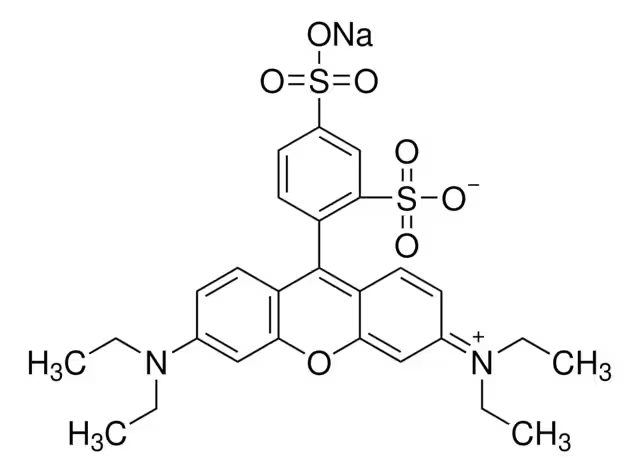
CAS Number3520-42-1
Synonyms4'-Butoxy-3-piperidinopropiophenone hydrochloride; Tanaclone; EINECS 222-529-8; dyclonine hydrochloride; SULFORHODAMINE B; MFCD00010180; C.I. 45100; Xanthylium, 3,6-bis(diethylamino)-9-(2,4-disulfophenyl)-, inner salt, sodium salt (1:1); dye acid red 52; Sodium 4-[6-(diethylamino)-3-(diethyliminio)-3H-xanthen-9-yl]benzene-1,3-disulfonate; Sulforhodamine-B; Dyclone; N,N,N',N'-tetraethylsulforhodamine; rhodamine 200 S sodium salt; Dyclocaine hydrochloride; Dyclonine HCL; Acid Red 52,Sulforhodamine B monosodium salt; Dyclothane; Acid Red 52; C.I.Acid Red 52; Sulforhodamine B sodium salt; Sulforhodamine B (sodium salt)
Molecular FormulaC27H29N2NaO7S2
Molecular Weight580.65
Purity≥73 (HPLC)%
Appearancepowder
EINECS222-529-8
Symbol
Signal WordWarning
| Chemical & Physical Properties | |
|---|---|
| CAS Number | 3520-42-1 |
| Catalog No. | 2A-9029899 |
| Chinese Name | 酸性红52 |
| Synonyms | 4'-Butoxy-3-piperidinopropiophenone hydrochloride; Tanaclone; EINECS 222-529-8; dyclonine hydrochloride; SULFORHODAMINE B; MFCD00010180; C.I. 45100; Xanthylium, 3,6-bis(diethylamino)-9-(2,4-disulfophenyl)-, inner salt, sodium salt (1:1); dye acid red 52; Sodium 4-[6-(diethylamino)-3-(diethyliminio)-3H-xanthen-9-yl]benzene-1,3-disulfonate; Sulforhodamine-B; Dyclone; N,N,N',N'-tetraethylsulforhodamine; rhodamine 200 S sodium salt; Dyclocaine hydrochloride; Dyclonine HCL; Acid Red 52,Sulforhodamine B monosodium salt; Dyclothane; Acid Red 52; C.I.Acid Red 52; Sulforhodamine B sodium salt; Sulforhodamine B (sodium salt) |
| Molecular Formula | C27H29N2NaO7S2 |
| Molecular Weight | 580.65 |
| Purity | ≥73 (HPLC) |
| Appearance | powder |
| Water Solubility | methanol: 1 mg/mL |
| Storage Condition | Store at room temperature, away from light, in a v |
| Application | Sulforhodamine B sodium salt is a fluorescent dye that can be used to quantitatively determine the amount of cellular protein in cultured cells. |
| EINECS | 222-529-8 |
| HTC | 3204120000 |
| PubChem ID | 24853778 |
| MDL Number | MFCD00010180 |
| SMILES | [Na+].CCN(CC)c1ccc2c(OC3=CC(\C=CC3=C2c4ccc(cc4S([O-])(=O)=O)S([O-])(=O)=O)=[N+](\CC)CC)c1 |
| InChI | 1S/C27H30N2O7S2.Na/c1-5-28(6-2)18-9-12-21-24(15-18)36-25-16-19(29(7-3)8-4)10-13-22(25)27(21)23-14-11-20(37(30,31)32)17-26(23)38(33,34)35;/h9-17H,5-8H2,1-4H3,(H-,30,31,32,33,34,35);/q;+1/p-1 |
| InChI Key | SXQCTESRRZBPHJ-UHFFFAOYSA-M |
| Beilstein/REAXYS | 3886008 |
| NACRES Code | NA.47 |
| UNSPSC | 12171500 |
| Hazard Symbols | transportation |
| MSDS | msds/29899_1_3520_42_1.pdf |
| Bioactivity | Sulforhodamine B sodium salt is a fluorescent dye with uses spanning from laser-induced fluorescence (LIF) to the quantification of cellular proteins of cultured cells. Related Catalog Signaling Pathways >> Others >> Others Dye Reagents Research Areas >> Others In Vitro Sulforhodamine B (SRB) is often used as a membrane-impermeable polar tracer or used for cell density determination via determination of cellular proteins (cytotoxicity assay). The SRB assay has been used to inexpensively conduct various screening assays to investigate cytotoxicity in cell based studies. This method relies on the property of SRB, which binds stoichiometrically to proteins under mild acidic conditions and then can be extracted using basic conditions; thus, the amount of bound dye can be used as a proxy for cell mass, which can then be extrapolated to measure cell proliferation. The protocol can be divided into four main steps: preparation of treatment, incubation of cells with treatment of choice, cell fixation and SRB staining, and absorbance measurement. This assay is limited to manual or semiautomatic screening, and can be used in an efficient and sensitive manner to test chemotherapeutic drugs or small molecules in adherent cells. It also has applications in evaluating the effects of gene expression modulation (knockdown, gene expression upregulation), as well as to study the effects of miRNA replacement on cell proliferation[1]. Cell Assay Gently add 25 μL (96-well format) or 5 μL (384-well format) cold 50% (wt/vol) TCA to each well directly to medium supernatant, and incubate the plates at 4 °C for 1 h. Mixing is not required, as this could lead to some cells detaching from the bottom of the well. Wash the plates four times by submerging the plate in a tub with slow-running tap water and remove excess water by gently tapping the plate into a paper towel. After the last wash allow the plate to air-dry at room temperature. Add 50 μL (96-well format) or 20 μL (384-well format) of 0.04% (wt/vol) SRB solution to each well. Leave at room temperature for 1 h and then quickly rinse the plates four times with 1% (vol/vol) acetic acid (200 μL for 96-well format or 30 μL for 384-well format) to remove unbound dye. Allow the plate to air-dry at room temperature[1]. References [1]. Orellana EA, et al. Sulforhodamine B (SRB) Assay in Cell Culture to Investigate Cell Proliferation. Bio Protoc. 2016 Nov 5;6(21). pii: e1984. Chemical & Physical Properties Molecular Formula C27H29N2NaO7S2 Molecular Weight 580.65 PSA 150.78000 LogP 7.81310 Water Solubility methanol: 1 mg/mL |
| Use of | Sulforhodamine B sodium salt is a fluorescent dye with uses spanning from laser-induced fluorescence (LIF) to the quantification of cellular proteins of cultured cells. Properties Articles180 Name lissamine rhodamine Synonym More Synonyms Acid Red 52 Biological Activity Description Sulforhodamine B sodium salt is a fluorescent dye with uses spanning from laser-induced fluorescence (LIF) to the quantification of cellular proteins of cultured cells. Related Catalog Signaling Pathways >> Others >> Others Dye Reagents Research Areas >> Others In Vitro Sulforhodamine B (SRB) is often used as a membrane-impermeable polar tracer or used for cell density determination via determination of cellular proteins (cytotoxicity assay). The SRB assay has been used to inexpensively conduct various screening assays to investigate cytotoxicity in cell based studies. This method relies on the property of SRB, which binds stoichiometrically to proteins under mild acidic conditions and then can be extracted using basic conditions; thus, the amount of bound dye can be used as a proxy for cell mass, which can then be extrapolated to measure cell proliferation. The protocol can be divided into four main steps: preparation of treatment, incubation of cells with treatment of choice, cell fixation and SRB staining, and absorbance measurement. This assay is limited to manual or semiautomatic screening, and can be used in an efficient and sensitive manner to test chemotherapeutic drugs or small molecules in adherent cells. It also has applications in evaluating the effects of gene expression modulation (knockdown, gene expression upregulation), as well as to study the effects of miRNA replacement on cell proliferation[1]. References [1]. Orellana EA, et al. Sulforhodamine B (SRB) Assay in Cell Culture to Investigate Cell Proliferation. Bio Protoc. 2016 Nov 5;6(21). pii: e1984. Chemical & Physical Properties Molecular Formula C27H29N2NaO7S2 PSA 150.78000 LogP 7.81310 |
| Tax Rebate | 9.0% |
| Supervision | None MFN tariff: 6.5% Ordinary tariff: 30.0% |
| Transport Info | Product name: Purity: 0.0% |
| MSDS Transport Info | Module 14. Shipping information European Land Transport Dangerous Regulations: -International Maritime Dangerous Regulations: -International Air Transport Dangerous Regulations: - 14.2 Names specified by the United Nations (UN) European Land Transport Dangerous Regulations: Non-dangerous goods IMDG Code: Non-dangerous goods International air transport dangerous goods regulations: non-dangerous goods 14.3 Transport hazard categories European Land Transport Dangerous Regulations: -International Maritime Dangerous Regulations: -International Air Transport Dangerous Regulations: - 14.4 Package group European Land Transport Dangerous Regulations: -International Maritime Dangerous Regulations: -International Air Transport Dangerous Regulations: - 14.5 Environmental hazards European Land Transport Dangerous Regulations: No International Maritime Transport Dangerous Regulations Maritime Pollutants: No International Air Transport Risk Regulations: No 14.6 Special reminder to users No data available |
| Related Products in Pigments & Additives | ||
|---|---|---|
| Disperse Red 13 | 3180-81-2 | 2A-9029532 |
| Acid Blue 113 | 3351-05-1 | 2A-9029704 |
| Fluorescent Brightener 134 | 3426-43-5 | 2A-9029786 |
| Direct Red 23 | 3441-14-3 | 2A-9029821 |
| Pigment Orange 5 | 3468-63-1 | 2A-9029841 |
| Pigment Orange 13 | 3520-72-7 | 2A-9029901 |
| Disperse Blue 79:1 | 3618-72-2 | 2A-9030001 |
| Disperse Blue 79:1 | 3618-73-3 | 2A-9030002 |
| Acid Red 1 | 3734-67-6 | 2A-9030135 |
| Disperse Red 5 | 3769-57-1 | 2A-9030174 |
| Browse all Pigments & Additives products » | ||
Phone:
630-322-8886
630-322-8887
Email:
Office Locations:
Chicago, IL, USA
San Francisco, CA, USA


 EN
EN


 SDS
SDS