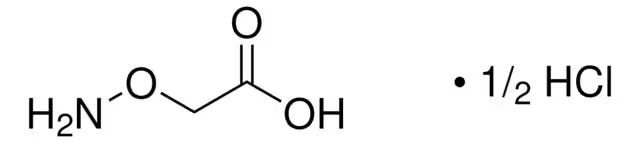
CAS Number2921-14-4
SynonymsO-Carboxymethylhydroxylamine hemihydrochloride; (Aminooxy)acetic acid hydrochloride (2:1); 2-aminooxyacetic acid; (carboxymethoxy)amine hemihydrochloride; Acetic acid, 2-(aminooxy)-, hydrochloride (2:1); Carboxymethoxylamine-D2; Aminyloxy-acetic Acid Hemihydrochlorid; 2-AMINOOXY-ACETICACIHYDROCHLORIDE; aminooxyaceticacidhemichloride; AMinooxyacetic acid Hydrochloride; O-(carboxymethyl) hydroxylamine hemichloride; 2-aminooxy-aceticacihydrochloride(2:1); Bis((aminooxy)acetic) acid hydrochloride; MFCD00012955; Aminooxyacetic acid hemihydrochloride; 2-(Aminooxy)acetic acid hydrochloride(2:1); (Aminooxy)acetic Acid Hemihydrochloride; (aminooxy)-aceticacihydrochloride(2:1); CarboxyMethoxylaMine HeMihydrochloride; O-(Carboxymethyl)hydroxylamine hemihydrochloride; Carboxymethoxyamine hemihydrochlo
Molecular FormulaNH2OCH2COOH · 0.5HCl
Molecular Weight109.30
Purity98%
Boiling Point326.7ºC at 760 mmHg
Melting Point156 °C (dec.) (lit.)
Appearancecrystalline powder
EINECS220-862-3
Symbol
Signal WordWarning
| Chemical & Physical Properties | |
|---|---|
| CAS Number | 2921-14-4 |
| Catalog No. | 2A-9029188 |
| Chinese Name | 羧甲氧基胺半盐酸盐 |
| Synonyms | O-Carboxymethylhydroxylamine hemihydrochloride; (Aminooxy)acetic acid hydrochloride (2:1); 2-aminooxyacetic acid; (carboxymethoxy)amine hemihydrochloride; Acetic acid, 2-(aminooxy)-, hydrochloride (2:1); Carboxymethoxylamine-D2; Aminyloxy-acetic Acid Hemihydrochlorid; 2-AMINOOXY-ACETICACIHYDROCHLORIDE; aminooxyaceticacidhemichloride; AMinooxyacetic acid Hydrochloride; O-(carboxymethyl) hydroxylamine hemichloride; 2-aminooxy-aceticacihydrochloride(2:1); Bis((aminooxy)acetic) acid hydrochloride; MFCD00012955; Aminooxyacetic acid hemihydrochloride; 2-(Aminooxy)acetic acid hydrochloride(2:1); (Aminooxy)acetic Acid Hemihydrochloride; (aminooxy)-aceticacihydrochloride(2:1); CarboxyMethoxylaMine HeMihydrochloride; O-(Carboxymethyl)hydroxylamine hemihydrochloride; Carboxymethoxyamine hemihydrochlo |
| Molecular Formula | NH2OCH2COOH · 0.5HCl |
| Molecular Weight | 109.30 |
| Purity | 98 |
| Boiling Point | 326.7ºC at 760 mmHg |
| Melting Point | 156 °C (dec.) (lit.) |
| Appearance | crystalline powder |
| Water Solubility | break down |
| Storage Condition | Sealed in a cool, dry environment |
| Packaging | II |
| Application | Aminooxyacetic acid hemihydrochloride is a malate-aspartate shuttle (MAS) inhibitor and also inhibits the GABA-degrading enzyme GABA-T. |
| EINECS | 220-862-3 |
| PubChem ID | 24892403 |
| MDL Number | MFCD00012955 |
| SMILES | Cl.NOCC(O)=O.NOCC(O)=O |
| InChI | 1S/2C2H5NO3.ClH/c2*3-6-1-2(4)5;/h2*1,3H2,(H,4,5);1H |
| InChI Key | KBXIJIPYZKPDRU-UHFFFAOYSA-N |
| Beilstein/REAXYS | 3680528 |
| NACRES Code | NA.22 |
| UNSPSC | 12352100 |
| Hazard Symbols | 3 |
| MSDS | msds/29188_1_2921_14_4.pdf |
| Bioactivity | Aminooxyacetic acid hemihydrochloride is a malate-aspartate shuttle (MAS) inhibitor which also inhibits the GABA degradating enzyme GABA-T. Related Catalog Signaling Pathways >> Membrane Transporter/Ion Channel >> GABA Receptor Signaling Pathways >> Neuronal Signaling >> GABA Receptor Research Areas >> Cancer Target MAS[1], GABA-T[2] In Vitro Aminooxyacetic acid hemihydrochloride (AOAA) dose-dependently decreases the survival of C6 glioma cells. Aminooxyacetic acid hemihydrochloride treatment produces a significant increase in the percentage of the cells arrested in the stage of G0/G1, as well as a significant decrease in the percentage of the cells at S phase and G2/M phase. Aminooxyacetic acid hemihydrochloride treatment leads to an obvious decrease in the number of the cells in the phase of cell division. Aminooxyacetic acid hemihydrochloride significantly increases the percentage of the cells in both early-stage apoptosis and necrosis. Treatment of the cells with 1 mM or 5 mM Aminooxyacetic acid hemihydrochloride leads to decreased levels of aging of the cells[1]. Glutamine-dependent cell lines show greater inhibition of cell growth by Aminooxyacetic acid hemihydrochloride (AOA) compare with cells that are less glutamine dependent[3]. In Vivo The accumulation of GABA in cerebellum and whole brain is initially very rapid, being significantly increased already 5 min after the injection of Aminooxyacetic acid hemihydrochloride (AOAA). The rapid initial accumulation becomes gradually slower and maximal levels (400 to 600 % of the control levels) are reached 2 to 6 h after Aminooxyacetic acid hemihydrochloride. Still 24 h after Aminooxyacetic acid hemihydrochloride the GABA levels are elevated by about 250%. From 2 to 6 h after Aminooxyacetic acid hemihydrochloride the convulsions are completely blocked. Twenty four hours after Aminooxyacetic acid hemihydrochloride the convulsions are almost identical to the controls[2]. Kinase Assay Enzyme activity of aspartate transaminase is measured by a colorimetric assay assessing formation of pyruvate from oxaloacetate, a product of GOT1/2 (also called AST1/2) activity, as described previously. In brief, cells grown in 6-well plates are collected after 6, 24, or 48 hours of Aminooxyacetic acid hemihydrochloride (AOA) treatment and washed with cold PBS, lysed, and supernatant used for analysis[3]. Cell Assay Breast cancer cell lines are used in this study. Cells are plated in 96-well plates at 1,500 to 5,000 cells per well in 100 μL media. New medium with varying concentration of Aminooxyacetic acid hemihydrochloride (AOA) is added after 12 hours. The assay is performed after 48 hours[3]. Animal Admin Female albino rats (150 to 200 g) bred at our department are used. Aminooxyacetic acid hemihydrochloride (AOAA) is injected into a tail vein (2 mL/kg body weight). For this purpose the rat is placed in a plastic tube and the tail warmed in water 42°C[2]. References [1]. Wang C, et al. Malate-aspartate shuttle inhibitor aminooxyacetic acid leads to decreased intracellular ATP levels and altered cell cycle of C6 glioma cells by inhibiting glycolysis. Cancer Lett. 2016 Aug 1;378(1):1-7. [2]. Pagliusi SR, et al. Aminooxyacetic acid induced accumulation of GABA in the rat brain. Interaction with GABA receptors and distribution in compartments. Naunyn Schmiedebergs Arch Pharmacol. 1983 Apr;322(3):210-5. [3]. Korangath P, et al. Targeting Glutamine Metabolism in Breast Cancer with Aminooxyacetate. Clin Cancer Res. 2015 Jul 15;21(14):3263-73. Chemical & Physical Properties Boiling Point 326.7ºC at 760 mmHg Melting Point 156 °C (dec.)(lit.) Molecular Formula NH2OCH2COOH·0.5HCl Molecular Weight 109.30 Flash Point 151.4ºC PSA 145.10000 LogP 0.12520 Vapour Pressure 4.24E-05mmHg at 25°C InChIKey KBXIJIPYZKPDRU-UHFFFAOYSA-N SMILES Cl.NOCC(=O)O.NOCC(=O)O Storage condition -20°C Freezer |
| Use of | Aminooxyacetic acid hemihydrochloride is a malate-aspartate shuttle (MAS) inhibitor which also inhibits the GABA degradating enzyme GABA-T. Properties Name Carboxymethoxylamine hemihydrochloride Synonym More Synonyms Aminooxyacetic acid hemihydrochloride Biological Activity Description Aminooxyacetic acid hemihydrochloride is a malate-aspartate shuttle (MAS) inhibitor which also inhibits the GABA degradating enzyme GABA-T. Related Catalog Signaling Pathways >> Membrane Transporter/Ion Channel >> GABA Receptor Signaling Pathways >> Neuronal Signaling >> GABA Receptor Research Areas >> Cancer MAS[1], GABA-T[2] References [2]. Pagliusi SR, et al. Aminooxyacetic acid induced accumulation of GABA in the rat brain. Interaction with GABA receptors and distribution in compartments. Naunyn Schmiedebergs Arch Pharmacol. 1983 Apr;322(3):210-5. [3]. Korangath P, et al. Targeting Glutamine Metabolism in Breast Cancer with Aminooxyacetate. Clin Cancer Res. 2015 Jul 15;21(14):3263-73. Chemical & Physical Properties PSA 145.10000 LogP 0.12520 InChIKey KBXIJIPYZKPDRU-UHFFFAOYSA-N SMILES Cl.NOCC(=O)O.NOCC(=O)O |
| Transport Info | Shipping Name: UN |
| MSDS Transport Info | Module 14. Shipping information 14.1 UN dangerous goods number European Land Transport Dangerous Regulations: -International Maritime Dangerous Regulations: -International Air Transport Dangerous Regulations: - 14.2 United Nations shipping name European Land Transport Dangerous Regulations: Non-dangerous goods IMDG Code: Non-dangerous goods International air transport dangerous goods regulations: non-dangerous goods 14.3 Transport hazard categories European Land Transport Dangerous Regulations: -International Maritime Dangerous Regulations: -International Air Transport Dangerous Regulations: - 14.4 Package group European Land Transport Dangerous Regulations: -International Maritime Dangerous Regulations: -International Air Transport Dangerous Regulations: - 14.5 Environmental hazards European Land Transport Danger Regulations: No International Maritime Danger Regulations International Air Transport Danger Regulations: No Marine pollutants (yes/no): No 14.6 Special reminder to users No data available |
| Related Products in Specialty Chemicals | ||
|---|---|---|
| Hexadecanethiol | 2917-26-2 | 2A-9029181 |
| Dimethyl isopropylmalonate | 2917-78-4 | 2A-9029182 |
| 1-Hepten-3-one | 2918-13-0 | 2A-9029183 |
| Cyclobutanol | 2919-23-5 | 2A-9029184 |
| 4-Cyanobiphenyl | 2920-38-9 | 2A-9029186 |
| Tetradecylthioacetic acid | 2921-20-2 | 2A-9029189 |
| 2-Heptadecanone | 2922-51-2 | 2A-9029194 |
| Potassium trifluoroacetate | 2923-16-2 | 2A-9029196 |
| Sodium trifluoroacetate | 2923-18-4 | 2A-9029197 |
| Silver trifluoromethanesulphonate | 2923-28-6 | 2A-9029198 |
| Browse all Specialty Chemicals products » | ||
Phone:
630-322-8886
630-322-8887
Email:
Office Locations:
Chicago, IL, USA
San Francisco, CA, USA


 EN
EN


 SDS
SDS