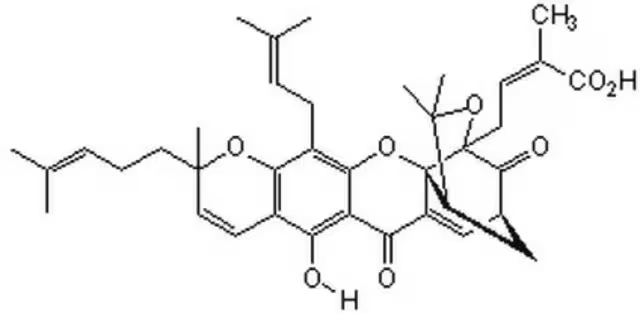
CAS Number2752-65-0
SynonymsGUTTIC ACID; GUTTATIC ACID; cambogicacid; Gambogic acid
Molecular FormulaC38H44O8
Molecular Weight628.75
Purity≥95 (TLC)%
Density1.3±0.1 g/cm3
Boiling Point808.9±65.0 °C at 760 mmHg
Melting Point88.5°C
Appearanceamorphous solid
Symbol
Signal WordWarning
| Chemical & Physical Properties | |
|---|---|
| CAS Number | 2752-65-0 |
| Catalog No. | 2A-9028974 |
| Chinese Name | 藤黄酸 |
| Synonyms | GUTTIC ACID; GUTTATIC ACID; cambogicacid; Gambogic acid |
| Molecular Formula | C38H44O8 |
| Molecular Weight | 628.75 |
| Purity | ≥95 (TLC) |
| Density | 1.3±0.1 g/cm3 |
| Boiling Point | 808.9±65.0 °C at 760 mmHg |
| Melting Point | 88.5°C |
| Appearance | amorphous solid |
| Storage Condition | The warehouse is ventilated and dried at low tempe |
| Application | Gambogic acid comes from the garcinia resin of the Garcinia hanburyi tree. Gambogic acid inhibits Bcl-XL, Bcl-2, Bcl-W, Bcl-B, Bfl-1 and Mcl-1 with IC50 of 1.47 μM, 1.21 μM, 2.02 μM, 0.66 μM, 1.06 μM |
| HTC | 2942000000 |
| PubChem ID | 14814284 |
| MDL Number | MFCD16878985 |
| SMILES | O1[C@@]32C4(OC(C3CC(C=C2C(=O)c5c1c(c6c(c5O)C=C[C@](O6)(CCC=C(C)C)C)CC=C(C)C)C4=O)(C)C)C\C=C(\C)/C(=O)O |
| InChI | 1S/C38H44O8/c1-20(2)10-9-15-36(8)16-14-24-29(39)28-30(40)26-18-23-19-27-35(6,7)46-37(33(23)41,17-13-22(5)34(42)43)38(26,27)45-32(28)25(31(24)44-36)12-11-21(3)4/h10-11,13-14,16,18,23,27,39H,9,12,15,17,19H2,1-8H3,(H,42,43)/b22-13-/t23?,27?,36-,37?,38-/m1/s1 |
| InChI Key | GEZHEQNLKAOMCA-PLUQQRNKSA-N |
| NACRES Code | NA.77 |
| UNSPSC | 12352106 |
| Hazard Symbols | transportation |
| MSDS | msds/28974_1_2752_65_0.pdf |
| Bioactivity | Gambogic acid is derived from the gamboges resin of the tree Garcinia hanburyi. Gambogic acid inhibits Bcl-XL, Bcl-2, Bcl-W, Bcl-B, Bfl-1 and Mcl-1 with IC50s of 1.47 μM, 1.21 μM, 2.02 μM, 0.66 μM, 1.06 μM and 0.79 μM. Related Catalog Signaling Pathways >> Autophagy >> Autophagy Signaling Pathways >> Apoptosis >> Bcl-2 Family Research Areas >> Cancer Natural Products >> Others Target Bcl-B:0.66 μM (IC50) Mcl-1:0.79 μM (IC50) Bfl-1:1.06 μM (IC50) Bcl-2:1.21 μM (IC50) Bcl-xL:1.47 μM (IC50) Bcl-W:2.02 μM (IC50) Autophagy In Vitro Gambogic Acid is a medicinal compound derived from the gamboges resin of the tree, Garcinia hanburyi. Gambogic Acid has documented cytotoxic activity against tumor cell lines in culture, with concentrations required for killing 50% of cells (LD50 of ~1 μM). The activity of Gambogic Acid against the 6 human anti-apoptotic Bcl-2-family proteins is contrasted, using FPAs. Gambogic Acid displaces to various extents FITC-BH3 peptide binding to all 6 proteins, with apparent IC50 1.47 μM for Bcl-XL, 1.21 μM for Bcl-2, 2.02 μM for Bcl-W, 0.66 μM for Bcl-B, 1.06 μM for Bfl-1, and 0.79 μM for Mcl-1[1]. The growth inhibitory effects of Gambogic Acid (GA) or Cisplatin (CDDP) on A549, NCI-H460, and NCI-H1299 cells are assessed by the MTT assay after 48 h exposure. A concentration-dependent inhibition of cell growth is observed with Gambogic Acid and CDDP, with IC50s of 3.56±0.36 and 21.88±3.21 μM for A549 cells, 4.05±0.51 and 25.76±4.03 μM for NCI-H460 cells, and 1.12±0.31 μM and 25.21±4.38 μM for NCI-H1299 cells[2]. In Vivo To further investigate whether Gambogic Acid synergises CDDP against tumour growth in vivo, A549 tumors are implanted in SCID mice. When mice are treated with CDDP combined with Gambogic Acid, the tumor inhibition rate is 69.3%, whereas those of mice treated with CDDP and GA alone are 57.2% and 29.0%, respectively[2]. Cell Assay The in vitro cell viability effects of Gambogic Acid, CDDP alone, or combined treatments are determined by MTT assay. The cells (2×10⁴ cells per mL) are seeded into 96-well culture plates. After overnight incubation, A549 cells are treated with Gambogic Acid (0.44, 0.88, 1.75, 3.5, 7, 10.5 and 14 μM); NCI-H460 cells are treated with Gambogic Acid (0.5, 1, 2, 4, 8, 12 and 16 μM); NCI-H1299 cells are treated with Gambogic Acid (0.125, 0.25, 0.5, 1, 2 and 4 μM). For the combined treatment in NSCLC cells, three sequences are tested: (a) Gambogic Acid followed by CDDP cells are exposed to Gambogic Acid for 48 h, and then after washout of Gambogic Acid, cells are treated with CDDP for an additional 48 h; (b) CDDP followed by Gambogic Acid cells are exposed to CDDP for 48 h, and then after washout of CDDP, cells are treated with Gambogic Acid for an additional 48 h; and (c) concurrent treatment cells are exposed to both Gambogic Acid and ADM for 48 h. The nature of the drug interaction is analysed by using the combination index (CI)[2]. Animal Admin Mice[2] To determine the in vivo antitumour activity of Gambogic Acid combined with CDDP, viable A549 cells (5×10⁶/100 μL PBS per mouse) are subcutaneously injected into the right flank of 7- to 8-week-old male SCID mice. When the average tumor volume reach 100 mm3, the mice are randomly divided into four treatment groups, including control (saline only, n=5), Gambogic Acid (3.0 mg/kg per 2 days, intravenously; n=6), CDDP (4 mg/kg per week, intravenously; n=6), and sequential combination (CDDP treatment one day before Gambogic Acid treatment, n=6). CDDP (4 mg/kg, weekly) is generally administered at doses less than the maximum-tolerated dose in an attempt to allow any additive effects of combination treatment with platinum-based agents and Gambogic Acid to be more easily detected. Tumor size is measured once every 2 days with a calipre. Body weight is recorded once every 2 days. After 14 days, the mice are killed and the tumors are excised and stored at -80 °C until further analysis. References [1]. Zhai D, et al. Gambogic acid is an antagonist of antiapoptotic Bcl-2 family proteins. Mol Cancer Ther. 2008 Jun;7(6):1639-46. [2]. Wang LH, et al. Gambogic acid synergistically potentiates cisplatin-induced apoptosis in non-small-cell lung cancer through suppressing NF-κB and MAPK/HO-1 signalling. Br J Cancer. 2014 Jan 21;110(2):341-52. Chemical & Physical Properties Density 1.3±0.1 g/cm3 Boiling Point 808.9±65.0 °C at 760 mmHg Melting Point 88.5°C Molecular Formula C38H44O8 Molecular Weight 628.751 Flash Point 251.4±27.8 °C Exact Mass 628.303589 PSA 119.36000 LogP 10.30 Vapour Pressure 0.0±3.0 mmHg at 25°C Index of Refraction 1.627 InChIKey GEZHEQNLKAOMCA-XKZIYDEJSA-N SMILES CC(C)=CCCC1(C)C=Cc2c(O)c3c(c(CC=C(C)C)c2O1)OC12C(=CC4CC1C(C)(C)OC2(CC=C(C)C(=O)O)C4=O)C3=O |
| Use of | Gambogic acid is derived from the gamboges resin of the tree Garcinia hanburyi. Gambogic acid inhibits Bcl-XL, Bcl-2, Bcl-W, Bcl-B, Bfl-1 and Mcl-1 with IC50s of 1.47 μM, 1.21 μM, 2.02 μM, 0.66 μM, 1.06 μM and 0.79 μM. Properties Articles29 Name gambogic acid Synonym More Synonyms Gambogic Acid Biological Activity Description Gambogic acid is derived from the gamboges resin of the tree Garcinia hanburyi. Gambogic acid inhibits Bcl-XL, Bcl-2, Bcl-W, Bcl-B, Bfl-1 and Mcl-1 with IC50s of 1.47 μM, 1.21 μM, 2.02 μM, 0.66 μM, 1.06 μM and 0.79 μM. Related Catalog Signaling Pathways >> Autophagy >> Autophagy Signaling Pathways >> Apoptosis >> Bcl-2 Family Research Areas >> Cancer Natural Products >> Others Bcl-B:0.66 μM (IC50) Mcl-1:0.79 μM (IC50) Bfl-1:1.06 μM (IC50) Bcl-2:1.21 μM (IC50) Bcl-xL:1.47 μM (IC50) Bcl-W:2.02 μM (IC50) In Vivo To further investigate whether Gambogic Acid synergises CDDP against tumour growth in vivo, A549 tumors are implanted in SCID mice. When mice are treated with CDDP combined with Gambogic Acid, the tumor inhibition rate is 69.3%, whereas those of mice treated with CDDP and GA alone are 57.2% and 29.0%, respectively[2]. References [1]. Zhai D, et al. Gambogic acid is an antagonist of antiapoptotic Bcl-2 family proteins. Mol Cancer Ther. 2008 Jun;7(6):1639-46. [2]. Wang LH, et al. Gambogic acid synergistically potentiates cisplatin-induced apoptosis in non-small-cell lung cancer through suppressing NF-κB and MAPK/HO-1 signalling. Br J Cancer. 2014 Jan 21;110(2):341-52. Chemical & Physical Properties Molecular Formula C38H44O8 Exact Mass 628.303589 PSA 119.36000 LogP 10.30 Index of Refraction 1.627 InChIKey GEZHEQNLKAOMCA-XKZIYDEJSA-N |
| Transport Info | Shipping Name: UN |
| MSDS Transport Info | Module 14. Shipping information 14.1 United Nations number European Dangerous Regulations for land transport: 2811 International Dangerous Regulations for sea transport: 2811 International Dangerous Regulations for air transport: 2811 14.2 United Nations shipping name European Land Transport Dangerous Regulations: TOXIC SOLID, ORGANIC, N.O.S. (Gambogic acid) IMDG Code: TOXIC SOLID, ORGANIC, N.O.S. (Gambogic acid) International air transport hazard regulations: Toxic solid, organic, n.o.s. (Gambogic acid) 14.3 Transport hazard categories European Land Transport Danger Regulations: 6.1 International Maritime Transport Danger Regulations: 6.1 International Air Transport Danger Regulations: 6.1 14.4 Package group European Land Transport Danger Regulations: III International Maritime Transport Danger Regulations: III International Air Transport Danger Regulations: III 14.5 Environmental hazards European Land Transport Danger Regulations: No International Maritime Danger Regulations International Air Transport Danger Regulations: No Marine pollutants (yes/no): No 14.6 Special precautions No data available |
| Related Products in Specialty Chemicals | ||
|---|---|---|
| Solvent Green 5 | 2744-50-5 | 2A-9028962 |
| 3,5-Dimethylbenzyl chloride | 2745-54-2 | 2A-9028963 |
| 4-Methoxybenzyl bromide | 2746-25-0 | 2A-9028966 |
| 5-Chloronaphthalen-1-amine | 2750-80-3 | 2A-9028971 |
| Tetraphenylphosphonium bromide | 2751-90-8 | 2A-9028972 |
| Mebeverine hydrochloride | 2753-45-9 | 2A-9028975 |
| 1,4-Bis(hydroxydimethylsilyl)benzene | 2754-32-7 | 2A-9028977 |
| Isobornyl propanoate | 2756-56-1 | 2A-9028979 |
| CBZ L Valine | 92077-76-4 | 2A-9028981 |
| (2-Bromoethyl)trimethylammonium bromide | 2758-06-7 | 2A-9028982 |
| Browse all Specialty Chemicals products » | ||
Phone:
630-322-8886
630-322-8887
Email:
Office Locations:
Chicago, IL, USA
San Francisco, CA, USA


 EN
EN


 SDS
SDS