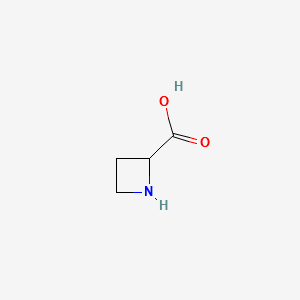
CAS Number2517-04-6
SynonymsAzetidine-2-carboxylic acid; (±)-2-Azetidinecarboxylic Acid; UNII:775261TI36; 2-Azetidinecarboxylic acid; 2-azetidine-carboxylic acid; 2-carboxyazetidine; azetidinecarboxylic acid; azethidine-2-carboxylic acid; 1-AZETIDINESULFONAMIDE; azetidine-1-sulphonamide; EINECS 219-740-2
Molecular FormulaC4H7NO2
Molecular Weight101.11
Purity98.00%
Density1.3±0.1 g/cm3
Boiling Point242.0±33.0 °C at 760 mmHg
Melting Point217°C (rough estimate)
| Chemical & Physical Properties | |
|---|---|
| CAS Number | 2517-04-6 |
| Catalog No. | 2A-9028672 |
| Chinese Name | 氮杂环丁烷-2-羧酸 |
| Synonyms | Azetidine-2-carboxylic acid; (±)-2-Azetidinecarboxylic Acid; UNII:775261TI36; 2-Azetidinecarboxylic acid; 2-azetidine-carboxylic acid; 2-carboxyazetidine; azetidinecarboxylic acid; azethidine-2-carboxylic acid; 1-AZETIDINESULFONAMIDE; azetidine-1-sulphonamide; EINECS 219-740-2 |
| Molecular Formula | C4H7NO2 |
| Molecular Weight | 101.11 |
| Purity | 98.00 |
| Density | 1.3±0.1 g/cm3 |
| Boiling Point | 242.0±33.0 °C at 760 mmHg |
| Melting Point | 217°C (rough estimate) |
| Storage Condition | room temperature, dry |
| Application | Azetidine-2-carboxylic acid is a non-proteogenic amino acid homolog of proline. Can be found in common beets. In many species, including humans, it can be mistakenly incorporated into proteins in plac |
| HTC | 2933990090 |
| PubChem ID | 115171 |
| SMILES | O=C(O)C1CCN1 |
| InChI | InChI=1S/C4H7NO2/c6-4(7)3-1-2-5-3/h3,5H,1-2H2,(H,6,7) |
| InChI Key | IADUEWIQBXOCDZ-UHFFFAOYSA-N |
| Bioactivity | Azetidine-2-carboxylic acid is a non proteinogenic amino acid homologue of proline. Found in common beets. Azetidine-2-carboxylic acid can be misincorporated into proteins in place of proline in many species, including humans. Toxic and teratogenic agent[1][2]. Related Catalog Signaling Pathways >> Others >> Others Research Areas >> Cancer Natural Products >> Others In Vitro Azetidine-2-carboxylic acid (375-5oo μg per day) is incorporated into the collagen synthesized by chick embryo cartilage in vitro[3]. References [1]. Rubenstein E, et al. Azetidine-2-carboxylic acid in the food chain. Phytochemistry. 2009 Jan;70(1):100-4. [2]. Rubenstein E, et al. Misincorporation of the proline analog azetidine-2-carboxylic acid in the pathogenesis of multiple sclerosis: a hypothesis. J Neuropathol Exp Neurol. 2008 Nov;67(11):1035-40. [3]. Lane JM, et al. Effect of the proline analogue azetidine-2-carboxylic acid on collagen synthesis in vivo. I. Arrest of collagen accumulation in growing chick embryos. Biochim Biophys Acta. 1971 Jun 29;236(3):517-27. Chemical & Physical Properties Density 1.3±0.1 g/cm3 Boiling Point 242.0±33.0 °C at 760 mmHg Melting Point 217°C (rough estimate) Molecular Formula C4H7NO2 Molecular Weight 101.104 Flash Point 100.1±25.4 °C Exact Mass 101.047676 PSA 49.33000 LogP -0.83 Vapour Pressure 0.0±1.0 mmHg at 25°C Index of Refraction 1.499 InChIKey IADUEWIQBXOCDZ-UHFFFAOYSA-N SMILES O=C(O)C1CCN1 |
| Use of | Azetidine-2-carboxylic acid is a non proteinogenic amino acid homologue of proline. Found in common beets. Azetidine-2-carboxylic acid can be misincorporated into proteins in place of proline in many species, including humans. Toxic and teratogenic agent[1][2]. Properties Name azetidine-2-carboxylic acid Synonym More Synonyms Azetidine-2-carboxylic acid Biological Activity Description Azetidine-2-carboxylic acid is a non proteinogenic amino acid homologue of proline. Found in common beets. Azetidine-2-carboxylic acid can be misincorporated into proteins in place of proline in many species, including humans. Toxic and teratogenic agent[1][2]. Related Catalog Signaling Pathways >> Others >> Others Research Areas >> Cancer Natural Products >> Others In Vitro Azetidine-2-carboxylic acid (375-5oo μg per day) is incorporated into the collagen synthesized by chick embryo cartilage in vitro[3]. References [1]. Rubenstein E, et al. Azetidine-2-carboxylic acid in the food chain. Phytochemistry. 2009 Jan;70(1):100-4. [2]. Rubenstein E, et al. Misincorporation of the proline analog azetidine-2-carboxylic acid in the pathogenesis of multiple sclerosis: a hypothesis. J Neuropathol Exp Neurol. 2008 Nov;67(11):1035-40. [3]. Lane JM, et al. Effect of the proline analogue azetidine-2-carboxylic acid on collagen synthesis in vivo. I. Arrest of collagen accumulation in growing chick embryos. Biochim Biophys Acta. 1971 Jun 29;236(3):517-27. Chemical & Physical Properties Molecular Formula C4H7NO2 Exact Mass 101.047676 PSA 49.33000 LogP -0.83 Index of Refraction 1.499 InChIKey IADUEWIQBXOCDZ-UHFFFAOYSA-N |
| Tax Rebate | 13.0% |
| Supervision | None. MFN tariff: 6.5%. Ordinary tariff: 20.0% |
| Transport Info | Product name: Summary 2933990090. heterocyclic compounds with nitrogen hetero-atom(s) only. VAT:17.0%. Tax rebate rate:13.0%. . MFN tariff:6.5%. General tariff:20.0% |
| Related Products in Heterocyclic Building Blocks | ||
|---|---|---|
| Sodium mercaptobenzothiazole | 2492-26-4 | 2A-9028637 |
| 4-Ethynylpyridine | 2510-22-7 | 2A-9028655 |
| 3-Ethynylpyridine | 2510-23-8 | 2A-9028656 |
| 4-Methyloxazole-5-carboxylic acid | 2510-32-9 | 2A-9028658 |
| 2-Bromo-1,3-benzothiazole | 2516-40-7 | 2A-9028665 |
| 2-Methylthiophene-3-thiol | 2527-76-6 | 2A-9028694 |
| 3-Acetyl-2,5-dimethylthiophene | 2530-30-1 | 2A-9028698 |
| 2-Amino-6-methylbenzothiazole | 2536-91-6 | 2A-9028705 |
| 2-Chloromethyl-1,3-dioxolane | 2568-30-1 | 2A-9028758 |
| 6-Chloro-2-hydroxy-4-methylquinoline | 2585-04-8 | 2A-9028775 |
| Browse all Heterocyclic Building Blocks products » | ||
Phone:
630-322-8886
630-322-8887
Email:
Office Locations:
Chicago, IL, USA
San Francisco, CA, USA


 EN
EN


 SDS
SDS