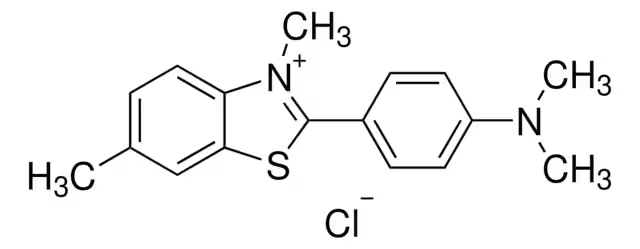
CAS Number2390-54-7
Synonyms2-[4-(Dimethylamino)phenyl]-3,6-dimethyl-1,3-benzothiazol-3-ium chloride; THIOFLAVINET,TG; EINECS 219-228-9; THIOFLAVINE TG; 2-(4-(Dimethylamino)phenyl)-3,6-dimethylbenzo[d]thiazol-3-ium chloride; thioflavin T; MFCD00011944; Acronol Yellow T; SETOFLAVINE T; Benzothiazolium, 2-[4-(dimethylamino)phenyl]-3,6-dimethyl-, chloride (1:1); BASIC YELLOW 1; Setoflavin T; Thioflavine TCN; Thioflavine T; Benzothiazolium, 2-[4- (dimethylamino)phenyl]-3,6-dimethyl-, chloride
Molecular FormulaC17H19ClN2S
Molecular Weight318.86
Purity75.00%
Melting Point212ºC
AppearanceYellow to ocher - yellow powder
Symbol
Signal WordWarning
| Chemical & Physical Properties | |
|---|---|
| CAS Number | 2390-54-7 |
| Catalog No. | 2A-9028423 |
| Chinese Name | 硫黄素 T |
| Synonyms | 2-[4-(Dimethylamino)phenyl]-3,6-dimethyl-1,3-benzothiazol-3-ium chloride; THIOFLAVINET,TG; EINECS 219-228-9; THIOFLAVINE TG; 2-(4-(Dimethylamino)phenyl)-3,6-dimethylbenzo[d]thiazol-3-ium chloride; thioflavin T; MFCD00011944; Acronol Yellow T; SETOFLAVINE T; Benzothiazolium, 2-[4-(dimethylamino)phenyl]-3,6-dimethyl-, chloride (1:1); BASIC YELLOW 1; Setoflavin T; Thioflavine TCN; Thioflavine T; Benzothiazolium, 2-[4- (dimethylamino)phenyl]-3,6-dimethyl-, chloride |
| Molecular Formula | C17H19ClN2S |
| Molecular Weight | 318.86 |
| Purity | 75.00 |
| Melting Point | 212ºC |
| Appearance | Yellow to ocher - yellow powder |
| Storage Condition | Store in a sealed container away from light at roo |
| Packaging | III |
| Application | Thioflavin T is a cationic Benzothiazole dye that increases fluorescence intensity upon binding to amyloid in tissue sections. |
| HTC | 32041300 |
| PubChem ID | 540039 |
| SMILES | Cc1ccc2c(c1)sc(-c1ccc(N(C)C)cc1)[n+]2C.[Cl-] |
| InChI | InChI=1S/C17H19N2S.ClH/c1-12-5-10-15-16(11-12)20-17(19(15)4)13-6-8-14(9-7-13)18(2)3;/h5-11H,1-4H3;1H/q+1;/p-1 |
| InChI Key | JADVWWSKYZXRGX-UHFFFAOYSA-M |
| Hazard Symbols | 6.1(b) |
| Bioactivity | Thioflavin T is a cationic Benzothiazole dye that shows enhanced fluorescence upon binding to amyloid in tissue sections. Related Catalog Signaling Pathways >> Others >> Others Dye Reagents Research Areas >> Others In Vitro Thioflavin T (ThT) is a benzothiazole dye that exhibits enhanced fluorescence upon binding to amyloid fibrils and is commonly used to diagnose amyloid fibrils, both ex vivo and in vitro. In aqueous solutions, Thioflavin T is found to exist as micelles at concentrations commonly used to monitor fibrils by fluorescence assay (~10-20 μM). Specific conductivity changes are measured at varying concentration of Thioflavin T and the critical micellar concentration is calculated to be 4.0±0.5 μM. Changes in the fluorescence excitation and emission of Thioflavin T are also dependent on the micelle formation. The Thioflavin T micelles of 3 nm diameter are directly visualized using atomic force microscopy, and bound Thioflavin T micelles are observed along the fibril length for representative fibrils. Increasing concentration of Thioflavin T above the critical micellar concentration shows increased numbers of micelles bound along the length of the amyloid fibrils. Thioflavin T micelles are disrupted at low pH as observed by atomic force microscopy and fluorescence enhancement upon binding of Thioflavin T to amyloid fibrils also reduced by several-fold upon decreasing the pH to below 3.The micelles of Thioflavin T bind amyloid fibrils leading to enhancement of fluorescence emission[1]. Kinase Assay Thioflavin T (ThT) is prepared by dissolving ~3 mg dry powder in 1 mL water. The solution is filtered through 0.22 μm syringe filters followed by measurement of the concentration by diluting the stock solution in ethanol and using an extinction coefficient of 26,620 M-1 cm-1 at 416 nm. The stock solution is stored at 4 °C covered with foil and used for up to a month to make assay solutions by diluting either in water or desired buffer[1]. Thioflavin T (ThT) fluorescence emission is measured with excitation at 450 nm and recording the spectrum between 465 and 565 nm with 5 nm slits using a FluoroMax 2 spectrofluorometer. The excitation spectra are collected by setting the emission wavelength to 482 nm and collecting the spectrum between 300 and 470 nm with 5 nm slit widths, and 1 s integration time and 1 nm interval. Emission spectra between 465 and 565 nm are collected upon excitation at 450 nm. Excitation and emission spectra in the presence of amyloid fibrils are measured with varying concentrations of Thioflavin T and 5 ng/mL amyloid (calculated based on starting protein concentration) before collecting the spectra[1]. References [1]. Khurana R, et al. Mechanism of thioflavin T binding to amyloid fibrils. J Struct Biol. 2005 Sep;151(3):229-38. Chemical & Physical Properties Melting Point 212ºC Molecular Formula C17H19ClN2S Molecular Weight 318.864 Exact Mass 318.095734 PSA 35.36000 LogP 0.77120 InChIKey JADVWWSKYZXRGX-UHFFFAOYSA-M SMILES Cc1ccc2c(c1)sc(-c1ccc(N(C)C)cc1)[n+]2C.[Cl-] |
| Use of | Thioflavin T is a cationic Benzothiazole dye that shows enhanced fluorescence upon binding to amyloid in tissue sections. Properties Articles151 Name thioflavine T Synonym More Synonyms Thioflavine T Biological Activity Description Thioflavin T is a cationic Benzothiazole dye that shows enhanced fluorescence upon binding to amyloid in tissue sections. Related Catalog Signaling Pathways >> Others >> Others Dye Reagents Research Areas >> Others References [1]. Khurana R, et al. Mechanism of thioflavin T binding to amyloid fibrils. J Struct Biol. 2005 Sep;151(3):229-38. Chemical & Physical Properties Exact Mass 318.095734 PSA 35.36000 LogP 0.77120 InChIKey JADVWWSKYZXRGX-UHFFFAOYSA-M |
| Tax Rebate | 13.0% |
| Supervision | None. MFN tariff: 6.5%. Ordinary tariff: 20.0% |
| Transport Info | Shipping Name: UN |
| MSDS Transport Info | Module 14. Shipping information 14.1 UN dangerous goods number European Land Transport Dangerous Regulations: -International Maritime Dangerous Regulations: -International Air Transport Dangerous Regulations: - 14.2 United Nations shipping name European Land Transport Dangerous Regulations: Non-dangerous goods IMDG Code: Non-dangerous goods International air transport dangerous goods regulations: non-dangerous goods 14.3 Transport hazard categories European Land Transport Dangerous Regulations: -International Maritime Dangerous Regulations: -International Air Transport Dangerous Regulations: - 14.4 Package group European Land Transport Dangerous Regulations: -International Maritime Dangerous Regulations: -International Air Transport Dangerous Regulations: - 14.5 Environmental hazards European Land Transport Danger Regulations: No International Maritime Danger Regulations International Air Transport Danger Regulations: No Marine pollutants (yes/no): No 14.6 Special reminder to users No data available |
| Related Products in Specialty Chemicals | ||
|---|---|---|
| Sodium 1-butanesulfonate | 2386-54-1 | 2A-9028411 |
| Ethylmagnesium chloride | 2386-64-3 | 2A-9028413 |
| 1-(2-Chloroethyl)imidazolidin-2-one | 2387-20-4 | 2A-9028415 |
| Carbocistein | 2387-59-9 | 2A-9028416 |
| 3-Methoxythioanisole | 2388-74-1 | 2A-9028419 |
| Basic Violet 11 | 2390-63-8 | 2A-9028425 |
| Didecyldimethylammonium bromide | 2390-68-3 | 2A-9028426 |
| L-Alanyl-L-alanine | 2392-61-2 | 2A-9028428 |
| 3-Aminomethylbenzoic acid | 2393-20-6 | 2A-9028429 |
| 1-(4-Dimethylaminophenyl)-2,2,2-trifluoroethanone | 2396-05-6 | 2A-9028431 |
| Browse all Specialty Chemicals products » | ||
Phone:
630-322-8886
630-322-8887
Email:
Office Locations:
Chicago, IL, USA
San Francisco, CA, USA


 EN
EN


 SDS
SDS