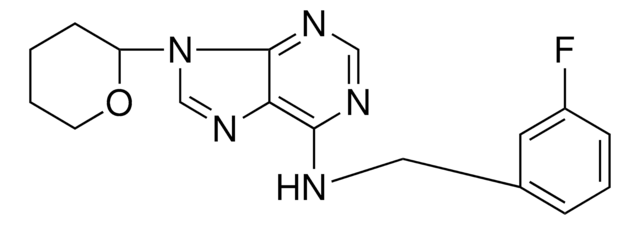
CAS Number2312-73-4
SynonymsPyranyl benzyladenine; MFCD00056971; N-Benzyl-9-(tetrahydro-2H-pyran-2-yl)-9H-purin-6-amine; UNII:23NQ6S177V; N-Benzyl-9-(tetrahydro-2H-pyran-2-yl)adenine; 6-Benzylamino-9-(2-tetrahydropyranyl)-9H-purine,BPA
Molecular FormulaC17H18FN5O
Molecular Weight327.364
Purity98.00%
Density1.4±0.1 g/cm3
Boiling Point541.1±60.0 °C at 760 mmHg
Melting Point110-114ºC
Appearancewhite crystal
Symbol
Signal WordWarning
| Chemical & Physical Properties | |
|---|---|
| CAS Number | 2312-73-4 |
| Catalog No. | 2A-9028302 |
| Chinese Name | N-苄基-9-(四氢-2H-吡喃-2-基)腺嘌呤 |
| Synonyms | Pyranyl benzyladenine; MFCD00056971; N-Benzyl-9-(tetrahydro-2H-pyran-2-yl)-9H-purin-6-amine; UNII:23NQ6S177V; N-Benzyl-9-(tetrahydro-2H-pyran-2-yl)adenine; 6-Benzylamino-9-(2-tetrahydropyranyl)-9H-purine,BPA |
| Molecular Formula | C17H18FN5O |
| Molecular Weight | 327.364 |
| Purity | 98.00 |
| Density | 1.4±0.1 g/cm3 |
| Boiling Point | 541.1±60.0 °C at 760 mmHg |
| Melting Point | 110-114ºC |
| Appearance | white crystal |
| Storage Condition | Ventilated and low temperature drying |
| Application | BAP9THP is a synthetic cytokinin derivative and growth regulator. BAP9THP promoted chlorophyll retention (and delayed senescence) in plant tissues unusually strongly, whereas tobacco callus growth was |
| PubChem ID | 3713863 |
| MDL Number | MFCD18429021 |
| SMILES | c1ccc(CNc2ncnc3c2ncn3C2CCCCO2)cc1 |
| InChI | InChI=1S/C17H19N5O/c1-2-6-13(7-3-1)10-18-16-15-17(20-11-19-16)22(12-21-15)14-8-4-5-9-23-14/h1-3,6-7,11-12,14H,4-5,8-10H2,(H,18,19,20) |
| InChI Key | POFWRMVFWIJXHP-UHFFFAOYSA-N |
| Hazard Symbols | transportation |
| MSDS | msds/28302_1_2312_73_4.pdf |
| Bioactivity | BAP9THP is a synthetic cytokinin derivative and a growth regulator. BAP9THP promotes chlorophyll retention (and senescence delay) in plant tissues exceptionally strongly, and growth of tobacco callus almost as strongly as 6-Benzylaminopurine (BAP). BAP9THP induces adventitious shoot formation ignificantly more strongly than N6-isopentenyladenine or Kinetin[1][2]. Related Catalog Research Areas >> Others Signaling Pathways >> Others >> Others In Vitro The cytokinin derivative BAP9THP is an important component of these protocols: culture of isolated apical meristem or growing shoot apices on media containing this compound resulted in signifcant shoot multiplication[1]. both BAP9THP and BAP9THF are found to delay senescence and induce several growth responses more strongly than BAP[2]. References [1]. Smýkalová, I., et al. The effects of novel synthetic cytokinin derivatives and endogenous cytokinins on the in vitro growth responses of hemp (Cannabis sativa L.) explants. Plant Cell Tiss Organ Cult 139, 381-394 (2019). [2]. Vylíčilová H, et al. Naturally Occurring and Artificial N9-Cytokinin Conjugates: From Synthesis to Biological Activity and Back. Biomolecules. 2020;10(6):832. Published 2020 May 29. Chemical & Physical Properties Density 1.4±0.1 g/cm3 Boiling Point 541.1±60.0 °C at 760 mmHg Melting Point 110-114ºC Molecular Formula C17H19N5O Molecular Weight 309.366 Flash Point 281.1±32.9 °C Exact Mass 309.158966 PSA 64.86000 LogP 2.45 Vapour Pressure 0.0±1.4 mmHg at 25°C Index of Refraction 1.700 InChIKey POFWRMVFWIJXHP-UHFFFAOYSA-N SMILES c1ccc(CNc2ncnc3c2ncn3C2CCCCO2)cc1 |
| Use of | BAP9THP is a synthetic cytokinin derivative and a growth regulator. BAP9THP promotes chlorophyll retention (and senescence delay) in plant tissues exceptionally strongly, and growth of tobacco callus almost as strongly as 6-Benzylaminopurine (BAP). BAP9THP induces adventitious shoot formation ignificantly more strongly than N6-isopentenyladenine or Kinetin[1][2]. Properties Name N-Benzyl-9-(2-tetrahydropyranyl)adenine Synonym More Synonyms BAP9THP Biological Activity Description BAP9THP is a synthetic cytokinin derivative and a growth regulator. BAP9THP promotes chlorophyll retention (and senescence delay) in plant tissues exceptionally strongly, and growth of tobacco callus almost as strongly as 6-Benzylaminopurine (BAP). BAP9THP induces adventitious shoot formation ignificantly more strongly than N6-isopentenyladenine or Kinetin[1][2]. Related Catalog Research Areas >> Others Signaling Pathways >> Others >> Others In Vitro The cytokinin derivative BAP9THP is an important component of these protocols: culture of isolated apical meristem or growing shoot apices on media containing this compound resulted in signifcant shoot multiplication[1]. both BAP9THP and BAP9THF are found to delay senescence and induce several growth responses more strongly than BAP[2]. References [1]. Smýkalová, I., et al. The effects of novel synthetic cytokinin derivatives and endogenous cytokinins on the in vitro growth responses of hemp (Cannabis sativa L.) explants. Plant Cell Tiss Organ Cult 139, 381-394 (2019). [2]. Vylíčilová H, et al. Naturally Occurring and Artificial N9-Cytokinin Conjugates: From Synthesis to Biological Activity and Back. Biomolecules. 2020;10(6):832. Published 2020 May 29. Chemical & Physical Properties Molecular Formula C17H19N5O Exact Mass 309.158966 PSA 64.86000 Index of Refraction 1.700 InChIKey POFWRMVFWIJXHP-UHFFFAOYSA-N |
| Transport Info | Product name: Purity: 98.0% |
| MSDS Transport Info | Module 14. Shipping information 14.1 UN number European Land Transport Dangerous Regulations: -International Maritime Dangerous Regulations: -International Air Transport Dangerous Regulations: - 14.2 Names specified by the United Nations (UN) European Land Transport Dangerous Regulations: No dangerous goods IMDG Code: No dangerous goods International Air Transport Dangerous Regulations: No dangerous goods 14.3 Transport hazard categories European Land Transport Dangerous Regulations: -International Maritime Dangerous Regulations: -International Air Transport Dangerous Regulations: - 14.4 Package group European Land Transport Dangerous Regulations: -International Maritime Dangerous Regulations: -International Air Transport Dangerous Regulations: - 14.5 Environmental hazards European Land Transport Dangerous Regulations: No International Maritime Transport Dangerous Regulations Maritime Pollutants: No International Air Transport Risk Regulations: No 14.6 Special precautions for users No data available |
| Related Products in Heterocyclic Building Blocks | ||
|---|---|---|
| 4-Amino-3-fluoropyridine | 2247-88-3 | 2A-9028215 |
| 1-(4-Fluorophenyl)piperazine | 2252-63-3 | 2A-9028224 |
| 2-Methyl-1H-imidazole-1-propanamine | 2258-21-1 | 2A-9028228 |
| 4-Bromo-1H-imidazole | 2302-25-2 | 2A-9028278 |
| 4,5-Dibromo-1H-imidazole | 2302-30-9 | 2A-9028279 |
| 5-Fluoro-1H-indole-3-carboxaldehyde | 2338-71-8 | 2A-9028324 |
| 6-Fluoroindole-3-acetonitrile | 2341-25-5 | 2A-9028330 |
| 5-Fluoroindoline | 2343-22-8 | 2A-9028331 |
| 6-Fluoroindoline | 2343-23-9 | 2A-9028332 |
| 5-Amino-1,3,4-thiadiazole-2-thiol | 2349-67-9 | 2A-9028346 |
| Browse all Heterocyclic Building Blocks products » | ||
Phone:
630-322-8886
630-322-8887
Email:
Office Locations:
Chicago, IL, USA
San Francisco, CA, USA


 EN
EN


 SDS
SDS