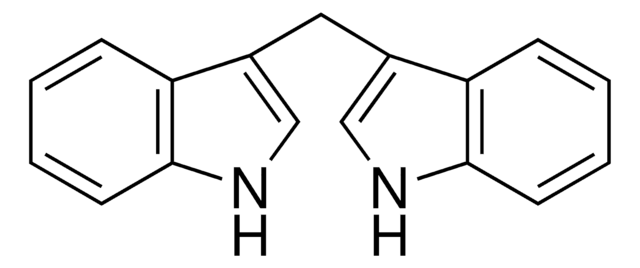
CAS Number1968-05-4
SynonymsHB 236; 3-(1H-indol-3-ylmethyl)-1H-indole; ARUNDINE; di(1H-indol-3-yl)methane; DI-3-INDOLYLMETHANE; DIM; 3-DIINDOLYL METHANE; 3,3'-Diindolylmethane; 2-(1H-Indol-3-ylmethyl)-1H-indole; 3,3'-Methylenediindole; 3,3'-Methylenebisindole;DIM; DI INDOLYL METHANE; di-(1H-3-indolyl)methane; Indole dimer; 3,3'-methylene-bis(1H-indole); 3,3-Methylenediindole; Indolyl-CH2-Indolyl; MFCD00195766; 3,3'-Methylenebis(1H-indole); 3,3'-Diindolymetane; Diindole methane
Molecular FormulaC17H14N2
Molecular Weight246.31
Purity98.00%
Density1.3±0.1 g/cm3
Boiling Point504.8±30.0 °C at 760 mmHg
Melting Point167 °C
AppearanceWhite crystalline powder
| Chemical & Physical Properties | |
|---|---|
| CAS Number | 1968-05-4 |
| Catalog No. | 2A-9027744 |
| Chinese Name | 3,3'-亚甲基二吲哚 |
| Synonyms | HB 236; 3-(1H-indol-3-ylmethyl)-1H-indole; ARUNDINE; di(1H-indol-3-yl)methane; DI-3-INDOLYLMETHANE; DIM; 3-DIINDOLYL METHANE; 3,3'-Diindolylmethane; 2-(1H-Indol-3-ylmethyl)-1H-indole; 3,3'-Methylenediindole; 3,3'-Methylenebisindole;DIM; DI INDOLYL METHANE; di-(1H-3-indolyl)methane; Indole dimer; 3,3'-methylene-bis(1H-indole); 3,3-Methylenediindole; Indolyl-CH2-Indolyl; MFCD00195766; 3,3'-Methylenebis(1H-indole); 3,3'-Diindolymetane; Diindole methane |
| Molecular Formula | C17H14N2 |
| Molecular Weight | 246.31 |
| Purity | 98.00 |
| Density | 1.3±0.1 g/cm3 |
| Boiling Point | 504.8±30.0 °C at 760 mmHg |
| Melting Point | 167 °C |
| Appearance | White crystalline powder |
| Storage Condition | Keep the container sealed and stored in a cool, dr |
| Application | 3,3'-Diindolylmethane is a potent androgen receptor (AR) antagonist. |
| HTC | 2933990090 |
| PubChem ID | 529850 |
| SMILES | c1ccc2c(Cc3c[nH]c4ccccc34)c[nH]c2c1 |
| InChI | InChI=1S/C17H14N2/c1-3-7-16-14(5-1)12(10-18-16)9-13-11-19-17-8-4-2-6-15(13)17/h1-8,10-11,18-19H,9H2 |
| InChI Key | VFTRKSBEFQDZKX-UHFFFAOYSA-N |
| Bioactivity | 3,3'-Diindolylmethane is a strong, pure androgen receptor (AR) antagonist. Related Catalog Signaling Pathways >> Others >> Androgen Receptor Research Areas >> Cancer Natural Products >> Others Target Androgen receptor[1] In Vitro 3,3'-Diindolylmethane (DIM) is a strong antagonist of androgen receptor (AR) function but exhibits less than obvious structural similarity to the endogenous AR ligand, dihydrotestosterone (DHT). 3,3'-Diindolylmethane is a major digestive product of indole-3-carbinol, a potential anticancer component of cruciferous vegetables. 3,3'-Diindolylmethane exhibits potent antiproliferative and antiandrogenic properties in androgen-dependent human prostate cancer cells. 3,3'-Diindolylmethane suppresses cell proliferation of LNCaP cells and inhibits DHT stimulation of DNA synthesis. Moreover, 3,3'-Diindolylmethane inhibits endogenous PSA transcription and reduced intracellular and secreted PSA protein levels induced by DHT in LNCaP cells. Also, 3,3'-Diindolylmethane inhibits, in a concentration-dependent manner, the DHT-induced expression of a prostate-specific antigen promoter-regulated reporter gene construct in transiently transfected LNCaP cells. Co-treatment with 50 μM 3,3'-Diindolylmethane partially inhibits the translocation of AR induced by DHT treatment and showed distribution of the AR to be both cytoplasmic and nuclear. Furthermore, 3,3'-Diindolylmethane treatment prevents the formation of AR foci in the nucleus. 3,3'-Diindolylmethane alone produces a predominantly cytoplasmic distribution of fluorescence[1]. In Vivo Mice are randomized into two groups and are treated daily s.c. with either vehicle or 3,3'-Diindolylmethane (10 mg/kg) for 30 days. Tumor volume and the weight of mice are recorded once every 3 days using calipers. 3,3'-Diindolylmethane (DIM) treatment resulted in a marked inhibition of SNU-484 xenograft tumor growth. Notably, the body weight of mice from both groups did not significantly differ from the vehicle control following 30 days of drug exposure, suggesting that 3,3'-Diindolylmethane has no severe toxicity to the mice. Taken together, these findings demonstrate that 3,3'-Diindolylmethane administration significantly inhibited SNU-484 xenograft growthin vivo mediated by the inactivation of YAP[2]. Cell Assay The human prostate adenocarcinoma cell lines LNCaP-FGC and PC-3 are grown as adherent monolayers in 10% FBS-DMEM, supplemented with 4.0 g/L glucose and 3.7 g/L sodium bicarbonate in a humidified incubator at 37°C and 5% CO2, and passaged at ~80% confluency. Cultures used in subsequent experiments are at less than 40 passages. Cells grown in stripped conditions are in 5% DCC-FBS-DMEM base supplemented with 4 g/L glucose, 3.7 g/L sodium bicarbonate, and 0.293 g/L L-glutamine. Before the beginning of the treatments, cells are depleted of androgen for 4-7 days in medium composed of DMEM base without phenol red and with 4 g/L glucose and 3.7 g/L sodium bicarbonate. During the depletion period, medium is changed every 48 h. Treatments are administered by the addition of 1 μL of a 1,000-fold concentrated solution of 3,3'-Diindolylmethane in Me2SO/mL of medium. Once the treatment period started, medium is changed daily to counter possible loss of readily metabolized compounds[1]. Animal Admin Mice[2] Four-week-old female SPF/VAF immunodeficient mice are injected subcutaneously (s.c.) into the right flank with 0.1 mL Matrigel containing 3.5×10⁶ human gastric cancer cells (SNU-484). The mice are randomized into 2 groups 1 week after tumor implantation: i) the untreated control group (n=5, DMSO in 50 μL PBS daily) and ii) the 3,3'-Diindolylmethane-treated group (n=5, 10 mg/kg in 50 μL PBS once daily). Gastric primary tumors are excised, and the final tumor volume is measured once every 3 days using a caliper and calculated as (width)2×length/2. The experiment is terminated on day 39. Half of the tumor tissue is prepared for western blotting and the other half is snap frozen in liquid nitrogen and stored at −80°C. References [1]. Le HT, et al. Plant-derived 3,3'-Diindolylmethane is a strong androgen antagonist in human prostate cancer cells. J Biol Chem. 2003 Jun 6;278(23):21136-45. [2]. Li XJ, et al. 3,3'-Diindolylmethane suppresses the growth of gastric cancer cells via activation of the Hippo signaling pathway. Oncol Rep. 2013 Nov;30(5):2419-26. Chemical & Physical Properties Density 1.3±0.1 g/cm3 Boiling Point 504.8±30.0 °C at 760 mmHg Melting Point 167 °C Molecular Formula C17H14N2 Molecular Weight 246.307 Flash Point 232.5±15.8 °C Exact Mass 246.115692 PSA 31.58000 LogP 4.05 Vapour Pressure 0.0±1.2 mmHg at 25°C Index of Refraction 1.765 InChIKey VFTRKSBEFQDZKX-UHFFFAOYSA-N SMILES c1ccc2c(Cc3c[nH]c4ccccc34)c[nH]c2c1 Storage condition 2-8°C |
| Use of | 3,3'-Diindolylmethane is a strong, pure androgen receptor (AR) antagonist. Properties Articles17 Name 3,3'-diindolylmethane Synonym More Synonyms 3,3'-Diindolylmethane Biological Activity Description 3,3'-Diindolylmethane is a strong, pure androgen receptor (AR) antagonist. Related Catalog Signaling Pathways >> Others >> Androgen Receptor Research Areas >> Cancer Natural Products >> Others Androgen receptor[1] In Vitro 3,3'-Diindolylmethane (DIM) is a strong antagonist of androgen receptor (AR) function but exhibits less than obvious structural similarity to the endogenous AR ligand, dihydrotestosterone (DHT). 3,3'-Diindolylmethane is a major digestive product of indole-3-carbinol, a potential anticancer component of cruciferous vegetables. 3,3'-Diindolylmethane exhibits potent antiproliferative and antiandrogenic properties in androgen-dependent human prostate cancer cells. 3,3'-Diindolylmethane suppresses cell proliferation of LNCaP cells and inhibits DHT stimulation of DNA synthesis. Moreover, 3,3'-Diindolylmethane inhibits endogenous PSA transcription and reduced intracellular and secreted PSA protein levels induced by DHT in LNCaP cells. Also, 3,3'-Diindolylmethane inhibits, in a concentration-dependent manner, the DHT-induced expression of a prostate-specific antigen promoter-regulated reporter gene construct in transiently transfected LNCaP cells. Co-treatment with 50 μM 3,3'-Diindolylmethane partially inhibits the translocation of AR induced by DHT treatment and showed distribution of the AR to be both cytoplasmic and nuclear. Furthermore, 3,3'-Diindolylmethane treatment prevents the formation of AR foci in the nucleus. 3,3'-Diindolylmethane alone produces a predominantly cytoplasmic distribution of fluorescence[1]. References [1]. Le HT, et al. Plant-derived 3,3'-Diindolylmethane is a strong androgen antagonist in human prostate cancer cells. J Biol Chem. 2003 Jun 6;278(23):21136-45. [2]. Li XJ, et al. 3,3'-Diindolylmethane suppresses the growth of gastric cancer cells via activation of the Hippo signaling pathway. Oncol Rep. 2013 Nov;30(5):2419-26. Chemical & Physical Properties Molecular Formula C17H14N2 Exact Mass 246.115692 PSA 31.58000 Index of Refraction 1.765 InChIKey VFTRKSBEFQDZKX-UHFFFAOYSA-N |
| Tax Rebate | 13.0% |
| Supervision | None. MFN tariff: 6.5%. Ordinary tariff: 20.0% |
| Transport Info | Product name: Purity: 98.0% |
| MSDS Transport Info | Module 14. Shipping information United Nations classification: inconsistent with United Nations classification standards UN number: not specified |
| Related Products in Pharmaceutical Intermediates | ||
|---|---|---|
| 4-Acetylbenzenesulfonyl chloride | 1788-10-9 | 2A-9027479 |
| (1S,2S,5S)-(-)-2-Hydroxy-3-pinanone | 1845-25-6 | 2A-9027564 |
| (R)-2-Hydroxymethylpropanoic acid | 1910-47-0 | 2A-9027672 |
| alpha-Toluenesulfonyl chloride | 1939-99-7 | 2A-9027706 |
| 2-Chloroethyl isocyanate | 1943-83-5 | 2A-9027714 |
| 4-Bromophenyl isothiocyanate | 1985-12-2 | 2A-9027765 |
| 2-Thienyl isocyanate | 2048-57-9 | 2A-9027888 |
| 4-Chlorophenyl isothiocyanate | 2131-55-7 | 2A-9028021 |
| 4-Acetylphenyl isothiocyanate | 2131-57-9 | 2A-9028022 |
| (S)-(-)-Methylsuccinic acid | 2174-58-5 | 2A-9028096 |
| Browse all Pharmaceutical Intermediates products » | ||
Phone:
630-322-8886
630-322-8887
Email:
Office Locations:
Chicago, IL, USA
San Francisco, CA, USA


 EN
EN


 SDS
SDS