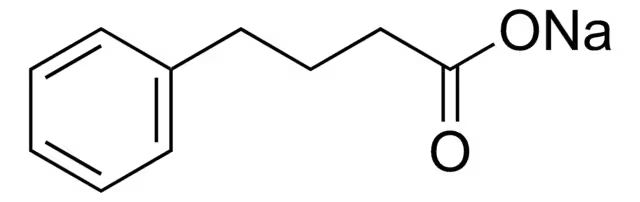
CAS Number1716-12-7
SynonymsBenzenebutanoic acid, sodium salt; 4-phenylbutyrate; Ammonaps; 4-Phenylbutyrate, sodium; Benzenebutanoic acid, sodium salt (1:1); Sodium phenylbutyrate; 4-Phenylbutyric Acid Sodium Salt; Phenylbutyric acid sodium salt; 4-PBA,4-Phenylbutyric acid,4-phenylbutyrate; Sodium 4-phenylbutanoate; 4-phenylbutanoic acid, sodium salt; MFCD00800247; BUPHENYL; triButyrate; Sodium 4-Phenylbutyrate
Molecular FormulaC10H11NaO2
Molecular Weight186.18
Purity98.00%
Density1.095g/cm3
Boiling Point290.7ºC at 760mmHg
Melting Point207 °C (dec.)(lit.)
AppearanceSolid;White to Almost white powder to crystal
Symbol
Signal WordWarning
| Chemical & Physical Properties | |
|---|---|
| CAS Number | 1716-12-7 |
| Catalog No. | 2A-9027344 |
| Chinese Name | 4-苯基丁酸钠盐 |
| Synonyms | Benzenebutanoic acid, sodium salt; 4-phenylbutyrate; Ammonaps; 4-Phenylbutyrate, sodium; Benzenebutanoic acid, sodium salt (1:1); Sodium phenylbutyrate; 4-Phenylbutyric Acid Sodium Salt; Phenylbutyric acid sodium salt; 4-PBA,4-Phenylbutyric acid,4-phenylbutyrate; Sodium 4-phenylbutanoate; 4-phenylbutanoic acid, sodium salt; MFCD00800247; BUPHENYL; triButyrate; Sodium 4-Phenylbutyrate |
| Molecular Formula | C10H11NaO2 |
| Molecular Weight | 186.18 |
| Purity | 98.00 |
| Density | 1.095g/cm3 |
| Boiling Point | 290.7ºC at 760mmHg |
| Melting Point | 207 °C (dec.)(lit.) |
| Appearance | Solid;White to Almost white powder to crystal |
| Water Solubility | Water solubility: soluble |
| Storage Condition | Sealed in a cool, dry environment |
| Application | Sodium phenylbutyrate is a histone deacetylase (HDAC) and endoplasmic reticulum stress (ER) inhibitor that can be used in the study of diseases such as cancer and infection. |
| HTC | 2916399090 |
| PubChem ID | 329831161 |
| SMILES | O=C([O-])CCCc1ccccc1.[Na+] |
| InChI | InChI=1S/C10H12O2.Na/c11-10(12)8-4-7-9-5-2-1-3-6-9;/h1-3,5-6H,4,7-8H2,(H,11,12);/q;+1/p-1 |
| InChI Key | VPZRWNZGLKXFOE-UHFFFAOYSA-M |
| Hazard Symbols | transportation |
| Bioactivity | Sodium phenylbutyrate is an inhibitor of HDAC and endoplasmic reticulum (ER) stress, used in cancer and infection research. Related Catalog Research Areas >> Cancer Target HDAC In Vitro Sodium phenylbutyrate is an inhibitor of HDAC, inhibits the growth of NSCLC Cell Lines at 2 mM. Sodium phenylbutyrate in combination with ciglitizone results in enhanced growth arrest of cancer cells[1]. Sodium phenylbutyrate (Sodium phenylbutyrate, 0-5 mM) inhibits ASFV infection in a dose-dependent manner. Sodium phenylbutyrate also inhibits the ASFV late protein synthesis and disrupts the virus-induced H3K9/K14 hypoacetylation status. Sodium phenylbutyrate and enrofloxacin act synergistically to abolish ASFV replication[2]. Addition of bafilomycin A1 results in accumulation of LC3II, whereas Benzenebutyric acid (4-PBA) substantially reduces this accumulation. LPS decreases the level of p62, whereas Benzenebutyric acid reverses this decrease upon LPS stimulation for 48 h. The percentage of cells with LPS-induced AVOs is increased at 48 h, whereas Benzenebutyric acid significantly reduces this percentage. Specifically, the percentage of cells with AVOs decreases from 61.6% to 53.1% upon Benzenebutyric acid treatment, supporting that Benzenebutyric acid inhibits LPS-induced autophagy. As a positive control for autophagy inhibition, bafilomycin A1 is used. The percentage of cells with LPS-induced AVOs is reduced by bafilomycin A1 treatment. The decreased OC area and fusion index observed after Benzenebutyric acid treatment are not observed with knockdown of ATG7. Inhibition of NF-κB using BAY 11-7082 and JSH23 reduce the LC3 II level upon LPS stimulation and completely abolish the inhibitory effect of Benzenebutyric acid on LPS-induced effects[3]. In Vivo LPS induces significant bone loss and decreases bone mineral density (BMD), bone volume (BV/TV), and trabecular thickness (Tb. Th) compared with PBS alone, whereas trabecular space (Tb. Sp.) is increased. Sodium phenylbutyrate attenuates LPS-induced bone loss. Treatment with Sodium phenylbutyrate increases BMD, BV/TV, and Tb. Th. compared with LPS alone, in addition to decreasing the enlargement of Tb. Sp., but no change is observed when mice are treated with Sodium phenylbutyrate alone. OC.S/BS as assessed by TRAP staining is also significantly reduced when Sodium phenylbutyrate is administered to LPS-treated mice. However, OC.N/BS tends to decrease, although not with statistical significance, when mice are treated with Sodium phenylbutyrate and LPS. These results indicate that the effect of Sodium phenylbutyrate on OC from LPS-treated mice is to reduce its size rather than number. Consistent with these findings, a marker of bone resorption in vivo, serum CTX-1 which is elevated by LPS treatment is decreased when Sodium phenylbutyrate administered to LPS-injected mice. However, co-treatment with Sodium phenylbutyrate do not significantly affect the levels of serum ALP and osteocalcin, 2 markers of bone formation in vivo, compared with LPS alone. Sodium phenylbutyrate also reduces the LPS-induced rise in serum MCP-1, indicating that Sodium phenylbutyrate decreases systemic inflammation induced by LPS[3]. Cell Assay Briefly, viable cells, as judged by trypan blue dye exclusion, are seeded at a density of 4 × 10⁴ cells/mL in 60-mm dishes in RPMI 1640 with 10% fetal bovine serum and 0.35% agarose on a base layer of 0.7% agarose. DMSO, TSA, or PB is added to both bottom and top agarose layers. Assays are performed in triplicate on at least three separate occasions, and colonies are counted at 10-14 days[1]. Animal Admin Mice[3] Female 10-week-old C57BL/6J mice are housed in the pathogen-free animal facility of IRC. Animals are randomized into the following 4 groups: vehicle control (n=5), vehicle+Benzenebutyric acid (n=6), LPS (n=6), and LPS+Benzenebutyric acid (n=6). Mice are treated with LPS in 200 μL phosphate-buffered saline (PBS) once a week (5 mg/kg, i.p.) for 3 weeks. Benzenebutyric acid solution is prepared by titrating equimolecular amounts of Benzenebutyric acid and sodium hydroxide to reach pH 7.4; mice are injected daily intraperitoneally in 200 μL PBS (or with PBS as a vehicle) at a dose of 240 mg/kg for 3 weeks. Mice are sacrificed by CO2 asphyxiation. To determine the bone mineral density (BMD) and microarchitecture of the long bone, the right femur is scanned. Scans are performed with an effective detector pixel size of 6.9 μm and a threshold of 77-255 mg/cc. Trabecular bone is analyzed in a region 1.6 mm in length and located 0.1 mm below the distal femur growth plate[3]. References [1]. Chang TH, et al. Enhanced growth inhibition by combination differentiation therapy with ligands of peroxisome proliferator-activated receptor-gamma and inhibitors of histone deacetylase in adenocarcinoma of the lung. Clin Cancer Res. 2002 Apr;8(4):1206-12. [2]. Frouco G, et, al. Sodium phenylbutyrate abrogates African swine fever virus replication by disrupting the virus-induced hypoacetylation status of histone H3K9/K14. Virus Res. 2017 Oct 15;242:24-29. [3]. Park HJ, et al. 4-Phenylbutyric acid protects against lipopolysaccharide-induced bone loss by modulating autophagy in osteoclasts. Biochem Pharmacol. 2018 May;151:9-17. Chemical & Physical Properties Density 1.095g/cm3 Boiling Point 290.7ºC at 760mmHg Melting Point 207 °C (dec.)(lit.) Molecular Formula C10H11NaO2 Molecular Weight 186.183 Flash Point 187.9ºC Exact Mass 186.065674 PSA 40.13000 LogP 0.75920 Vapour Pressure 0.00288mmHg at 25°C InChIKey VPZRWNZGLKXFOE-UHFFFAOYSA-M SMILES O=C([O-])CCCc1ccccc1.[Na+] Storage condition Desiccate at -20°C |
| Use of | Sodium phenylbutyrate is an inhibitor of HDAC and endoplasmic reticulum (ER) stress, used in cancer and infection research. Properties Articles18 Name sodium phenylbutyrate Synonym More Synonyms Sodium phenylbutyrate Biological Activity Description Sodium phenylbutyrate is an inhibitor of HDAC and endoplasmic reticulum (ER) stress, used in cancer and infection research. Related Catalog Research Areas >> Cancer References [1]. Chang TH, et al. Enhanced growth inhibition by combination differentiation therapy with ligands of peroxisome proliferator-activated receptor-gamma and inhibitors of histone deacetylase in adenocarcinoma of the lung. Clin Cancer Res. 2002 Apr;8(4):1206-12. [3]. Park HJ, et al. 4-Phenylbutyric acid protects against lipopolysaccharide-induced bone loss by modulating autophagy in osteoclasts. Biochem Pharmacol. 2018 May;151:9-17. Chemical & Physical Properties Molecular Formula C10H11NaO2 Exact Mass 186.065674 PSA 40.13000 LogP 0.75920 InChIKey VPZRWNZGLKXFOE-UHFFFAOYSA-M |
| Tax Rebate | 9.0% |
| Supervision | None MFN tariff: 6.5% Ordinary tariff: 30.0% |
| Transport Info | Shipping Name: UN |
| MSDS Transport Info | Module 14. Shipping information 14.1 UN dangerous goods number European Land Transport Dangerous Regulations: -International Maritime Dangerous Regulations: -International Air Transport Dangerous Regulations: - 14.2 United Nations shipping name European Land Transport Dangerous Regulations: Non-dangerous goods IMDG Code: Non-dangerous goods International air transport dangerous goods regulations: non-dangerous goods 14.3 Transport hazard categories European Land Transport Dangerous Regulations: -International Maritime Dangerous Regulations: -International Air Transport Dangerous Regulations: - 14.4 Package group European Land Transport Dangerous Regulations: -International Maritime Dangerous Regulations: -International Air Transport Dangerous Regulations: - 14.5 Environmental hazards European Land Transport Danger Regulations: No International Maritime Danger Regulations International Air Transport Danger Regulations: No Marine pollutants (yes/no): No 14.6 Special reminder to users No data available |
| Related Products in Specialty Chemicals | ||
|---|---|---|
| 4-Iodobenzoyl chloride | 1711-02-0 | 2A-9027332 |
| 3-Methoxybenzoyl chloride | 1711-05-3 | 2A-9027333 |
| 3-Methylbenzoyl chloride | 1711-06-4 | 2A-9027334 |
| 3-Cyanobenzoyl chloride | 1711-11-1 | 2A-9027337 |
| 1-Bromopyrene | 1714-29-0 | 2A-9027342 |
| Dichlorofluoroethane | 1717-00-6 | 2A-9027346 |
| 2-(Fluorosulfonyl)difluoroacetic acid | 1717-59-5 | 2A-9027348 |
| Sodium 5-[(4-nitrophenyl)azo]salicylate | 1718-34-9 | 2A-9027349 |
| Dichlorodiethylsilane | 1719-53-5 | 2A-9027350 |
| Tetrazolium Violet | 1719-71-7 | 2A-9027353 |
| Browse all Specialty Chemicals products » | ||
Phone:
630-322-8886
630-322-8887
Email:
Office Locations:
Chicago, IL, USA
San Francisco, CA, USA


 EN
EN


 SDS
SDS