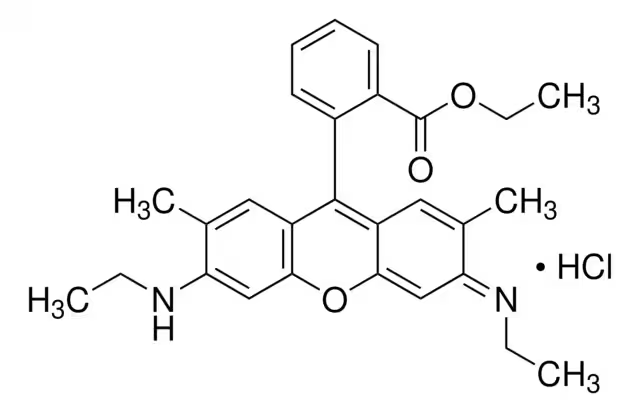
CAS Number989-38-8
Synonymsfanal pink gfk; Rhodamine 5GDN; Aizen Rhodamine 6GCP; Basic rhodamine yellow; Rhodamine 6GDN Extra; Basic Rhodaminic Yellow; Rhodamine 6JH-SA Extra 1150; Mitsui Rhodamine 6GCP; cibasicred1; Rhodamine 6G Extra; Basonyl Red 483; CI Basic Red 1; Basonyl Red 482; Rhodamine 6GBN; Nyco Liquid Red GF; Basic red 1; Rhodamine 5GL; Rhodamine 6JH; Flexo Red 482; Rhodamine 5GDN Extra; Eljon Pink Toner; Rhodamine F 5GL; fanalpinkb; Rhodamine F 5G; Rhodamine GDN Extra; Rhodamine 6G Extra Base; Rhodamine 6GCP; Fanal Pink B; red169; Calcozine Rhodamine 6GX
Molecular FormulaC28H31N2O3Cl
Molecular Weight479.01
Purity98.00%
Density1.15g/cm3
Boiling Point<200ºC
Melting Point215 °C
Appearancepowder
EINECS213-584-9
| Chemical & Physical Properties | |
|---|---|
| CAS Number | 989-38-8 |
| Catalog No. | 2A-9025823 |
| Chinese Name | 罗丹明6G |
| Synonyms | fanal pink gfk; Rhodamine 5GDN; Aizen Rhodamine 6GCP; Basic rhodamine yellow; Rhodamine 6GDN Extra; Basic Rhodaminic Yellow; Rhodamine 6JH-SA Extra 1150; Mitsui Rhodamine 6GCP; cibasicred1; Rhodamine 6G Extra; Basonyl Red 483; CI Basic Red 1; Basonyl Red 482; Rhodamine 6GBN; Nyco Liquid Red GF; Basic red 1; Rhodamine 5GL; Rhodamine 6JH; Flexo Red 482; Rhodamine 5GDN Extra; Eljon Pink Toner; Rhodamine F 5GL; fanalpinkb; Rhodamine F 5G; Rhodamine GDN Extra; Rhodamine 6G Extra Base; Rhodamine 6GCP; Fanal Pink B; red169; Calcozine Rhodamine 6GX |
| Molecular Formula | C28H31N2O3Cl |
| Molecular Weight | 479.01 |
| Purity | 98.00 |
| Density | 1.15g/cm3 |
| Boiling Point | <200ºC |
| Melting Point | 215 °C |
| Appearance | powder |
| Water Solubility | SOLUBLE |
| Storage Condition | Keep container sealed and store in a cool, dry pla |
| Application | Rhodamine 6G is a rhodamine analogue that can be used in Pgp efflux assays. It can be used in kinetic assays of MRP1-mediated efflux, as well as as a laser dye and has potential as a mitochondrial pro |
| EINECS | 213-584-9 |
| HTC | 3204130000 |
| PubChem ID | 24899367 |
| MDL Number | MFCD00012665 |
| SMILES | Cl.CCNc1cc2OC3=CC(=N/CC)\C(C)=CC3=C(c2cc1C)c4ccccc4C(=O)OCC |
| InChI | 1S/C28H30N2O3.ClH/c1-6-29-23-15-25-21(13-17(23)4)27(19-11-9-10-12-20(19)28(31)32-8-3)22-14-18(5)24(30-7-2)16-26(22)33-25;/h9-16,29H,6-8H2,1-5H3;1H/b30-24+; |
| InChI Key | VYXSBFYARXAAKO-WTKGSRSZSA-N |
| Beilstein/REAXYS | 3900071 |
| NACRES Code | NA.47 |
| UNSPSC | 12171500 |
| MSDS | msds/25823_1_989_38_8.pdf |
| Bioactivity | Rhodamine 6G is a rhodamine analog useful in Pgp efflux assays. It can be used in characterizing the kinetics of MRP1- mediated efflux, and as a laser dye and potential mitochondrial probe. Related Catalog Signaling Pathways >> Others >> Others Dye Reagents Research Areas >> Others In Vitro Rhodamine 6G, also known as Rhodamine 590, is widely used as a lasing medium and as a fluorescence tracer. For use in dye lasers, it is dissolved in methanol, ethanol and a variety of other organic solvents. In environmental flow studies, the tracer medium is typically water. In ethanol, the absorption of rhodamine 6G ranges between 440 nm and 570 nm, with the peak at 530 nm. It is thus ideally suited for pumping by frequency doubled Nd:YAG lasers at 532 nm, copper vapor lasers at 511 nm, and argon-ion lasers at 514 nm. The resulting emission spectrum varies from about 510 nm to around 710 nm with the peak at 550 nm depending on the solvent and the dye concentration. However, the laser emission range is much narrower, from around 560 nm to 610 nm with the peak wavelength around 575 nm. Energy conversion efficiencies greater than 50% are achievable. In order to select the optimal solvent and dye concentration, good knowledge of their effects is a pre-requisite. Rhodamine 6G in DMSO shows a distinct behavior exhibiting only 41% of the fluorescence intensity of the methanol case with an 11 nm red-shifted wavelength. Relatively small changes of the fluorescence spectrum are observed for the different solvents; the highest fluorescence intensity is observed for methanol and lowest for DMSO. The shortest peak wavelength is found in methanol (568 nm) and the longest in DMSO (579 nm). Changing the dye concentration provides tunability between 550 nm in the dilute case and 620 nm at high concentration, at which point the fluorescence spectrum indicates the formation of rhodamine 6G aggregates[1]. Rhodamine 6G is a fluorescent dye capable of penetrating a living cell. Upon entering the cell, Rhodamine 6G binds to the inner membranes of mitochondria. Based on these observations, it has been proposed that Rhodamine dyes may be used for producing fluorescent images of mitochondria with low background noise and high resolution. Extremely low concentrations of Rhodamine 6G appear to selectively destroy malignant cells in culture, sparing the normal cell populations[2]. In Vivo Melanoma-transplanted mice receiving Rhodamine 6G demonstrate prolonged survival, improved clinical parameters, inhibited tumor growth and metastases count, compared to their untreated counterparts. Twice-a-week 10-6M Rhodamine 6G regimen yield the most prominent results[2]. The Rhodamine-6G enters the circulatory system and labels leukocytes. It is possible to monitor changes in the interactions between leukocytes and the endothelium by determining the numbers of rolling and adhering leukocytes as well as the total flux of these cells[3]. Cell Assay Malignant cells and normal control cultures are seeded in equal (protein adjusted) cell amounts into 6-well tissue culture plates. The cells are pulsed with 25µCi/mL of 3H-Thymidine and immediately treated with Rhodamine 6G at the fixed concentration of 1 μM for 24h, 48h, 72h or 5 days (120h). Following 24h, 48h, 72h or 5 days, the excessive radioactive material is ished out with PBS. The cell samples are transferred into polystyrene vials containing 4 ml scintillation liquid, and their radioactivity counted in a β-counter. Total cell protein is assessed by Bradford's assay[2]. Animal Admin Mice: C57Bl mice are implanted with B16-F10 melanoma and treated with Rhodamine 6G (1, 0.1, 0.01 μM) at different dosage/time regimens. Viability and proliferation of cultured tumor cells are analyzed[2]. References [1]. Zehentbauer FM, et al. Fluorescence spectroscopy of Rhodamine 6G: concentration and solvent effects. Spectrochim Acta A Mol Biomol Spectrosc. 2014;121:147-51. [2]. Kutushov M, et al. Low concentrations of Rhodamine 6G selectively destroy tumor cells and improve survival of melanoma transplanted mice. Neoplasma. 2013;60(3):262-73. [3]. Jain RK, et al. Measuring leukocyte-endothelial interactions in mice. Cold Spring Harb Protoc. 2013 Jun 1;2013(6):561-3. Chemical & Physical Properties Density 1.15g/cm3 Boiling Point <200ºC Melting Point 290 °C Molecular Formula C28H31ClN2O3 Molecular Weight 479.010 Flash Point 318.6ºC Exact Mass 478.202332 PSA 63.83000 LogP 7.22550 Index of Refraction 1.593 InChIKey VYXSBFYARXAAKO-UHFFFAOYSA-N SMILES CCNc1cc2oc3cc(=[NH+]CC)c(C)cc-3c(-c3ccccc3C(=O)OCC)c2cc1C.[Cl-] Water Solubility SOLUBLE |
| Use of | Rhodamine 6G is a rhodamine analog useful in Pgp efflux assays. It can be used in characterizing the kinetics of MRP1- mediated efflux, and as a laser dye and potential mitochondrial probe. Properties Articles129 Name rhodamine 6G Synonym More Synonyms Rhodamine 6G Biological Activity Description Rhodamine 6G is a rhodamine analog useful in Pgp efflux assays. It can be used in characterizing the kinetics of MRP1- mediated efflux, and as a laser dye and potential mitochondrial probe. Related Catalog Signaling Pathways >> Others >> Others Dye Reagents Research Areas >> Others In Vitro Rhodamine 6G, also known as Rhodamine 590, is widely used as a lasing medium and as a fluorescence tracer. For use in dye lasers, it is dissolved in methanol, ethanol and a variety of other organic solvents. In environmental flow studies, the tracer medium is typically water. In ethanol, the absorption of rhodamine 6G ranges between 440 nm and 570 nm, with the peak at 530 nm. It is thus ideally suited for pumping by frequency doubled Nd:YAG lasers at 532 nm, copper vapor lasers at 511 nm, and argon-ion lasers at 514 nm. The resulting emission spectrum varies from about 510 nm to around 710 nm with the peak at 550 nm depending on the solvent and the dye concentration. However, the laser emission range is much narrower, from around 560 nm to 610 nm with the peak wavelength around 575 nm. Energy conversion efficiencies greater than 50% are achievable. In order to select the optimal solvent and dye concentration, good knowledge of their effects is a pre-requisite. Rhodamine 6G in DMSO shows a distinct behavior exhibiting only 41% of the fluorescence intensity of the methanol case with an 11 nm red-shifted wavelength. Relatively small changes of the fluorescence spectrum are observed for the different solvents; the highest fluorescence intensity is observed for methanol and lowest for DMSO. The shortest peak wavelength is found in methanol (568 nm) and the longest in DMSO (579 nm). Changing the dye concentration provides tunability between 550 nm in the dilute case and 620 nm at high concentration, at which point the fluorescence spectrum indicates the formation of rhodamine 6G aggregates[1]. Rhodamine 6G is a fluorescent dye capable of penetrating a living cell. Upon entering the cell, Rhodamine 6G binds to the inner membranes of mitochondria. Based on these observations, it has been proposed that Rhodamine dyes may be used for producing fluorescent images of mitochondria with low background noise and high resolution. Extremely low concentrations of Rhodamine 6G appear to selectively destroy malignant cells in culture, sparing the normal cell populations[2]. In Vivo Melanoma-transplanted mice receiving Rhodamine 6G demonstrate prolonged survival, improved clinical parameters, inhibited tumor growth and metastases count, compared to their untreated counterparts. Twice-a-week 10-6M Rhodamine 6G regimen yield the most prominent results[2]. The Rhodamine-6G enters the circulatory system and labels leukocytes. It is possible to monitor changes in the interactions between leukocytes and the endothelium by determining the numbers of rolling and adhering leukocytes as well as the total flux of these cells[3]. References [1]. Zehentbauer FM, et al. Fluorescence spectroscopy of Rhodamine 6G: concentration and solvent effects. Spectrochim Acta A Mol Biomol Spectrosc. 2014;121:147-51. [2]. Kutushov M, et al. Low concentrations of Rhodamine 6G selectively destroy tumor cells and improve survival of melanoma transplanted mice. Neoplasma. 2013;60(3):262-73. [3]. Jain RK, et al. Measuring leukocyte-endothelial interactions in mice. Cold Spring Harb Protoc. 2013 Jun 1;2013(6):561-3. Chemical & Physical Properties Exact Mass 478.202332 PSA 63.83000 LogP 7.22550 Index of Refraction 1.593 InChIKey VYXSBFYARXAAKO-UHFFFAOYSA-N Water Solubility SOLUBLE |
| Tax Rebate | 13.0% |
| Supervision | None. MFN tariff: 6.5%. Ordinary tariff: 30.0% |
| Transport Info | Product name: Summary 2922199090. other amino-alcohols, other than those containing more than one kind of oxygen function, their ethers and esters; salts thereof. VAT:17.0%. Tax rebate rate:13.0%. . MFN tariff:6.5%. General tariff:30.0% |
| Related Products in Pigments & Additives | ||
|---|---|---|
| Acid Red 94 | 632-69-9 | 2A-9024613 |
| Acid Orange 7 | 633-96-5 | 2A-9024624 |
| Acid Blue 74 | 860-22-0 | 2A-9025427 |
| Acid Red 27 | 915-67-3 | 2A-9025577 |
| Pigment Red 122 | 980-26-7 | 2A-9025814 |
| Pigment Violet 19 | 1047-16-1 | 2A-9025973 |
| Pigment Red 49:1 | 1103-38-4 | 2A-9026121 |
| Pigment Red 49:2 | 1103-39-5 | 2A-9026122 |
| Solvent Red 1 | 1229-55-6 | 2A-9026530 |
| Solvent Red 27 | 1320-06-5 | 2A-9026662 |
| Browse all Pigments & Additives products » | ||
Phone:
630-322-8886
630-322-8887
Email:
Office Locations:
Chicago, IL, USA
San Francisco, CA, USA


 EN
EN


 SDS
SDS