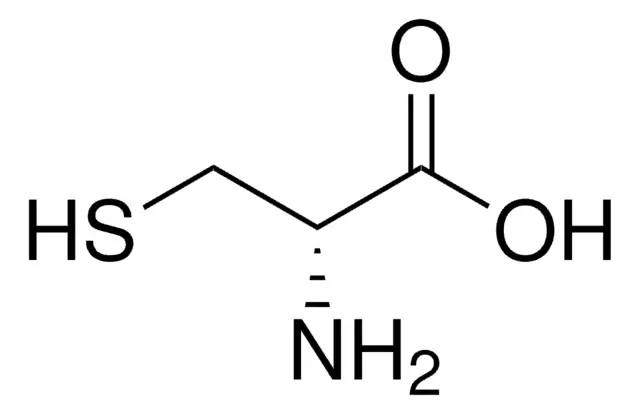
CAS Number921-01-7
SynonymsS-cysteine; (D,L)-H-Cys-OH; D-Cystein; MFCD00066461; (2S)-2-amino-3-sulfanylpropanoic acid; EINECS 213-062-0; Cysteine,D; 2-amino-3-sulfopropionic acid; D-Zystein; H-D-Cys-OH
Molecular FormulaC3H7NO2S
Molecular Weight121.16
Purity≥99 (RT)%
Density1.3±0.1 g/cm3
Boiling Point293.9±35.0 °C at 760 mmHg
Melting Point~230 °C (dec.)
Appearancepowder or crystals
| Chemical & Physical Properties | |
|---|---|
| CAS Number | 921-01-7 |
| Catalog No. | 2A-0200680 |
| Chinese Name | D-半胱氨酸 |
| Synonyms | S-cysteine; (D,L)-H-Cys-OH; D-Cystein; MFCD00066461; (2S)-2-amino-3-sulfanylpropanoic acid; EINECS 213-062-0; Cysteine,D; 2-amino-3-sulfopropionic acid; D-Zystein; H-D-Cys-OH |
| Molecular Formula | C3H7NO2S |
| Molecular Weight | 121.16 |
| Purity | ≥99 (RT) |
| Density | 1.3±0.1 g/cm3 |
| Boiling Point | 293.9±35.0 °C at 760 mmHg |
| Melting Point | ~230 °C (dec.) |
| Appearance | powder or crystals |
| Storage Condition | -20℃, avoid light, ventilated and dry place |
| Application | D-Cysteine is the D-isomer of cysteine and a powerful inhibitor of E. coli growth. D-Cysteine produces H2S mediated by D-amino acid oxidase and is a neuroprotective agent against cerebellar atax |
| HTC | 29309013 |
| PubChem ID | 57648407 |
| MDL Number | MFCD00066461 |
| SMILES | N[C@H](CS)C(O)=O |
| InChI | 1S/C3H7NO2S/c4-2(1-7)3(5)6/h2,7H,1,4H2,(H,5,6)/t2-/m1/s1 |
| InChI Key | XUJNEKJLAYXESH-UWTATZPHSA-N |
| Beilstein/REAXYS | 1721407 |
| NACRES Code | NA.22 |
| eCl@ss | 32160406 |
| UNSPSC | 12352209 |
| MSDS | msds/25588_1_921_01_7.pdf |
| Bioactivity | D-Cysteine is the D-isomer of cysteine and a powerful inhibitor of Escherichia coli growth. D-cysteine is mediated by D-amino acid oxidase to produce H2S and is a neuroprotectant against cerebellar ataxias. D-Cysteine could inhibit the growth and cariogenic virulence of dual-species biofilms formed by S. mutans and S. sanguinis[1][2][3]. Related Catalog Research Areas >> Infection Research Areas >> Neurological Disease Signaling Pathways >> Anti-infection >> Bacterial Target Human Endogenous Metabolite References [1]. Seki T. Availability of D-cysteine as a protectant for cerebellar neurons. Nihon Yakurigaku Zasshi. 2019;154(3):133-137. [2]. Soutourina J, et al. Role of D-cysteine desulfhydrase in the adaptation of Escherichia coli to D-cysteine. J Biol Chem. 2001 Nov 2;276(44):40864-72. [3]. Guo X1, et al. Effect of D-cysteine on dual-species biofilms of Streptococcus mutans and Streptococcus sanguinis. Sci Rep. 2019 Apr 30;9(1):6689. Chemical & Physical Properties Density 1.3±0.1 g/cm3 Boiling Point 293.9±35.0 °C at 760 mmHg Melting Point 230ºC Molecular Formula C3H7NO2S Molecular Weight 121.158 Flash Point 131.5±25.9 °C Exact Mass 121.019745 PSA 102.12000 LogP 0.23 Vapour Pressure 0.0±1.3 mmHg at 25°C Index of Refraction 1.550 InChIKey XUJNEKJLAYXESH-UWTATZPHSA-N SMILES NC(CS)C(=O)O Storage condition −20°C Stability Stable. Incompatible with strong oxidizing agents. |
| Use of | D-Cysteine is the D-isomer of cysteine and a powerful inhibitor of Escherichia coli growth. D-cysteine is mediated by D-amino acid oxidase to produce H2S and is a neuroprotectant against cerebellar ataxias. D-Cysteine could inhibit the growth and cariogenic virulence of dual-species biofilms formed by S. mutans and S. sanguinis[1][2][3]. Properties Articles17 Name D-cysteine Synonym More Synonyms D-Cysteine Biological Activity Description D-Cysteine is the D-isomer of cysteine and a powerful inhibitor of Escherichia coli growth. D-cysteine is mediated by D-amino acid oxidase to produce H2S and is a neuroprotectant against cerebellar ataxias. D-Cysteine could inhibit the growth and cariogenic virulence of dual-species biofilms formed by S. mutans and S. sanguinis[1][2][3]. Related Catalog Research Areas >> Infection Research Areas >> Neurological Disease Signaling Pathways >> Anti-infection >> Bacterial Human Endogenous Metabolite References [1]. Seki T. Availability of D-cysteine as a protectant for cerebellar neurons. Nihon Yakurigaku Zasshi. 2019;154(3):133-137. [2]. Soutourina J, et al. Role of D-cysteine desulfhydrase in the adaptation of Escherichia coli to D-cysteine. J Biol Chem. 2001 Nov 2;276(44):40864-72. [3]. Guo X1, et al. Effect of D-cysteine on dual-species biofilms of Streptococcus mutans and Streptococcus sanguinis. Sci Rep. 2019 Apr 30;9(1):6689. Chemical & Physical Properties Molecular Formula C3H7NO2S Exact Mass 121.019745 PSA 102.12000 Index of Refraction 1.550 InChIKey XUJNEKJLAYXESH-UWTATZPHSA-N SMILES NC(CS)C(=O)O Stability Stable. Incompatible with strong oxidizing agents. |
| Transport Info | Product name: D-cysteine |
| Related Products in Specialty Chemicals | ||
|---|---|---|
| Clomifene | 911-45-5 | 2A-9025573 |
| Sodium cyanate | 917-61-3 | 2A-9025579 |
| 3-Aminopropyltriethoxysilane | 919-30-2 | 2A-9025582 |
| Isobutyllithium | 920-36-5 | 2A-9025583 |
| Heptamethyldisilazane | 920-68-3 | 2A-9025587 |
| Potassium tartrate | 921-53-9 | 2A-9025590 |
| 1,4-Pentadien-3-ol | 922-65-6 | 2A-9025594 |
| Methyl propiolate | 922-67-8 | 2A-9025595 |
| Potassium hydrogen DL-aspartate | 923-09-1 | 2A-0201422 |
| D-Alanyl-D-alanine | 923-16-0 | 2A-9025598 |
| Browse all Specialty Chemicals products » | ||
Phone:
630-322-8886
630-322-8887
Email:
Office Locations:
Chicago, IL, USA
San Francisco, CA, USA


 EN
EN


 SDS
SDS