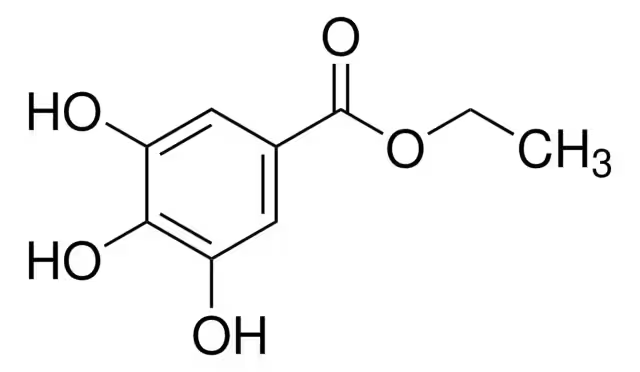
CAS Number831-61-8
SynonymsN-ETHYLGALLATE; nipa48; MFCD00016430; nipagallina; ethyl 3,4,5-trihydroxybenzoate; Nipa No. 48; 3,4,5-Trihydroxybenzoic acid ethyl ester; 3,4,5-trihydroxyethylbenzoate; Progallin A; Gallic acid ethyl ester; Phyllemblin; Gallic acid ethyl; EINECS 212-608-5; Ethyl gallate; Benzoic acid, 3,4,5-trihydroxy-, ethyl ester; ethylgallate
Molecular Formula3,4,5-(OH)3C6H2COOC2H5
Molecular Weight198.17
Purity≥96.0 (HPLC)%
Density1.4±0.1 g/cm3
Boiling Point447.3±40.0 °C at 760 mmHg
Melting Point149-153 °C
Appearancesolid
EINECS212-608-5
Symbol
Signal WordWarning
| Chemical & Physical Properties | |
|---|---|
| CAS Number | 831-61-8 |
| Catalog No. | 2A-9025389 |
| Chinese Name | 没食子酸乙酯 |
| Synonyms | N-ETHYLGALLATE; nipa48; MFCD00016430; nipagallina; ethyl 3,4,5-trihydroxybenzoate; Nipa No. 48; 3,4,5-Trihydroxybenzoic acid ethyl ester; 3,4,5-trihydroxyethylbenzoate; Progallin A; Gallic acid ethyl ester; Phyllemblin; Gallic acid ethyl; EINECS 212-608-5; Ethyl gallate; Benzoic acid, 3,4,5-trihydroxy-, ethyl ester; ethylgallate |
| Molecular Formula | 3,4,5-(OH)3C6H2COOC2H5 |
| Molecular Weight | 198.17 |
| Purity | ≥96.0 (HPLC) |
| Density | 1.4±0.1 g/cm3 |
| Boiling Point | 447.3±40.0 °C at 760 mmHg |
| Melting Point | 149-153 °C |
| Appearance | solid |
| Water Solubility | soluble |
| Storage Condition | Keep container sealed and store in a cool, dry pla |
| Application | Ethyl gallate is a non-flavonoid phenolic compound that is also a hydrogen peroxide scavenger. |
| EINECS | 212-608-5 |
| HTC | 2918290000 |
| PubChem ID | 57651155 |
| MDL Number | MFCD00016430 |
| SMILES | CCOC(=O)c1cc(O)c(O)c(O)c1 |
| InChI | 1S/C9H10O5/c1-2-14-9(13)5-3-6(10)8(12)7(11)4-5/h3-4,10-12H,2H2,1H3 |
| InChI Key | VFPFQHQNJCMNBZ-UHFFFAOYSA-N |
| Beilstein/REAXYS | 2116014 |
| NACRES Code | NA.22 |
| UNSPSC | 12352100 |
| Hazard Symbols | transportation |
| MSDS | msds/25389_1_831_61_8.pdf |
| Bioactivity | Ethyl gallate is a nonflavonoid phenolic compound and also a scavenger of hydrogen peroxide. Related Catalog Signaling Pathways >> Others >> Others Research Areas >> Metabolic Disease Natural Products >> Phenols In Vitro Ethyl gallate is a nonflavonoid phenolic compound and also a scavenger of hydrogen peroxide. After treatment for 24 h or 48 h with Ethyl gallate, HL-60 cells show changes in morphology, including shrinkage of the cell membrane and the development of apoptotic bodies. Consistent with these effects, the viability of Ethyl gallate-treated cells decreases in a time- and dose-dependent manner, demonstrating that Ethyl gallate has a cytotoxic effect on HL-60 cells. Ethyl gallate treatment increases the proportion of cells in subG1 phase in a concentration- and time-dependent manner. Treatment of cells for 24 h or 48 h with 50 μM or 75 μM Ethyl gallate increases the percentage of cells in the subG1 phase from a baseline of 2.9% to 26.5% or 52.6%, respectively. It is found that Ethyl gallate treatment of HL-60 cells decreases the expression of Bcl-2 at 75 μM Ethyl gallate, and increases Bax and truncated Bid (tBid) expression at 24 h[1]. In Vivo No significant difference in the serum total protein, albumin, globulin and glucose is found between the rats fed with A. nilotica (L.) leaf extract on ethyl gallate equivalent basis and those fed with Ethyl gallate alone. Significant differences in total bilirubin level, however, exist between the rats that receive A. nilotica (L.) leaf extract, 500 mg/kg body weight (ethyl gallate equivalent of 10 mg/kg, 0.34±0.01 mg/dL) and those receiving 10 mg/kg body weight of Ethyl gallate (0.26±0.01 mg/dL). Significant difference is found for ALT between groups fed with 500 and 1000 mg/kg body weight of A. nilotica (L.) leaf extract (26.52±1.23 and 30.05±1.38 U/L) and 10 and 20 mg/kg of Ethyl gallate (20.50±0.94 and 24.67±1.13 U/L)[2]. Kinase Assay The expression of apoptosis-related proteins (caspases-8, -9, -3; AIF; Endo G; Bid; Bax; and Bcl-2) in HL-60 cells is determined by sodium dodecyl sulfate-polyacrylamide gel electrophoresis (SDS-PAGE) of lysates followed by western blotting. For this, HL-60 cells (1.5×10⁶) are treated with 50 μM or 75 μM Ethyl gallate for 6 h, 12 h, or 24 h. Total cell lysates are obtained by resuspending cells in ice-cold radioimmunoprecipitation assay (RIPA) buffer for 30 min followed by centrifugation. Protein concentration is determined using a NanoDrop spectrophotometer. Aliquots of lysates (100 μg protein equivalents) are resolved by 12% SDS-PAGE and transferred onto nitrocellulose membranes[1]. Cell Assay HL-60 cells (1×10⁶) are treated with 50 μM or 75 μM Ethyl gallate for 24 h or 48 h at 37°C. Cells are then harvested by centrifugation and fixed in 70% ethanol at 4°C for 24 h. Fixed cells are resuspended in PBS containing 40 μg/mL Propidium iodide (PI), 100 μg/mL RNase A, and 0.1% Triton X-100 and incubated in the dark for 30 min at room temperature. Cell cycle distribution is analyzed by flow cytometry on a FACSCalibur. To investigate apoptotic cells, HL-60 cells (1×10⁶) incubated with different concentration of 50 μM, 75 μM and 100 μM Ethyl gallate for 24 h or 48 h at 37°C, and then DAPI staining is conducted. The cells are photographed using a fluorescence microscopy[1]. Animal Admin Forty eight female albino Wistar rats of six to eight weeks old are used and divided into eight groups based on their body weights. Group 1 rats serve as control receiving 1.0 mL of the vehicle (0.1% ethanol); Group 2 rats receive A. nilotica (L.) leaf extract (250 mg/kg body weight); Group 3 rats receive A. nilotica (L.) leaf extract (500 mg/kg body weight); Group 4 rats receive A. nilotica (L.) leaf extract (1000 mg/kg body weight); Group 5 rats receive A. nilotica (L.) leaf extract (2000 mg/kg body weight); Group 6 rats receive Ethyl gallate (5 mg/kg body weight); Group 7 rats receive Ethyl gallate (10 mg/kg body weight); Group 8 rats receive Ethyl gallate (20 mg/kg body weight). Body weights are recorded on 0th and 14th day for each group and all rats are decapitated after an overnight fast[2]. References [1]. Kim WH, et al. Ethyl gallate induces apoptosis of HL-60 cells by promoting the expression of caspases-8, -9, -3, apoptosis-inducing factor and endonuclease G. Int J Mol Sci. 2012;13(9):11912-22. [2]. Mohan S, et al. In vitro protection of biological macromolecules against oxidative stress and in vivo toxicity evaluation of Acacia nilotica (L.) and ethyl gallate in rats. BMC Complement Altern Med. 2014 Jul 21;14:257. Chemical & Physical Properties Density 1.4±0.1 g/cm3 Boiling Point 447.3±40.0 °C at 760 mmHg Melting Point 149-153 °C Molecular Formula C9H10O5 Molecular Weight 198.173 Flash Point 185.0±20.8 °C Exact Mass 198.052826 PSA 86.99000 LogP 2.07 Vapour Pressure 0.0±1.1 mmHg at 25°C Index of Refraction 1.611 InChIKey VFPFQHQNJCMNBZ-UHFFFAOYSA-N SMILES CCOC(=O)c1cc(O)c(O)c(O)c1 Water Solubility soluble |
| Use of | Ethyl gallate is a nonflavonoid phenolic compound and also a scavenger of hydrogen peroxide. Properties Articles38 Name ethyl gallate Synonym More Synonyms Ethyl gallate Biological Activity Description Ethyl gallate is a nonflavonoid phenolic compound and also a scavenger of hydrogen peroxide. Related Catalog Signaling Pathways >> Others >> Others Research Areas >> Metabolic Disease Natural Products >> Phenols References [2]. Mohan S, et al. In vitro protection of biological macromolecules against oxidative stress and in vivo toxicity evaluation of Acacia nilotica (L.) and ethyl gallate in rats. BMC Complement Altern Med. 2014 Jul 21;14:257. Chemical & Physical Properties Molecular Formula C9H10O5 Exact Mass 198.052826 PSA 86.99000 Index of Refraction 1.611 InChIKey VFPFQHQNJCMNBZ-UHFFFAOYSA-N Water Solubility soluble |
| Tax Rebate | 9.0% |
| Supervision | A. Customs clearance form for inbound goods B. Customs clearance form for outbound goods |
| Inspection | R. Hygiene supervision and inspection of imported food S. Hygiene supervision and inspection of exported food |
| Transport Info | Product name: Purity: 0.0% |
| MSDS Transport Info | Module 14. Shipping information 14.1 UN dangerous goods number European Land Transport Dangerous Regulations: -International Maritime Dangerous Regulations: -International Air Transport Dangerous Regulations: - 14.2 Names specified by the United Nations (UN) European Land Transport Dangerous Regulations: Non-dangerous goods IMDG Code: Non-dangerous goods International air transport dangerous goods regulations: non-dangerous goods 14.3 Transport hazard categories European Land Transport Dangerous Regulations: -International Maritime Dangerous Regulations: -International Air Transport Dangerous Regulations: - 14.4 Package group European Land Transport Dangerous Regulations: -International Maritime Dangerous Regulations: -International Air Transport Dangerous Regulations: - 14.5 Environmental hazards European Land Transport Dangerous Regulations: No International Maritime Transport Dangerous Regulations Maritime Pollutants: No International Air Transport Risk Regulations: No 14.6 Special reminder to users No data available The above information is believed to be correct, but is not all-inclusive and should be used as a guide only. The information in this document is based on our current knowledge and is Correct safety instructions apply to this product. This information does not represent a warranty as to the properties of this product. See reverse side of invoice or packing slip. |
| Related Products in Specialty Chemicals | ||
|---|---|---|
| Diphenylphosphine | 829-85-6 | 2A-9025379 |
| 1-Naphthyl acetate | 830-81-9 | 2A-9025383 |
| 5-Bromogramine | 830-93-3 | 2A-9025384 |
| 5-Chlorogramine | 830-94-4 | 2A-9025385 |
| Sodium picramate | 831-52-7 | 2A-9025388 |
| Methyl 4-methoxycinnamate | 832-01-9 | 2A-9025391 |
| 2-Naphthol-6-sulfonic acid potassium salt | 833-66-9 | 2A-9025395 |
| 4-Nitrodiphenylamine | 836-30-6 | 2A-9025399 |
| 4-(Benzyloxy)benzyl chloride | 836-42-0 | 2A-9025400 |
| Diphenyl phosphate | 838-85-7 | 2A-9025404 |
| Browse all Specialty Chemicals products » | ||
Phone:
630-322-8886
630-322-8887
Email:
Office Locations:
Chicago, IL, USA
San Francisco, CA, USA


 EN
EN


 SDS
SDS