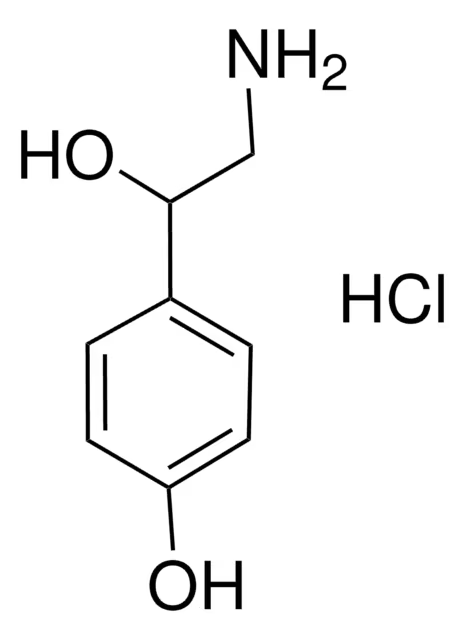
CAS Number770-05-8
SynonymsBenzenemethanol, α-(aminomethyl)-4-hydroxy-, hydrochloride (1:1); 4-(2-amino-1-hydroxyethyl)phenol hydrochloride; EINECS 212-216-4; MFCD00012881; 4-(2-Amino-1-hydroxyethyl)phenol hydrochloride (1:1)
Molecular FormulaHOC6H4CH(CH2NH2)OH · HCl
Molecular Weight189.64
Purity≥98.0 (GC)%
Boiling Point360.7ºC at 760 mmHg
Melting Point~170 °C (dec.) (lit.)
AppearanceWhite or off-white solid
EINECS212-216-4
Symbol
Signal WordWarning
| Chemical & Physical Properties | |
|---|---|
| CAS Number | 770-05-8 |
| Catalog No. | 2A-9025187 |
| Chinese Name | 章胺盐酸盐 |
| Synonyms | Benzenemethanol, α-(aminomethyl)-4-hydroxy-, hydrochloride (1:1); 4-(2-amino-1-hydroxyethyl)phenol hydrochloride; EINECS 212-216-4; MFCD00012881; 4-(2-Amino-1-hydroxyethyl)phenol hydrochloride (1:1) |
| Molecular Formula | HOC6H4CH(CH2NH2)OH · HCl |
| Molecular Weight | 189.64 |
| Purity | ≥98.0 (GC) |
| Boiling Point | 360.7ºC at 760 mmHg |
| Melting Point | ~170 °C (dec.) (lit.) |
| Appearance | White or off-white solid |
| Water Solubility | soluble |
| Storage Condition | Should be sealed and stored dry. |
| Packaging | III |
| Application | Octopamine hydrochloride is an endogenous biogenic amine that acts on the adrenaline and dopamine systems. |
| EINECS | 212-216-4 |
| HTC | 2922199090 |
| PubChem ID | 329761037 |
| MDL Number | MFCD00012881 |
| SMILES | Cl[H].NCC(O)c1ccc(O)cc1 |
| InChI | 1S/C8H11NO2.ClH/c9-5-8(11)6-1-3-7(10)4-2-6;/h1-4,8,10-11H,5,9H2;1H |
| InChI Key | PUMZXCBVHLCWQG-UHFFFAOYSA-N |
| Beilstein/REAXYS | 3915414 |
| NACRES Code | NA.24 |
| UNSPSC | 85151701 |
| Hazard Symbols | 6.1(b) |
| MSDS | msds/25187_1_770_05_8.pdf |
| Bioactivity | Octopamine Hydrochloride is an endogenous biogenic amine that is closely related to norepinephrine, and has effects on the adrenergic and dopaminergic systems.Target: Dopamine Receptor; Adrenergic ReceptorOctopamine is present in relatively high concentrations in neuronal as well as in non-neuronal tissues of most invertebrate species studied, and modulates almost every physiological process. Octopamine acts as neurohormone including desensitization of sensory inputs, influence on learning and memory, or regulation of the mood of the animal in the central nervous system. Octopamine is the only neuroactive non-peptide transmitter whose physiological role is restricted to invertebrates, and all octopamine receptors belong to the family of G-protein coupled receptors [1].Octopamine (10 μM) injected into the mushroom body (MB) calyces or the antennal lobe but not the lateral protocerebral lobe produces a lasting, pairing-specific enhancement of extension of the proboscis. Octopamine (10 μM) injected into the MB calyces results in an additional pairing-specific effect, because it does not lead to an acquisition but a consolidation after conditioning [2]. Octopamine treatment significantly elevates levels of octopamine in the brain and caused a significant dose-dependent increase in the number of new foragers. Octopamine treatment is effective only when given to bees old enough to forage, i.e., older than 4 days of age. Octopamine influences division of labor in honey bee colonies [3]. Related Catalog Signaling Pathways >> GPCR/G Protein >> Adrenergic Receptor Natural Products >> Others Research Areas >> Neurological Disease References [1]. Roeder, T., Octopamine in invertebrates. Prog Neurobiol, 1999. 59(5): p. 533-61. [2]. Hammer, M. and R. Menzel, Multiple sites of associative odor learning as revealed by local brain microinjections of octopamine in honeybees. Learn Mem, 1998. 5(1-2): p. 146-56. [3]. Schulz, D.J. and G.E. Robinson, Octopamine influences division of labor in honey bee colonies. J Comp Physiol A, 2001. 187(1): p. 53-61. Chemical & Physical Properties Boiling Point 360.7ºC at 760 mmHg Melting Point ~170 °C (dec.)(lit.) Molecular Formula C8H12ClNO2 Molecular Weight 189.639 Flash Point 172ºC Exact Mass 189.055649 PSA 66.48000 LogP 1.88660 InChIKey PUMZXCBVHLCWQG-UHFFFAOYSA-N SMILES Cl.NCC(O)c1ccc(O)cc1 Storage condition Desiccate at RT Stability Stable. Water Solubility soluble |
| Use of | Octopamine Hydrochloride is an endogenous biogenic amine that is closely related to norepinephrine, and has effects on the adrenergic and dopaminergic systems.Target: Dopamine Receptor; Adrenergic ReceptorOctopamine is present in relatively high concentrations in neuronal as well as in non-neuronal tissues of most invertebrate species studied, and modulates almost every physiological process. Octopamine acts as neurohormone including desensitization of sensory inputs, influence on learning and memory, or regulation of the mood of the animal in the central nervous system. Octopamine is the only neuroactive non-peptide transmitter whose physiological role is restricted to invertebrates, and all octopamine receptors belong to the family of G-protein coupled receptors [1].Octopamine (10 μM) injected into the mushroom body (MB) calyces or the antennal lobe but not the lateral protocerebral lobe produces a lasting, pairing-specific enhancement of extension of the proboscis. Octopamine (10 μM) injected into the MB calyces results in an additional pairing-specific effect, because it does not lead to an acquisition but a consolidation after conditioning [2]. Octopamine treatment significantly elevates levels of octopamine in the brain and caused a significant dose-dependent increase in the number of new foragers. Octopamine treatment is effective only when given to bees old enough to forage, i.e., older than 4 days of age. Octopamine influences division of labor in honey bee colonies [3]. Properties Name Octopamine hydrochloride Synonym More Synonyms Octopamine hydrochloride Biological Activity Description Octopamine Hydrochloride is an endogenous biogenic amine that is closely related to norepinephrine, and has effects on the adrenergic and dopaminergic systems.Target: Dopamine Receptor; Adrenergic ReceptorOctopamine is present in relatively high concentrations in neuronal as well as in non-neuronal tissues of most invertebrate species studied, and modulates almost every physiological process. Octopamine acts as neurohormone including desensitization of sensory inputs, influence on learning and memory, or regulation of the mood of the animal in the central nervous system. Octopamine is the only neuroactive non-peptide transmitter whose physiological role is restricted to invertebrates, and all octopamine receptors belong to the family of G-protein coupled receptors [1].Octopamine (10 μM) injected into the mushroom body (MB) calyces or the antennal lobe but not the lateral protocerebral lobe produces a lasting, pairing-specific enhancement of extension of the proboscis. Octopamine (10 μM) injected into the MB calyces results in an additional pairing-specific effect, because it does not lead to an acquisition but a consolidation after conditioning [2]. Octopamine treatment significantly elevates levels of octopamine in the brain and caused a significant dose-dependent increase in the number of new foragers. Octopamine treatment is effective only when given to bees old enough to forage, i.e., older than 4 days of age. Octopamine influences division of labor in honey bee colonies [3]. Related Catalog Signaling Pathways >> GPCR/G Protein >> Adrenergic Receptor Natural Products >> Others Research Areas >> Neurological Disease References [1]. Roeder, T., Octopamine in invertebrates. Prog Neurobiol, 1999. 59(5): p. 533-61. [2]. Hammer, M. and R. Menzel, Multiple sites of associative odor learning as revealed by local brain microinjections of octopamine in honeybees. Learn Mem, 1998. 5(1-2): p. 146-56. [3]. Schulz, D.J. and G.E. Robinson, Octopamine influences division of labor in honey bee colonies. J Comp Physiol A, 2001. 187(1): p. 53-61. Chemical & Physical Properties Exact Mass 189.055649 PSA 66.48000 LogP 1.88660 InChIKey PUMZXCBVHLCWQG-UHFFFAOYSA-N Storage condition Desiccate at RT Stability Stable. Water Solubility soluble |
| Tax Rebate | 13.0% |
| Supervision | None. MFN tariff: 6.5%. Ordinary tariff: 30.0% |
| Transport Info | Shipping Name: UN |
| MSDS Transport Info | Module 14. Shipping information 14.1 UN dangerous goods number European Land Transport Dangerous Regulations: -International Maritime Dangerous Regulations: -International Air Transport Dangerous Regulations: - 14.2 United Nations shipping name European Land Transport Dangerous Regulations: Non-dangerous goods IMDG Code: Non-dangerous goods International air transport dangerous goods regulations: non-dangerous goods 14.3 Transport hazard categories European Land Transport Dangerous Regulations: -International Maritime Dangerous Regulations: -International Air Transport Dangerous Regulations: - 14.4 Package group European Land Transport Dangerous Regulations: -International Maritime Dangerous Regulations: -International Air Transport Dangerous Regulations: - 14.5 Environmental hazards European Land Transport Danger Regulations: No International Maritime Danger Regulations International Air Transport Danger Regulations: No Marine pollutants (yes/no): No 14.6 Special reminder to users No data available |
| Related Products in Specialty Chemicals | ||
|---|---|---|
| 4-Ethynylanisole | 768-60-5 | 2A-9025173 |
| 3-Ethynylanisole | 768-70-7 | 2A-9025175 |
| 1-Methyladamantane | 768-91-2 | 2A-9025177 |
| 1,3-Dimethylbarbituric acid | 769-42-6 | 2A-9025184 |
| 4-tert-Butylaniline | 769-92-6 | 2A-9025186 |
| 1-Phenoxy-2-propanol | 770-35-4 | 2A-9025189 |
| 4-Chloro-N-isopropylaniline | 770-40-1 | 2A-9025191 |
| (-)-4-Hydroxynorephedrin | 771-91-5 | 2A-9025198 |
| 1-Phenyl-1-cyclohexene | 771-98-2 | 2A-9025199 |
| 2-Hydroxy-5-nitrobenzyl bromide | 772-33-8 | 2A-9025202 |
| Browse all Specialty Chemicals products » | ||
Phone:
630-322-8886
630-322-8887
Email:
Office Locations:
Chicago, IL, USA
San Francisco, CA, USA


 EN
EN


 SDS
SDS