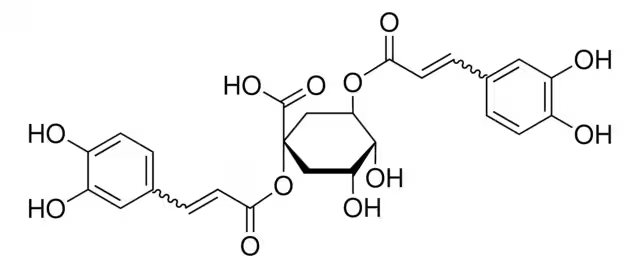
CAS Number19870-46-3
Synonyms1,5-Dicaffeoylquinic acid; 1,3-Dicaffeoylquinic acid; Cynarine; 1,5-di-O-Caffeoylquinic acid; 1,3-O-Dicaffeoylquinic acid; 1,3-di-O-Caffeoylquinic acid
Molecular FormulaC25H24O12
Molecular Weight516.45
Purity≥98.0 (HPLC)%
Density1.6±0.1 g/cm3
Boiling Point819.9±65.0 °C at 760 mmHg
Appearancewhite to off-white
Symbol
Signal WordWarning


Please Login or Create an Account to: See VlP prices and availability
US Stock: ship in 0-1 business day
Global Stock: ship in 5-7 days
| Chemical & Physical Properties | |
|---|---|
| CAS Number | 19870-46-3 |
| Catalog No. | 2A-9002494 |
| Chinese Name | 1,3-二咖啡酰奎宁酸 |
| Synonyms | 1,5-Dicaffeoylquinic acid; 1,3-Dicaffeoylquinic acid; Cynarine; 1,5-di-O-Caffeoylquinic acid; 1,3-O-Dicaffeoylquinic acid; 1,3-di-O-Caffeoylquinic acid |
| Molecular Formula | C25H24O12 |
| Molecular Weight | 516.45 |
| Purity | ≥98.0 (HPLC) |
| Density | 1.6±0.1 g/cm3 |
| Boiling Point | 819.9±65.0 °C at 760 mmHg |
| Appearance | white to off-white |
| Water Solubility | soluble5mg/mL, clear, colorless to light yellow |
| Storage Condition | 2-8°C |
| Application | 1,3-Dicaffeoylquinic acid is a derivative of caffeoylquinic acid, which has antioxidant activity and free radical scavenging activity. |
| MDL Number | MFCD13196505 |
| SMILES | O[C@@H]1C[C@@](C[C@@H](OC(=O)\C=C\c2ccc(O)c(O)c2)[C@@H]1O)(OC(=O)\C=C\c3ccc(O)c(O)c3)C(O)=O |
| InChI | 1S/C25H24O12/c26-15-5-1-13(9-17(15)28)3-7-21(31)36-20-12-25(24(34)35,11-19(30)23(20)33)37-22(32)8-4-14-2-6-16(27)18(29)10-14/h1-10,19-20,23,26-30,33H,11-12H2,(H,34,35)/b7-3+,8-4+/t19-,20-,23-,25+/m1/s1 |
| InChI Key | YDDUMTOHNYZQPO-PSEXTPKNSA-N |
| NACRES Code | NA.24 |
| UNSPSC | 41116107 |
| Hazard Symbols | Transport |
| MSDS | msds/2494_1_19870_46_3.pdf |
| Bioactivity | 1,3-Dicaffeoylquinic acid is a caffeoylquinic acid derivative that exhibits antioxidant activity and radical scavenging activity. Related Catalog Signaling Pathways >> PI3K/Akt/mTOR >> Akt Signaling Pathways >> PI3K/Akt/mTOR >> PI3K Natural Products >> Acids and Aldehydes Research Areas >> Neurological Disease Target Akt PI3K In Vitro 1,3-Dicaffeoylquinic acid shows increased neuronal cell viability against Aβ(42) toxicity in a concentration-dependent manner in neurons. 1,3-Dicaffeoylquinic acid activates both phosphoinositide 3-kinase (PI3K)/Akt and extracellular regulated protein kinase 1/2 (Erk1/2) with stimulating their upstream tyrosine kinase A (Trk A). 1,3-Dicaffeoylquinic acid's anti-apoptotic potential is related to the enhanced inactivating phosphorylation of glycogen synthase kinase 3β (GSK3β) and the modulation of expression of apoptosis-related protein Bcl-2/Bax[2]. 1,3-Dicaffeoylquinic acid (10 μM, 20 μM, 50 μM, and 100 μM) significantly increases cell viablity before OGD/reperfusion, and prevents the depletion of GSH under OGD/reperfusion insult. 1,3-Dicaffeoylquinic acid induces nuclear translocation of Nrf2 in OGD/reperfusion treated astrocytes, and induces increased GCL activity, and the effect is lost in Nrf2 siRNA-transfected cells[3]. In Vivo 1,3-Dicaffeoylquinic acid (32.0 mg/kg, p.o.) and 1-O-ABL are absorbed very quickly in Wistar rats. The maximum plasma concentrations for 1,3-Dicaffeoylquinic acid and 1-O-ABL are 44.5 ± 7.1 and 19.1 ± 6.9 ng/mL, respectively[1]. Kinase Assay The whole cellular lysate is prepared using a RIPA Lysis Buffer added to a reaction buffer containing 0.1 M Tris (pH 8.2), 0.15 M KCl, 10 mM ATP, 10 mM l-glutamate, 20 mM MgCl2, and 2 mM EDTA at 37°C for 3 min, and then 5 mM cysteine is added at 37°C for 15 min. The production of glutamylcysteine is immediately quantified for HPLC analysis by O-phthalaldehyde derivatization. GCL activity is presented in units of femtomoles of -GC produced per milligram of protein per minute[3]. Cell Assay The viability of astrocytes is measured by the MTT reduction method. Briefly, the cells are rinsed with phosphate-buffered saline, pH 7.2, and incubated with 5 mg/mL MTT reagent for 3 h at 37°C. The medium is removed, and the cells are lysed with 1 mL of dimethyl sulfoxide. The absorbance is measured at 540 nm by a microplate reader[3]. Animal Admin Six male Wistar rats (200-250 g) are fasted for 12 h with free access to water prior to oral administration of I. britannica extract with an herb dose of 8.0 g/kg (equivalent to 32.0 mg/kg 1,3-Dicaffeoylquinic acid, and 4.01 mg/kg, 1-O-ABL). Blood samples (appr 0.25 mL) are collected from suborbital vein into heparinized tubes at 0, 0.08, 0.16, 0.33, 0.67, 1, 1.5, 2, 4, 6, 9 and 12 h after dosing, and then immediately centrifuged at 3500 rpm for 10 min. Harvested plasma samples are stored at -60°C until analysis. The plasma concentrations of 1,3-Dicaffeoylquinic acid and 1-O-ABL are calculated from the calibration curves obtained daily[1]. References [1]. Wang Z, et al. An LC-MS/MS method for simultaneous determination of 1,5-dicaffeoylquinic acid and 1-O-acetylbritannilactone in rat plasma and its application to a pharmacokinetic study. [2]. Xiao HB, et al. 1,5-dicaffeoylquinic acid protects primary neurons from amyloid β 1-42-induced apoptosis via PI3K/Akt signaling pathway. Chin Med J (Engl). 2011 Sep;124(17):2628-35. [3]. Cao X, et al. 1, 5-Dicaffeoylquinic acid-mediated glutathione synthesis through activation of Nrf2 protects against OGD/reperfusion-induced oxidative stress in astrocytes. Brain Res. 2010 Aug 6;1347:142-8. Chemical & Physical Properties Density 1.6±0.1 g/cm3 Boiling Point 819.9±65.0 °C at 760 mmHg Molecular Formula C25H24O12 Molecular Weight 516.451 Flash Point 278.1±27.8 °C Exact Mass 516.126770 PSA 211.28000 LogP 1.64 Appearance of Characters white to off-white Vapour Pressure 0.0±3.1 mmHg at 25°C Index of Refraction 1.719 Storage condition 2-8°C Water Solubility soluble5mg/mL, clear, colorless to light yellow |
| Use of | 1,3-Dicaffeoylquinic acid is a caffeoylquinic acid derivative that exhibits antioxidant activity and radical scavenging activity. Properties Name (1S,3R,4R,5R)-1,3-bis[[(E)-3-(3,4-dihydroxyphenyl)prop-2-enoyl]oxy]-4,5-dihydroxycyclohexane-1-carboxylic acid Synonym More Synonyms 1,3-Dicaffeoylquinic acid Biological Activity Description 1,3-Dicaffeoylquinic acid is a caffeoylquinic acid derivative that exhibits antioxidant activity and radical scavenging activity. Related Catalog Signaling Pathways >> PI3K/Akt/mTOR >> Akt Signaling Pathways >> PI3K/Akt/mTOR >> PI3K Natural Products >> Acids and Aldehydes Research Areas >> Neurological Disease References [1]. Wang Z, et al. An LC-MS/MS method for simultaneous determination of 1,5-dicaffeoylquinic acid and 1-O-acetylbritannilactone in rat plasma and its application to a pharmacokinetic study. [2]. Xiao HB, et al. 1,5-dicaffeoylquinic acid protects primary neurons from amyloid β 1-42-induced apoptosis via PI3K/Akt signaling pathway. Chin Med J (Engl). 2011 Sep;124(17):2628-35. [3]. Cao X, et al. 1, 5-Dicaffeoylquinic acid-mediated glutathione synthesis through activation of Nrf2 protects against OGD/reperfusion-induced oxidative stress in astrocytes. Brain Res. 2010 Aug 6;1347:142-8. Chemical & Physical Properties Molecular Formula C25H24O12 Exact Mass 516.126770 PSA 211.28000 Appearance of Characters white to off-white Index of Refraction 1.719 |
| Transport Info | Product name: Purity: 98.0% |
| MSDS Transport Info | Module 14. Shipping information 14.1 UN dangerous goods number European Land Transport Dangerous Regulations: -International Maritime Dangerous Regulations: -International Air Transport Dangerous Regulations: - 14.2 Names specified by the United Nations (UN) European Land Transport Dangerous Regulations: Non-dangerous goods IMDG Code: Non-dangerous goods International air transport dangerous goods regulations: non-dangerous goods 14.3 Transport hazard categories European Land Transport Dangerous Regulations: -International Maritime Dangerous Regulations: -International Air Transport Dangerous Regulations: - 14.4 Package group European Land Transport Dangerous Regulations: -International Maritime Dangerous Regulations: -International Air Transport Dangerous Regulations: - 14.5 Environmental hazards European Land Transport Dangerous Regulations: No International Maritime Transport Dangerous Regulations Maritime Pollutants: No International Air Transport Risk Regulations: No 14.6 Special reminder to users No data available |
| Related Products in Crop Science Building Blocks | ||
|---|---|---|
| 2,3-Dichloro-5-trifluoromethylpyridine | 69045-84-7 | 2A-9001657 |
| 2-Amino-5-trifluoromethylpyridine | 74784-70-6 | 2A-9002406 |
| 2-Bromo-3-trifluoromethylpyridine | 175205-82-0 | 2A-9002593 |
| 2-Chloro-5-(trifluoromethyl)pyridine | 52334-81-3 | 2A-9002898 |
| 2-Chloro-6-trifluoromethylpyridine | 39890-95-4 | 2A-9002965 |
| 2-Fluoro-6-trifluoromethylpyridine | 94239-04-0 | 2A-9003162 |
| 2-Hydroxy-3-trifluoromethylpyridine | 22245-83-6 | 2A-9003214 |
| Browse all Crop Science Building Blocks products » | ||
Phone:
630-322-8886
630-322-8887
Email:
Office Locations:
Chicago, IL, USA
San Francisco, CA, USA


 EN
EN

 SDS
SDS