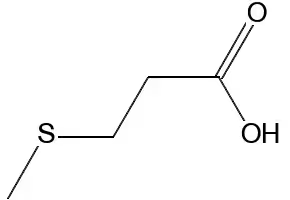
| Chemical & Physical Properties | |
|---|---|
| CAS Number | 646-01-5 |
| Catalog No. | 2A-9024726 |
| Chinese Name | 3-(甲硫基)丙酸 |
| Synonyms | MFCD00059635; 3-methylsulfanylpropanoic acid; EINECS 211-460-9 |
| Molecular Formula | C4H8O2S1 |
| Molecular Weight | 120.17 |
| Purity | 98.00 |
| Density | 1.16 |
| Boiling Point | 130ºC 2mm |
| Melting Point | 16ºC |
| Storage Condition | Store in an airtight container in a cool, dry plac |
| Packaging | II |
| Application | 3-(Methylthio)propionic acid is an intermediate in methionine metabolism. |
| HTC | 2930909090 |
| MDL Number | MFCD00059635 |
| SMILES | CSCCC(=O)O |
| InChI | InChI=1S/C4H8O2S/c1-7-3-2-4(5)6/h2-3H2,1H3,(H,5,6) |
| InChI Key | CAOMCZAIALVUPA-UHFFFAOYSA-N |
| Hazard Symbols | 8.0 |
| MSDS | msds/24726_1_646_01_5.pdf |
| Bioactivity | 3-(Methylthio)propionic acid is an intermediate in the methionine metabolism. Related Catalog Signaling Pathways >> Anti-infection >> Fungal Research Areas >> Cancer In Vitro Methionine has consistently been shown to be the most toxic amino acid in experiments devised to assess the relative toxicity of dietary amino acids. 3-methylthiopropionate is an intermediate in methionine catabolism in rat and monkey liver in vitro. This pathway appears to account for a major portion of methionine oxidation in vitro[1]. Cultures of Streptomyces lincolnensis accumulated 3-methylthioacrylic acid in amounts directly related to the concentration of methionine in the medium. The first intermediate in the pathway may be the keto acid, which is then oxidatively decarboxylated to 3-methylthiopropionic acid[2]. The purified 3-MTPA has antifungal activity in assays using F. oxysporum as a model fungus. Daily measurements of shoot and root length shows severe inhibition of seed germination and root and shoot development at concentrations above 12mg for partially purified extracts[3]. 3-methylthiopropionic acid ethyl ester possesses potential anticarcinogenic properties by inducing differentiation in well-differentiated colon cancer cells. Treatment of RCM-1 cells for 4 days with 3-methylthiopropionic acid ethyl ester between the doses of 0.25 and 2 mM progressively increases the percent area occupied by duct structures relative to the control, and also induces an increase in the number and the maximum diameter of the ducts in each culture plate[4]. Cell Assay RCM-1 cells are each plated into 35-mm plastic culture plates. Twenty-four hours after plating, cells are treated with 3-methylthiopropionic acid ethyl ester in 2 mL of 10% FBS-RPMI+F12 for 4 days, and are counted by using a hemacytometer, after trypsinization with 0.25% trypsin and 1 mM EDTA[4]. References [1]. Steele RD, et al. Identification of 3-methylthiopropionic acid as an intermediate in mammalian methioninemetabolism in vitro. J Biol Chem. 1978 Nov 10;253(21):7844-50. [2]. Surette R, et al. Formation of 3-methylthioacrylic acid from methionine by Streptomyces lincolnensis. Isolation of a peroxidase. J Antibiot (Tokyo). 1976 Jun;29(6):646-52. [3]. Kim YC, et al. 3-methylthiopropanoic acid produced by Enterobacter intermedium 60-2G inhibits fungal growth and weed seedling development. J Antibiot (Tokyo). 2003 Feb;56(2):177-80. [4]. Nakamura Y, et al. 3-Methylthiopropionic acid ethyl ester, isolated from Katsura-uri (Japanese pickling melon, Cucumis melo var. conomon), enhanced differentiation in human colon cancer cells. J Agric Food Chem. 2008 May 14;56(9):2977-84. Chemical & Physical Properties Density 1.16 Boiling Point 130ºC 2mm Melting Point 16ºC Molecular Formula C4H8O2S Molecular Weight 120.17 Flash Point 130°C/15mm PSA 52.32000 LogP 1.67190 Index of Refraction 1.4884 InChIKey CAOMCZAIALVUPA-UHFFFAOYSA-N SMILES CSCCC(=O)O |
| Use of | 3-(Methylthio)propionic acid is an intermediate in the methionine metabolism. Properties Name 3-(methylthio)propionic acid Synonym More Synonyms 3-(Methylthio)propionic acid Biological Activity Description 3-(Methylthio)propionic acid is an intermediate in the methionine metabolism. Related Catalog Signaling Pathways >> Anti-infection >> Fungal Research Areas >> Cancer References [1]. Steele RD, et al. Identification of 3-methylthiopropionic acid as an intermediate in mammalian methioninemetabolism in vitro. J Biol Chem. 1978 Nov 10;253(21):7844-50. [2]. Surette R, et al. Formation of 3-methylthioacrylic acid from methionine by Streptomyces lincolnensis. Isolation of a peroxidase. J Antibiot (Tokyo). 1976 Jun;29(6):646-52. [3]. Kim YC, et al. 3-methylthiopropanoic acid produced by Enterobacter intermedium 60-2G inhibits fungal growth and weed seedling development. J Antibiot (Tokyo). 2003 Feb;56(2):177-80. [4]. Nakamura Y, et al. 3-Methylthiopropionic acid ethyl ester, isolated from Katsura-uri (Japanese pickling melon, Cucumis melo var. conomon), enhanced differentiation in human colon cancer cells. J Agric Food Chem. 2008 May 14;56(9):2977-84. Chemical & Physical Properties Molecular Formula C4H8O2S PSA 52.32000 LogP 1.67190 Index of Refraction 1.4884 InChIKey CAOMCZAIALVUPA-UHFFFAOYSA-N SMILES CSCCC(=O)O |
| Tax Rebate | 13.0% |
| Supervision | None. MFN tariff: 6.5%. Ordinary tariff: 30.0% |
| Transport Info | Product name: Purity: 98.0% |
| MSDS Transport Info | Module 14. Shipping information United Nations classification: Class 8 Corrosives UN number: 3265 Proper shipping name: Corrosive Liquid, Acidic, Organic, Not Otherwise Specified Packing grade: III |
| Related Products in Specialty Chemicals | ||
|---|---|---|
| L-Histidine hydrochloride | 645-35-2 | 2A-9024719 |
| 2,2-Diethoxyethylamine | 645-36-3 | 2A-9024720 |
| Triisopentylamine | 645-41-0 | 2A-9024721 |
| Hydrocinnamoyl chloride | 645-45-4 | 2A-9024722 |
| Dipentyl succinate | 645-69-2 | 2A-9024725 |
| 4-Methylvaleric acid | 646-07-1 | 2A-9024728 |
| Isobutyl stearate | 646-13-9 | 2A-9024729 |
| 1,5-Dicyanopentane | 646-20-8 | 2A-9024730 |
| 3,3,4,4,5,5,6,6,7,7,8,8,8-Tridecafluoro-1-octanol | 647-42-7 | 2A-9024732 |
| Tetrafluoroterephthalic acid | 652-36-8 | 2A-9024738 |
| Browse all Specialty Chemicals products » | ||
Phone:
630-322-8886
630-322-8887
Email:
Office Locations:
Chicago, IL, USA
San Francisco, CA, USA


 EN
EN


 SDS
SDS