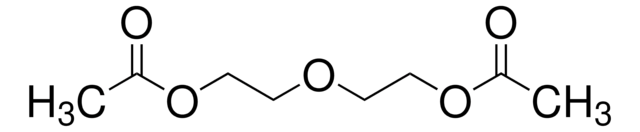
CAS Number628-68-2
SynonymsDiethyleneglycol diacetate; EINECS 211-049-4; Ethanol, 2,2'-oxybis-, diacetate; Diethylene Glycol Diacetate; Oxydiethan-2,1-diyldiacetat; Oxydi-2,1-ethanediyl diacetate; Oxydiethane-2,1-diyl diacetate; MFCD00026211
Molecular Formula(H3CCO2CH2CH2)2O
Molecular Weight190.19
Purity97%
Density1.1±0.1 g/cm3
Boiling Point248.0±0.0 °C at 760 mmHg
Melting Point19°C
Appearanceclear liquid
EINECS211-049-4
Symbol
Signal WordWarning
| Chemical & Physical Properties | |
|---|---|
| CAS Number | 628-68-2 |
| Catalog No. | 2A-9024563 |
| Chinese Name | 二乙二醇二乙酸酯 |
| Synonyms | Diethyleneglycol diacetate; EINECS 211-049-4; Ethanol, 2,2'-oxybis-, diacetate; Diethylene Glycol Diacetate; Oxydiethan-2,1-diyldiacetat; Oxydi-2,1-ethanediyl diacetate; Oxydiethane-2,1-diyl diacetate; MFCD00026211 |
| Molecular Formula | (H3CCO2CH2CH2)2O |
| Molecular Weight | 190.19 |
| Purity | 97 |
| Density | 1.1±0.1 g/cm3 |
| Boiling Point | 248.0±0.0 °C at 760 mmHg |
| Melting Point | 19°C |
| Appearance | clear liquid |
| Storage Condition | room temperature, dry |
| Application | Diethylene glycol diacetate is a PROTAC linker, belonging to the PEG class. Can be used to synthesize PROTAC molecules. |
| EINECS | 211-049-4 |
| HTC | 2918990090 |
| PubChem ID | 24884525 |
| MDL Number | MFCD00026211 |
| SMILES | CC(=O)OCCOCCOC(C)=O |
| InChI | 1S/C8H14O5/c1-7(9)12-5-3-11-4-6-13-8(2)10/h3-6H2,1-2H3 |
| InChI Key | UBPGILLNMDGSDS-UHFFFAOYSA-N |
| NACRES Code | NA.22 |
| UNSPSC | 12352100 |
| Hazard Symbols | transportation |
| MSDS | msds/24563_1_628_68_2.pdf |
| Bioactivity | Diethylene glycol diacetate is a PEG-based PROTAC linker that can be used in the synthesis of PROTACs[1]. Related Catalog Research Areas >> Cancer Signaling Pathways >> PROTAC >> PROTAC Linker Target PEGs In Vitro PROTACs contain two different ligands connected by a linker; one is a ligand for an E3 ubiquitin ligase and the other is for the target protein. PROTACs exploit the intracellular ubiquitin-proteasome system to selectively degrade target proteins[1]. References [1]. An S, et al. Small-molecule PROTACs: An emerging and promising approach for the development of targeted therapy drugs. EBioMedicine. 2018 Oct;36:553-562 Chemical & Physical Properties Density 1.1±0.1 g/cm3 Boiling Point 248.0±0.0 °C at 760 mmHg Melting Point 19°C Molecular Formula C8H14O5 Molecular Weight 190.194 Flash Point 100.4±20.4 °C Exact Mass 190.084122 PSA 61.83000 LogP -0.08 Vapour Pressure 0.0±0.5 mmHg at 25°C Index of Refraction 1.424 InChIKey UBPGILLNMDGSDS-UHFFFAOYSA-N SMILES CC(=O)OCCOCCOC(C)=O |
| Use of | Diethylene glycol diacetate is a PEG-based PROTAC linker that can be used in the synthesis of PROTACs[1]. Properties Name diethylene glycol diacetate Synonym More Synonyms Oxydiethan-2,1-diyldiacetat Biological Activity Description Diethylene glycol diacetate is a PEG-based PROTAC linker that can be used in the synthesis of PROTACs[1]. Related Catalog Research Areas >> Cancer Signaling Pathways >> PROTAC >> PROTAC Linker In Vitro PROTACs contain two different ligands connected by a linker; one is a ligand for an E3 ubiquitin ligase and the other is for the target protein. PROTACs exploit the intracellular ubiquitin-proteasome system to selectively degrade target proteins[1]. References [1]. An S, et al. Small-molecule PROTACs: An emerging and promising approach for the development of targeted therapy drugs. EBioMedicine. 2018 Oct;36:553-562 Chemical & Physical Properties Molecular Formula C8H14O5 Exact Mass 190.084122 PSA 61.83000 LogP -0.08 Index of Refraction 1.424 InChIKey UBPGILLNMDGSDS-UHFFFAOYSA-N SMILES CC(=O)OCCOCCOC(C)=O |
| Tax Rebate | 13.0% |
| Supervision | None. MFN tariff: 6.5%. Ordinary tariff: 30.0% |
| Transport Info | Product name: Purity: 98.0% |
| MSDS Transport Info | Module 14. Shipping information 14.1 UN dangerous goods number European Land Transport Dangerous Regulations: -International Maritime Dangerous Regulations: -International Air Transport Dangerous Regulations: - 14.2 Names specified by the United Nations (UN) European Land Transport Dangerous Regulations: Non-dangerous goods IMDG Code: Non-dangerous goods International air transport dangerous goods regulations: non-dangerous goods 14.3 Transport hazard categories European Land Transport Dangerous Regulations: -International Maritime Dangerous Regulations: -International Air Transport Dangerous Regulations: - 14.4 Package group European Land Transport Dangerous Regulations: -International Maritime Dangerous Regulations: -International Air Transport Dangerous Regulations: - 14.5 Environmental hazards European Land Transport Dangerous Regulations: No International Maritime Transport Dangerous Regulations Maritime Pollutants: No International Air Transport Risk Regulations: No 14.6 Special reminder to users No data available |
| Related Products in Specialty Chemicals | ||
|---|---|---|
| 2-Chloroethyl ethyl ether | 628-34-2 | 2A-9024557 |
| 1,2-Diformylhydrazine | 628-36-4 | 2A-9024558 |
| Amyl acetate | 628-63-7 | 2A-9024560 |
| 2-Ethoxyethyl chloroformate | 628-64-8 | 2A-9024561 |
| Trimethylene acetate | 628-66-0 | 2A-9024562 |
| 1-Heptyne | 628-71-7 | 2A-9024564 |
| Butyl thiocyanate | 628-83-1 | 2A-9024568 |
| Iminodiacetonitrile | 628-87-5 | 2A-9024569 |
| Ethyl palmitate | 628-97-7 | 2A-9024571 |
| 1-Chloroheptane | 629-06-1 | 2A-9024575 |
| Browse all Specialty Chemicals products » | ||
Phone:
630-322-8886
630-322-8887
Email:
Office Locations:
Chicago, IL, USA
San Francisco, CA, USA


 EN
EN


 SDS
SDS