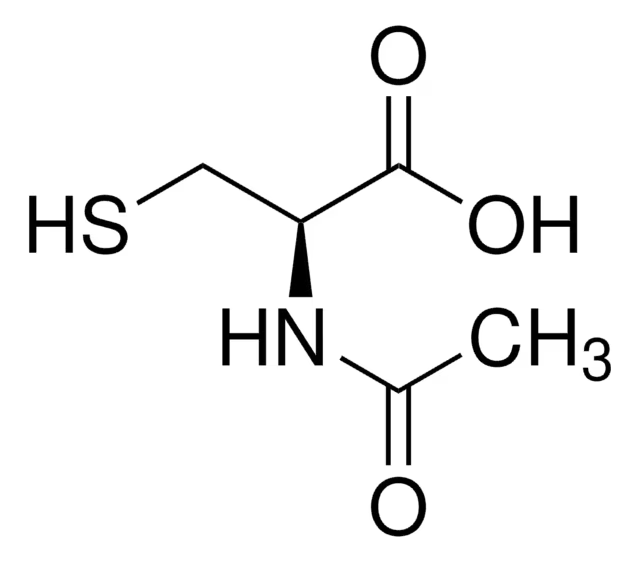
CAS Number616-91-1
SynonymsAC-ASP-GLU; 2-(acetylamino)-3-sulfanylpropanoic acid; N-acetyl-L-aspartyl-L-glutamate; Acetylcysteine; AC-ASP-GLU H2O; MFCD00004880; N-Acetylcysteine; EINECS 210-498-3; N-acetyl-aspartatylglutamate; NAAGA; SPAGLUMIC ACID; N-acetylcycteine; N-ACETYL-3-MERCAPTOALANINE; AC-ASP-GLU-OH; L-N-acetyl-cysteine; Isospaglumic acid; (2R)-2-acetylamino-2-carboxyethanethiol; N-acetyl-L-aspartyl-L-glutamic acid; N-acetyl-(R)-cysteine; Naaxia; ACETYL-D-E; N-Acetyl-L-Cysteine; NAAG; N-Acetyl-cysteine
Molecular FormulaHSCH2CH(NHCOCH3)CO2H
Molecular Weight163.19
Purity≥99 (TLC)%
Density1.3±0.1 g/cm3
Boiling Point407.7±40.0 °C at 760 mmHg
Melting Point106-108 °C (lit.)
Appearancepowder
EINECS210-498-3
Symbol
Signal WordWarning
| Chemical & Physical Properties | |
|---|---|
| CAS Number | 616-91-1 |
| Catalog No. | 2A-9024269 |
| Chinese Name | N-乙酰半胱氨酸 |
| Synonyms | AC-ASP-GLU; 2-(acetylamino)-3-sulfanylpropanoic acid; N-acetyl-L-aspartyl-L-glutamate; Acetylcysteine; AC-ASP-GLU H2O; MFCD00004880; N-Acetylcysteine; EINECS 210-498-3; N-acetyl-aspartatylglutamate; NAAGA; SPAGLUMIC ACID; N-acetylcycteine; N-ACETYL-3-MERCAPTOALANINE; AC-ASP-GLU-OH; L-N-acetyl-cysteine; Isospaglumic acid; (2R)-2-acetylamino-2-carboxyethanethiol; N-acetyl-L-aspartyl-L-glutamic acid; N-acetyl-(R)-cysteine; Naaxia; ACETYL-D-E; N-Acetyl-L-Cysteine; NAAG; N-Acetyl-cysteine |
| Molecular Formula | HSCH2CH(NHCOCH3)CO2H |
| Molecular Weight | 163.19 |
| Purity | ≥99 (TLC) |
| Density | 1.3±0.1 g/cm3 |
| Boiling Point | 407.7±40.0 °C at 760 mmHg |
| Melting Point | 106-108 °C (lit.) |
| Appearance | powder |
| Water Solubility | Water solubility: soluble; soluble in: alcohol |
| Storage Condition | 1. Sealed with argon and stored dry at 4ºC |
| Application | Acetylcysteine is a mucolytic agent that reduces the thickness of mucus. |
| EINECS | 210-498-3 |
| HTC | 2930909090 |
| PubChem ID | 24891402 |
| MDL Number | MFCD00004880 |
| SMILES | CC(=O)N[C@@H](CS)C(O)=O |
| InChI | 1S/C5H9NO3S/c1-3(7)6-4(2-10)5(8)9/h4,10H,2H2,1H3,(H,6,7)(H,8,9)/t4-/m0/s1 |
| InChI Key | PWKSKIMOESPYIA-BYPYZUCNSA-N |
| Beilstein/REAXYS | 1724426 |
| NACRES Code | NA.26 |
| UNSPSC | 12352209 |
| Hazard Symbols | transportation |
| MSDS | msds/24269_1_616_91_1.pdf |
| Bioactivity | Acetylcysteine is a mucolytic agent which reduces the thickness of the mucus. Related Catalog Research Areas >> Neurological Disease Natural Products >> Others Target Human Endogenous Metabolite In Vitro N-acetylcysteine prevents apoptotic DNA fragmentation and maintains long-term survival in the absence of other trophic support in serum-deprived PC12 cells. N-acetylcysteine also prevents death of PC12 cells and sympathetic neurons[2]. N-acetylcysteine causes dose-dependent reductions in viability in rat and human aortic smooth muscle cells[3]. N-acetylcysteine activates the Ras-extracellular signal-regulated kinase (ERK) pathway in PC12 cells. N-acetylcysteine protects neuronal cells from death evoked by withdrawal of trophic support. N-acetylcysteine increases nitric oxide (NO) release from protein-bound stores in vascular tissue. N-acetylcysteine pretreatment of PC12 cells interferes with NGF-dependent signaling and neurite outgrowth, and it is suggested that N-acetylcysteine interferes with redox-sensitive steps in the NGF mechanism[4]. In Vivo N-acetylcysteine (150, 300 mg/kg) treatment significantly reduces liver transaminases in all groups of treatment, mostly in group N-acetylcysteine 300. Lung glutathione peroxidase is significantly increases in group N-acetylcysteine 300 (P=0.04), while the other oxidation biomarkers show no significant differences[1]. N-acetylcysteine improves cognition of 12-month-old SAMP8 mice in both the T-maze footshock avoidance paradigm and the lever press appetitive task without inducing non-specific effects on motor activity, motivation to avoid shock, or body weight[5]. Cell Assay For survival experiments, washed cells are resuspended in RPM1 1640 medium and plated in 0.5 mL at a density of 8-10×105 per well in 24 well plastic culture dishes coated with rat tail collagen. To feed, but to avoid loss of floating cells, fresh medium (0.2 mL) is added to the cultures on days 1, 5, and 10. For experiments involving "primed" PC12 cells, cultures are pretreated for l-2 weeks with NGF in RPM1 1640 medium supplemented with 1% heat-iN-acetylcysteinetivated horse serum. The cells are then washed and passaged into serum-free RPM1 1640 medium. Animal Admin Rats: Rats are randomLy allocated into five groups: sham group (n=5), control group with IIR (n=8) and three groups with IIR who are given N-acetylcysteine in different dosages: 150 mg/kg intraperitoneally 5 min before ischemia (n=8, group N-acetylcysteine 150), 300 mg/kg i.p 5 min before ischemia (n=7, group N-acetylcysteine 300), and 150 mg/kg i.p 5 min before ischemia plus 150 mg/kg 5 min before reperfusion (n=7, group N-acetylcysteine 150 + 150). After 4 h of reperfusion, the animals are euthanized by exsanguination from the abdominal aorta. References [1]. Kalimeris K, et al. N-acetylcysteine ameliorates liver injury in a rat model of intestinal ischemia reperfusion. J Surg Res. 2016 Dec;206(2):263-272 [2]. Ferrari G, et al. N-acetylcysteine (D- and L-stereoisomers) prevents apoptotic death of neuronal cells. J Neurosci. 1995 Apr;15(4):2857-66. [3]. Tsai JC, et al. Induction of apoptosis by pyrrolidinedithiocarbamate and N-acetylcysteine in vascular smooth muscle cells. J Biol Chem. 1996 Feb 16;271(7):3667-70. [4]. Yan CY, et al. Prevention of PC12 cell death by N-acetylcysteine requires activation of the Ras pathway. J Neurosci. 1998 Jun 1;18(11):4042-9. [5]. Farr SA, et al. The antioxidants alpha-lipoic acid and N-acetylcysteine reverse memory impairment and brain oxidative stress in aged SAMP8 mice. J Neurochem. 2003 Mar;84(5):1173-83. Chemical & Physical Properties Density 1.3±0.1 g/cm3 Boiling Point 407.7±40.0 °C at 760 mmHg Melting Point 106-108 °C(lit.) Molecular Formula C5H9NO3S Molecular Weight 163.195 Flash Point 200.4±27.3 °C Exact Mass 163.030319 PSA 105.20000 LogP -0.15 Vapour Pressure 0.0±2.0 mmHg at 25°C Index of Refraction 1.519 InChIKey PWKSKIMOESPYIA-BYPYZUCNSA-N SMILES CC(=O)NC(CS)C(=O)O |
| Use of | Acetylcysteine is a mucolytic agent which reduces the thickness of the mucus. Properties Articles712 Name N-acetyl-L-cysteine Synonym More Synonyms Acetylcysteine(N-acetylcysteine) Biological Activity Description Acetylcysteine is a mucolytic agent which reduces the thickness of the mucus. Related Catalog Research Areas >> Neurological Disease Natural Products >> Others Human Endogenous Metabolite References [1]. Kalimeris K, et al. N-acetylcysteine ameliorates liver injury in a rat model of intestinal ischemia reperfusion. J Surg Res. 2016 Dec;206(2):263-272 [2]. Ferrari G, et al. N-acetylcysteine (D- and L-stereoisomers) prevents apoptotic death of neuronal cells. J Neurosci. 1995 Apr;15(4):2857-66. [3]. Tsai JC, et al. Induction of apoptosis by pyrrolidinedithiocarbamate and N-acetylcysteine in vascular smooth muscle cells. J Biol Chem. 1996 Feb 16;271(7):3667-70. Chemical & Physical Properties Molecular Formula C5H9NO3S Exact Mass 163.030319 PSA 105.20000 LogP -0.15 Index of Refraction 1.519 InChIKey PWKSKIMOESPYIA-BYPYZUCNSA-N SMILES CC(=O)NC(CS)C(=O)O |
| Tax Rebate | 13.0% |
| Supervision | None. MFN tariff: 6.5%. Ordinary tariff: 30.0% |
| Transport Info | Shipping Name: UN |
| MSDS Transport Info | Module 14. Shipping information 14.1 UN dangerous goods number European Land Transport Dangerous Regulations: -International Maritime Dangerous Regulations: -International Air Transport Dangerous Regulations: - 14.2 United Nations shipping name European Land Transport Dangerous Regulations: Non-dangerous goods IMDG Code: Non-dangerous goods International air transport dangerous goods regulations: non-dangerous goods 14.3 Transport hazard categories European Land Transport Dangerous Regulations: -International Maritime Dangerous Regulations: -International Air Transport Dangerous Regulations: - 14.4 Package group European Land Transport Dangerous Regulations: -International Maritime Dangerous Regulations: -International Air Transport Dangerous Regulations: - 14.5 Environmental hazards European Land Transport Danger Regulations: No International Maritime Danger Regulations International Air Transport Danger Regulations: No Marine pollutants (yes/no): No 14.6 Special reminder to users No data available |
| Related Products in Specialty Chemicals | ||
|---|---|---|
| N,N-Diethylmethylamine | 616-39-7 | 2A-9024255 |
| 4,6-Di-tert-butyl-2-methylphenol | 616-55-7 | 2A-9024261 |
| Benzylmalonic acid | 616-75-1 | 2A-9024263 |
| 5-Formylsalicylic acid | 616-76-2 | 2A-9024264 |
| 4-Hydroxy-3-nitrobenzoic acid | 616-82-0 | 2A-9024266 |
| Ethyl vanillate | 617-05-0 | 2A-9024270 |
| Ethyl oxamate | 617-36-7 | 2A-9024273 |
| DL-Aspartic acid | 617-45-8 | 2A-0200719 |
| DL-Malic acid | 617-48-1 | 2A-9024275 |
| Dimethyl itaconate | 617-52-7 | 2A-9024276 |
| Browse all Specialty Chemicals products » | ||
Phone:
630-322-8886
630-322-8887
Email:
Office Locations:
Chicago, IL, USA
San Francisco, CA, USA


 EN
EN


 SDS
SDS