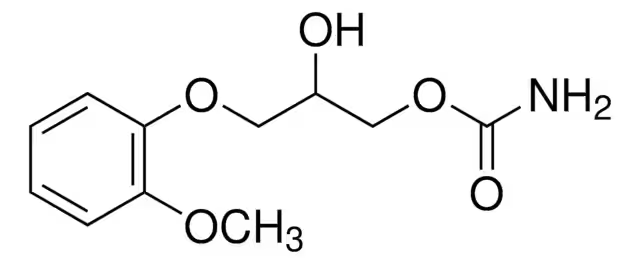
CAS Number532-03-6
SynonymsGuaiacol glyceryl ether carbamate; neuraxin; Relax; Methyocarbamol; Delaxin; 2-hydroxy-3-{[2-(methyloxy)phenyl]oxy}propyl carbamate; Relestrid; Carbamic Acid 2-Hydroxy-3-(2-methoxyphenoxy)propyl Ester; guaifenesin carbamate; EINECS 208-524-3; 2-Hydroxy-3-(2-methoxyphenoxy)propyl carbamate; Lumirelax; Miolaxene; Robaxan; Perilax; MFCD00057662; methocarbamol; Robamol; AHR 85; Traumacut; Miowas; Robaxin; 1,2-Propanediol, 3-(2-methoxyphenoxy)-, 1-carbamate; Avetil
Molecular FormulaC11H15NO5
Molecular Weight241.24
Purity98.00%
Density1.3±0.1 g/cm3
Boiling Point472.5±40.0 °C at 760 mmHg
Melting Point95-97ºC
EINECS208-524-3
Symbol
Signal WordWarning
| Chemical & Physical Properties | |
|---|---|
| CAS Number | 532-03-6 |
| Catalog No. | 2A-9022577 |
| Chinese Name | 美索巴莫 |
| Synonyms | Guaiacol glyceryl ether carbamate; neuraxin; Relax; Methyocarbamol; Delaxin; 2-hydroxy-3-{[2-(methyloxy)phenyl]oxy}propyl carbamate; Relestrid; Carbamic Acid 2-Hydroxy-3-(2-methoxyphenoxy)propyl Ester; guaifenesin carbamate; EINECS 208-524-3; 2-Hydroxy-3-(2-methoxyphenoxy)propyl carbamate; Lumirelax; Miolaxene; Robaxan; Perilax; MFCD00057662; methocarbamol; Robamol; AHR 85; Traumacut; Miowas; Robaxin; 1,2-Propanediol, 3-(2-methoxyphenoxy)-, 1-carbamate; Avetil |
| Molecular Formula | C11H15NO5 |
| Molecular Weight | 241.24 |
| Purity | 98.00 |
| Density | 1.3±0.1 g/cm3 |
| Boiling Point | 472.5±40.0 °C at 760 mmHg |
| Melting Point | 95-97ºC |
| Storage Condition | -20°C Freezer |
| Application | Methocarbamol is a central muscle relaxant. |
| EINECS | 208-524-3 |
| HTC | 2924299090 |
| PubChem ID | 329823369 |
| MDL Number | MFCD00057662 |
| SMILES | NC(OCC(O)COC1=C(OC)C=CC=C1)=O |
| InChI | 1S/C11H15NO5/c1-15-9-4-2-3-5-10(9)16-6-8(13)7-17-11(12)14/h2-5,8,13H,6-7H2,1H3,(H2,12,14) |
| InChI Key | GNXFOGHNGIVQEH-UHFFFAOYSA-N |
| NACRES Code | NA.24 |
| UNSPSC | 41116107 |
| Hazard Symbols | Transport |
| MSDS | msds/22577_1_532_03_6.pdf |
| Bioactivity | Methocarbamol is a central muscle relaxant used to treat skeletal muscle spasms.Target: Carbonic AnhydraseMethocarbamol is the carbamate of guaifenesin, but does not produce guaifenesin as a metabolite, because the carbamate bond is not hydrolyzed metabolically; metabolism is by Phase I ring hydroxylation and O-demethylation, followed by Phase II conjugation. All the major metabolites are unhydrolyzed carbamates. Methocarbamol is used as an adjunct in the symptomatic treatment of musculoskeletal conditions associated with painful muscle spasm [1, 2]. Related Catalog Signaling Pathways >> Others >> Others Research Areas >> Metabolic Disease References [1]. Bruce, R.B., L.B. Turnbull, and J.H. Newman, Metabolism of methocarbamol in the rat, dog, and human. J Pharm Sci, 1971. 60(1): p. 104-6. [2]. Sica, D.A., et al., Pharmacokinetics and protein binding of methocarbamol in renal insufficiency and normals. Eur J Clin Pharmacol, 1990. 39(2): p. 193-4. Chemical & Physical Properties Density 1.3±0.1 g/cm3 Boiling Point 472.5±40.0 °C at 760 mmHg Melting Point 95-97ºC Molecular Formula C11H15NO5 Molecular Weight 241.240 Flash Point 239.6±27.3 °C Exact Mass 241.095016 PSA 91.01000 LogP 0.55 Vapour Pressure 0.0±1.2 mmHg at 25°C Index of Refraction 1.541 InChIKey GNXFOGHNGIVQEH-UHFFFAOYSA-N SMILES COc1ccccc1OCC(O)COC(N)=O Storage condition -20°C Freezer |
| Use of | Methocarbamol is a central muscle relaxant used to treat skeletal muscle spasms.Target: Carbonic AnhydraseMethocarbamol is the carbamate of guaifenesin, but does not produce guaifenesin as a metabolite, because the carbamate bond is not hydrolyzed metabolically; metabolism is by Phase I ring hydroxylation and O-demethylation, followed by Phase II conjugation. All the major metabolites are unhydrolyzed carbamates. Methocarbamol is used as an adjunct in the symptomatic treatment of musculoskeletal conditions associated with painful muscle spasm [1, 2]. Properties Articles25 Name Methocarbamol Synonym More Synonyms methocarbamol Biological Activity Description Methocarbamol is a central muscle relaxant used to treat skeletal muscle spasms.Target: Carbonic AnhydraseMethocarbamol is the carbamate of guaifenesin, but does not produce guaifenesin as a metabolite, because the carbamate bond is not hydrolyzed metabolically; metabolism is by Phase I ring hydroxylation and O-demethylation, followed by Phase II conjugation. All the major metabolites are unhydrolyzed carbamates. Methocarbamol is used as an adjunct in the symptomatic treatment of musculoskeletal conditions associated with painful muscle spasm [1, 2]. Related Catalog Signaling Pathways >> Others >> Others Research Areas >> Metabolic Disease References [1]. Bruce, R.B., L.B. Turnbull, and J.H. Newman, Metabolism of methocarbamol in the rat, dog, and human. J Pharm Sci, 1971. 60(1): p. 104-6. [2]. Sica, D.A., et al., Pharmacokinetics and protein binding of methocarbamol in renal insufficiency and normals. Eur J Clin Pharmacol, 1990. 39(2): p. 193-4. Chemical & Physical Properties Molecular Formula C11H15NO5 Exact Mass 241.095016 PSA 91.01000 Index of Refraction 1.541 InChIKey GNXFOGHNGIVQEH-UHFFFAOYSA-N |
| Tax Rebate | 13.0% |
| Supervision | None. MFN tariff: 6.5%. Ordinary tariff: 30.0% |
| Transport Info | Shipping Name: UN |
| MSDS Transport Info | Module 14. Shipping information 14.1 UN dangerous goods number European Land Transport Dangerous Regulations: -International Maritime Dangerous Regulations: -International Air Transport Dangerous Regulations: - 14.2 United Nations shipping name European Land Transport Dangerous Regulations: Non-dangerous goods IMDG Code: Non-dangerous goods International air transport dangerous goods regulations: non-dangerous goods 14.3 Transport hazard categories European Land Transport Dangerous Regulations: -International Maritime Dangerous Regulations: -International Air Transport Dangerous Regulations: - 14.4 Package group European Land Transport Dangerous Regulations: -International Maritime Dangerous Regulations: -International Air Transport Dangerous Regulations: - 14.5 Environmental hazards European Land Transport Danger Regulations: No International Maritime Danger Regulations International Air Transport Danger Regulations: No Marine pollutants (yes/no): No 14.6 Special reminder to users No data available The above information is believed to be correct, but is not all-inclusive and should be used as a guide only. The information in this document is based on our current knowledge and is Correct safety instructions apply to this product. This information does not represent a warranty as to the properties of this product. See reverse side of invoice or packing slip. |
| Related Products in Specialty Chemicals | ||
|---|---|---|
| Azure C | 531-57-7 | 2A-9022569 |
| Benzidine dihydrochloride | 531-85-1 | 2A-9022573 |
| N,N'-Diphenylbenzidine | 531-91-9 | 2A-9022574 |
| Equol | 531-95-3 | 2A-9022575 |
| Sodium 2-naphthalenesulfonate | 532-02-5 | 2A-9022576 |
| 2,2-Dinaphthylamine | 532-18-3 | 2A-9022579 |
| 2-Chloroacetophenone | 532-27-4 | 2A-9022581 |
| Mandelonitrile | 532-28-5 | 2A-9022582 |
| 2-Isonitrosoacetophenone | 532-54-7 | 2A-9022585 |
| Basic Orange 2 | 532-82-1 | 2A-9022587 |
| Browse all Specialty Chemicals products » | ||
Phone:
630-322-8886
630-322-8887
Email:
Office Locations:
Chicago, IL, USA
San Francisco, CA, USA


 EN
EN


 SDS
SDS